Hegseth says US is 'accelerating' war on Iran, but strike at Turkey won't trigger NATO
Published in News & Features
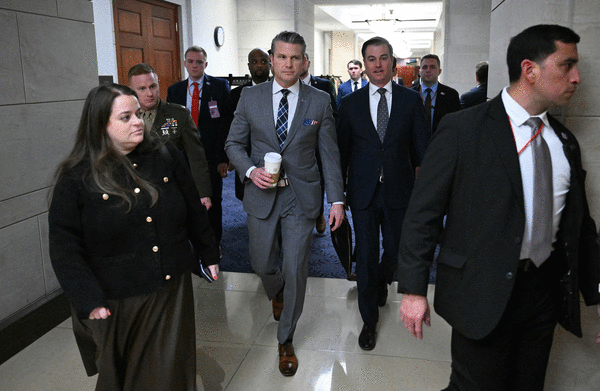
The U.S. war effort against Iran was “accelerating” as American and Israeli forces fought for control of Iranian airspace and pressed farther inland to seek and destroy Iranian missile capabilities, top U.S. officials said Wednesday.
“Four days in, we have only just begun to fight,” said U.S. Secretary of Defense Pete Hegseth.
“The throttle is coming up,” said Gen. Dan Caine, the chairman of the Joint Chiefs of Staff.
However, a reported Iranian missile strike at NATO member Turkey — intercepted by NATO defense systems — was not expected to immediately broaden the war theater by triggering a NATO clause requiring other member nations to get involved, Hegseth said.
Hegseth, striking an unapologetic tone, said Iran’s surviving leadership “don’t know what plays to call” after exhausting initial retaliatory strategies devised prior to the U.S. assault, while the U.S. is firing on all fronts and stacking up wins — including an American submarine recently sinking an Iranian warship with a torpedo in international waters, which Hegseth called the first such sinking since World War II.
“We are just getting started. We are accelerating, not decelerating,” he said. “We can sustain this fight easily for as long as we need to.”
Caine, striking a far more measured tone at the Pentagon briefing, spoke of the “sacrifice” of the six U.S. service members who have been killed in the conflict to date and the “clear military objectives” of the operation, which include dismantling “Iran’s ability to project power outside of its borders, both today and into the future.”
And he said the U.S. has made “steady progress” toward those goals in recent hours. He said Iran’s “ballistic missile shots” were down 86% from the first day of fighting, and down 23% “just in the last 24 hours.” He said their “one-way attack drone shots” are down 73% from the “opening days” of the war.
That has allowed the U.S. to establish “localized air superiority across the southern flank of the Iranian coast and penetrate their defenses with overwhelming precision and firepower,” Caine said. “We will now begin to expand inland, striking progressively deeper into Iranian territory and creating additional freedom of maneuver for U.S. forces.”
Hegseth and Caine spoke against a backdrop of escalating destruction across the Persian Gulf region, as Iran — which Hegseth acknowledged is a “formidable” enemy — continued to unleash a wave of retaliatory strikes and Israel pushed into Lebanon and against Iran-allied Hezbollah fighters there.
Their message of U.S. control in the region belied chaos in many parts of it — as sirens blared in Bahrain, U.S. and other foreign citizens scrambled to flee the area, global air traffic was in disarray and tanker traffic through the Strait of Hormuz, a key artery for the flow of global energy, was down by about 90%, according to the Associated Press.
Turkey’s defense ministry announced Wednesday that NATO air defenses had shot down a ballistic missile fired toward Turkish airspace from Iran, which raised additional questions about a rapidly expanding footprint of the war given that Turkey is a NATO member and protected by a treaty clause — Article 5 — stating that an attack on one member is an attack on all.
Hegseth said the U.S. was aware of the strike, but that he did not believe it would trigger Article 5 or force all of NATO into the conflict — which has already drawn in nations throughout the Gulf region as Iran has targeted U.S. allies and military facilities.
Hegseth jettisoned any pretense of constraint or measured force by the U.S., instead casting its operations as an all-out assault on “radical Islamist Iranian adversaries” that he suggested both Democrats and the U.S. media were badly misrepresenting to make President Donald Trump look bad.
He suggested the U.S. media was overly focused on losses, such as the deaths of U.S. military personnel, and not nearly focused enough on the progress the U.S. has made toward destroying Iran’s military capabilities in a matter of days.
“They are toast, and they know it — or at least soon enough they will know it,” he said of Iran. “And we’ve only just begun to hunt, dismantle, demoralize, destroy and defeat their capabilities, just four days in.”
He said that the U.S. and Israel in “under a week” will “have complete control of Iranian skies — uncontested air space,” which he said will mean that “we will fly all day, all night, day and night, finding, fixing and finishing the missiles and defense industrial base of the Iranian military, finding and fixing their leaders and their military leaders.”
“Death and destruction from the sky, all day long,” he said. “We’re playing for keeps.”
It was unclear what exactly Hegseth meant by that, given the Trump administration’s constant messaging that the war on Iran will not be another “endless” engagement for the U.S. in the Middle East.
The U.S. was using rules of engagement that are “bold, precise and designed to unleash American power, not shackle it,” Hegseth said. “This was never meant to be a fair fight, and it is not a fair fight. We are punching them while they’re down, which is exactly how it should be.”
Disruptions to tanker traffic through the Strait of Hormuz, and their potential effect on global and U.S. gas prices, were clearly on Trump’s mind. On Tuesday, he posted to his Truth Social platform that the U.S. would be providing wartime insurance for “ALL Maritime Trade” through Gulf shipping lanes — as other insurers began canceling coverage— and that the U.S. Navy would begin escorting tankers if necessary.
“No matter what, the United States will ensure the FREE FLOW of ENERGY to the WORLD,” he wrote.
The message drew immediate concern from some of Trump’s political opponents, who questioned the cost to the U.S. of securing energy shipments for the entire world, including rivals such as China, one of the largest purchasers of crude oil from the region.
“Very few, if any, of these tankers are coming to the United States,” Rep. Joaquin Castro, D-Texas, wrote on X. “This certainly looks like the United States will be subsidizing and protecting oil shipments to China.”
©2026 Los Angeles Times. Visit at latimes.com. Distributed by Tribune Content Agency, LLC.




Comments