St. Paul schools, reeling from ICE surge, try to keep students on track as many learn from home
Published in News & Features
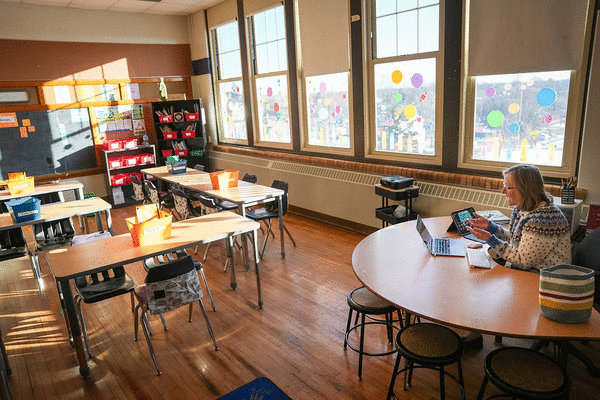
MINNEAPOLIS — Sunlight streamed into a fifth-grade classroom at Wellstone Elementary in St. Paul in late February, but no kids were there — just 26 empty chairs and a teacher on her laptop in the corner of the room.
Dawn Windham delivered a virtual lesson to students afraid to go to school due to the recent ICE surge, and while happy to maintain contact with her “babies,” she missed the voices and faces that would fill the room.
“My world is too quiet,” she said.
For more than a month, St. Paul, the state’s second-largest district, has offered a temporary e-learning option to students and families like several other Twin Cities school districts have done. As aggressive immigration enforcement tactics wind down, so, too, has online participation — from 7,000-plus of the district’s 32,200 students to 3,400 in the latest count.
Still, the numbers are high at schools like Wellstone Elementary, which provides Spanish and Karen language programming.
Recently, teachers in St. Paul and Minneapolis — where 6,000 students have gone online in recent weeks — testified at the State Capitol about the educational and emotional toll that the surge has taken on children, especially as more kids are not attending school at all, whether in-person or virtual.
In January, Minneapolis Public Schools reported that 17% of its students were absent that month, compared with 12% at the same time a year ago, while 24% of St. Paul students were absent at the end of January, compared with 18% a year earlier.
Some school leaders and lawmakers worry the loss of schooling could harm test scores and students’ mental health, much like the COVID-19 pandemic did when schools moved to online learning.
South High in Minneapolis entered the month of February with a backlog of Wi-Fi hotspots to deliver to students at home, despite being three weeks into the launch of a temporary online option now being extended districtwide to April 6.
Amy Hewett-Olatunde, who teaches English as a second language to students at St. Paul’s Humboldt High, told lawmakers recently that she has bright, ambitious students who have stopped turning in assignments.
“They’re living in a state of toxic stress,” she said.
St. Paul has redesigned its virtual lesson plans, and at Wellstone Elementary, the kids have shown grit, logging in daily, Windham said. But when they submit their work, “I don’t know if they’ve just gone click, click, click, click to be done with it, or they truly understand it,” she said.
The ICE surge has disrupted life across St. Paul Public Schools.
Sarah Lightner, principal of Groveland Park Elementary, informed lawmakers of a recent visit to a student’s house to pick up an iPad. She asked the family if help was needed to pay the rent: “Our bags are packed,” the mom replied. “We are leaving in the middle of the night. I’m tired of being trapped.”
Heidi Nistler, assistant superintendent of specialized services, recalled that two vans carrying special-education students were pulled over by federal agents, and imagined how that might affect students with disabilities: “The appearance of masked agents is not a routine interaction,” she said. “It is a high-intensity traumatic event.”
Schools are looking for financial help to bounce back from the disruptions — mental health supports, for example — as occurred during the COVID-19 era.
Emily Uecker, a social worker at Bruce Vento Elementary, said even after St. Paul voters backed a tax increase for schools, the budget is tight: “Without support from the state, I am terrified that social workers and counselors are going to get cut when our students need us most,” she said.
Last week, state Sen. Mary Kunesh, DFL-New Brighton, chair of the Education Finance Committee, invited a Columbia Heights principal to speak again about lost revenue owing to the recent departure of more than 100 students.
Republican Sen. Robert Farnsworth of Hibbing countered that DFLers were using immigration enforcement as a means to draw attention away from unfunded mandates that he says were passed along to districts by the DFL “trifecta” three years ago.
In St. Paul, elementary students who are ready are being welcomed back to school in three-week intervals. Windham had committed to teaching online exclusively, so as some of her students return, they are being taught in-person by teachers elsewhere in the building.
For now, her classroom still is empty, allowing her to recently welcome students looking for a space to conduct Ramadan prayers. She cried, they hugged and she shared her experience in a video posted to her Threads account. As of Feb. 25, the video had 2.6 million views on a Facebook page dedicated to inspirational content about Islam and Muslims.
Now, Windham said she looks forward to March 9, when online students have their next chance to return to Wellstone, and then to the day when the district ends temporary e-learning and everyone can return to her room. She is decorating in bright colors, with a string of lights, all made possible through donations.
“I want my students to come back to something magical,” she said.
©2026 The Minnesota Star Tribune. Visit at startribune.com. Distributed by Tribune Content Agency, LLC.






Comments