Red states target SNAP fraud, errors under threat of costly federal penalties
Published in News & Features
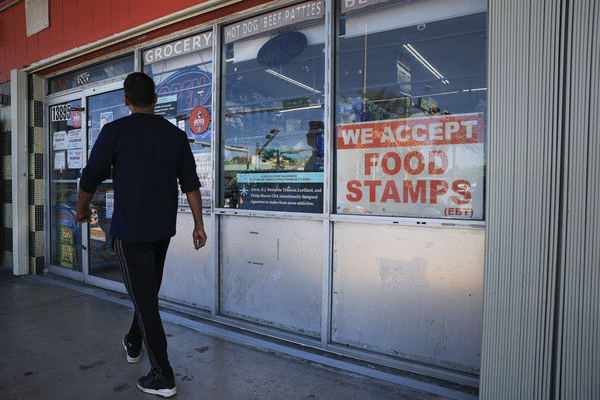
State officials across the country are looking to crack down on fraud and mistakes in the nation’s largest food assistance program, spurred by looming federal rules that will force states with high error rates to pay more.
But the Republican proposals mostly focus on more frequently verifying the eligibility of individual households that participate in the Supplemental Nutrition Assistance Program (SNAP), rather than on broader administrative shortcomings that allow most of the waste and fraud to occur.
Policies such as verifying recipients’ eligibility each month — which can involve cross-checking multiple databases or collecting extra documentation — might increase state agencies’ workloads without lowering error rates. This is especially likely if states don’t boost funding to handle the extra paperwork, investigate fraud or resolve recipient and agency errors.
Eliza Kinsey, an assistant professor at the University of Pennsylvania’s Perelman School of Medicine who focuses on hunger, said staffing shortages, outdated technology and changes to eligibility rules that require oversight are making it harder for state agencies to avoid overpaying or underpaying recipients — the errors that will cost states money under the new federal rules.
“The fact that we’re seeing error rates that are higher really makes sense, given the context of what’s going on in SNAP right now,” Kinsey said.
SNAP, formerly known as food stamps, is a federal-state program that provides recipients with a debit card that can be used to purchase food at grocery stores and other retailers. SNAP errors and fraud often get conflated, but they’re largely separate issues: Errors are unintentional mistakes by SNAP agencies or recipients, while fraud is intentional theft.
SNAP errors occur when the state overpays or underpays SNAP recipients. They’re caused either by unintentional recipient mistakes — forgetting to report a change in how many people live in the household, for example — or by an agency processing error, such as incorrectly calculating a household’s expenses.
States have encountered instances of individual recipient fraud, though they can go uninvestigated when resources are scarce. Large sums, in the millions, have been stolen by sophisticated crime rings that electronically “skim” money from the debit cards that SNAP recipients use to purchase food.
State SNAP error rates include recipient fraud, recipient errors, and state agency errors.
Alabama earned local and national media attention last year when initial U.S. Department of Agriculture data from early 2025 showed it leading the nation in stolen SNAP benefit claims, ahead of much more populous California and New York.
“There’s a lot of talk about SNAP fraud, and a lot of it is misrepresented,” Nancy Buckner, commissioner of the Alabama Department of Human Resources, which administers Alabama’s SNAP program, told state lawmakers at a January budget hearing. “The biggest SNAP fraud in this country are those people that are doing it electronically.”
In recent years, her department noticed SNAP purchases being made in states nowhere near Alabama, she said, including New York, Pennsylvania, Massachusetts and Maine.
“It was obvious to us we don’t have that many Alabama clients shopping in those other states,” she said. This month, Alabama became the second state, behind California, to issue SNAP debit cards to recipients with the kind of microchips that are standard on commercial debit cards. Chipped cards are harder to steal from than those with magnetic strips only.
In the middle of it all, states are staring down massive cuts in federal funding. President Donald Trump’s One Big Beautiful Bill Act puts states on the hook for more administrative costs and forces states to pay a higher share of benefits, in some cases hundreds of millions of dollars, if they have higher error rates.
“The federal government is telling states, you have to pay more in administrative costs, and you have to bring your error rates down simultaneously,” said Kinsey. “It feels like those two changes are in opposition with each other.”
Error prone
Last month, Alabama state lawmakers grilled Buckner, demanding to know her plan for lowering the state’s error rate.
Under Trump’s new law, Alabama’s SNAP administrative costs will rise by $39 million. Meanwhile, the state’s error rate, which Buckner expects to be about 9%, is below the national average, but high enough to allow the feds to force the state to cover 10% of its SNAP benefits starting in fiscal 2028.
All told, Alabama could be on the hook for an additional $200 million or more per year by 2028.
“Is there anything that can be done to prevent running into that $200 million wall?” Alabama state Sen. Greg Albritton, a Republican, asked Buckner during a budget hearing in January. “Right now I think that the train’s got the light on, heading straight for us.”
Buckner said she hoped for some extra wiggle room from the feds, but provided few details on how the department could lower Alabama’s error rate enough to avoid financial penalties.
Currently, the federal government pays for SNAP benefits and splits administration costs 50/50 with states. But starting in October, under the One Big Beautiful Bill Act, all states will be on the hook for 75% of their own administrative costs. And the new law allows the feds to penalize states for their SNAP errors, requiring them to pay from 5%-15% of their SNAP benefit costs if their error rates are over 6%.
The only states under the 6% threshold, per the most recent data available from USDA, which oversees the program, were Idaho, Nebraska, Nevada, South Dakota, Utah, Vermont, Wisconsin and Wyoming.
Republicans say these new rules will reduce the federal government’s investment in SNAP while giving states some “ skin in the game” when it comes to being responsible with federal money.
“One of the problems is the federal programs don’t mandate the prevention, detection and prosecution of fraud,” said Dawn Royal, with the United Council on Welfare Fraud, a national membership group focused on fraud in public assistance programs. “And so states are unwilling to spend state money in order to protect federal money.”
In Alabama, the USDA replaced nearly $16 million in stolen benefits from fiscal 2023 to fiscal 2025, according to federal data.
The Alabama Senate is currently considering a bill that would require state agencies to conduct monthly checks of other state databases to make sure SNAP enrollees remain eligible.
Buckner told state lawmakers that increasing eligibility checks for SNAP benefits would “shoot that error rate up, way up.” The state’s Legislative Fiscal Office estimated the additional work for both Medicaid and SNAP under the pending bill could cost $16.7 million per year.
“Monthly reporting is not the answer to that, at all,” she said.
But other states are looking at similar measures.
Lawmakers in states including Idaho, Kansas and Wyoming have introduced bills to require their state SNAP administrators to check eligibility of SNAP recipients more frequently. Missouri, Oklahoma and Utah bills would require verification of citizenship or legal immigration status before approving applicants for SNAP benefits. A Wisconsin bill would require the state’s Democratic governor to bow to a White House demand to turn over state data on SNAP recipients.
And in Arizona, GOP lawmakers wanted to go even further than the new federal requirements. Last week Democratic Gov. Katie Hobbs vetoed a package of Republican bills that would have required the state agency administering SNAP to get its error rate below 3% by 2030 or face financial penalties, and cut an additional 10% from its budget if the state failed to take corrective action.
States target fraud
SNAP fraud has made state and national headlines in recent years, but there’s not a broad consensus on the scale of the problem nor how to address it.
Some SNAP fraud is perpetrated by recipients who lie in order to get SNAP benefits for which they’re not eligible. But there’s also organized electronic SNAP theft, which involves thieves taking control of EBT accounts through electronic methods such as card skimming or cloning, bot attacks and phishing scams. Skimming is a form of theft where devices are illegally installed inside sales terminals at a store and capture card data. That data is then used to make unauthorized purchases or steal from the victim’s account.
In December, a longtime USDA employee was sentenced to two years in prison for her role in what the U.S. Department of Justice called a “sprawling fraud and bribery scheme” that generated more than $66 million in unauthorized SNAP transactions. The same month, two Romanian nationals were indicted for their role in allegedly stealing more than $160,000 in benefits in Oregon and elsewhere. In 2025, California reported more than $100 million in stolen funds from California SNAP recipients’ EBT cards.
States reported replacing more than $360 million in stolen benefits from fiscal 2023-2025, according to federal data. Experts and state officials differ on whether recipients or organized crime rings are the biggest threats to SNAP. But since the federal government stopped reimbursing stolen SNAP benefits at the end of 2024, more states are looking at ways to address fraud.
States including Arkansas, Maryland, Massachusetts, Michigan, New Jersey, Oklahoma and Virginia are joining Alabama and California in rolling out chip cards to make it harder for skimmers to steal SNAP benefits.
“SNAP fraud is rampant,” said Royal, of the United Council on Welfare Fraud. “If anybody tells you that there’s not SNAP fraud out there, they’re trying to pull the wool over your eyes. It exists in all 50 states. It is definitely a plague on the taxpayers.”
____
Stateline reporter Anna Claire Vollers can be reached at avollers@stateline.org.
____
©2026 States Newsroom. Visit at stateline.org. Distributed by Tribune Content Agency, LLC.





Comments