Venezuela's controversial attorney general forced to resign amid post-Maduro reshuffle
Published in News & Features
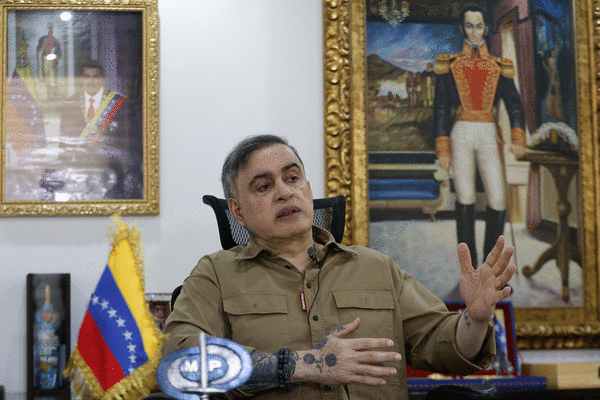
Venezuela’s National Assembly said Wednesday it had received the resignation of Attorney General Tarek William Saab, setting in motion a process to appoint a temporary replacement for the controversial prosecutor who has long faced accusations from critics of helping turn the country’s justice system into a tool of political repression.
Parliamentary leaders presented the document during a regular session, and National Assembly President Jorge Rodríguez outlined the next steps to fill the vacancy. He said lawmakers will appoint an acting official to temporarily head the institution because there is no deputy attorney general available to assume the role.
Rodríguez added that the interim arrangement will remain in place while a nominations committee is activated to evaluate the credentials of candidates for the permanent post.
Saab’s departure could pave the way for the appointment of an ally of interim President Delcy Rodríguez to lead the prosecutor’s office, according to political analysts and former officials, potentially reshaping the balance of power within the government’s legal apparatus.
Former Venezuelan prosecutor Zair Mundaray, who currently lives in central Florida, told the Miami Herald that Saab had effectively been asked to step down and that the National Assembly was expected to move quickly to name a replacement.
The National Assembly has not formally announced a candidate.
According to Mundaray, tensions surrounding debates over the recently approved amnesty law, which has led to the release of political prisoners and regime opponents, contributed to Saab’s departure, including what he described as revelations of irregularities within the public ministry. He also said Saab had delayed implementation of the law, a claim authorities have not publicly addressed.
A powerful institution at the center of political power
The attorney general’s office plays a central role in Venezuela’s political system, overseeing criminal prosecutions and investigations. Control of the institution has long been viewed as a key lever of political power, particularly in a country where the justice system has been repeatedly accused by critics and international observers of lacking independence.
Analysts say any leadership change could signal shifts within the ruling coalition, particularly as authorities seek to implement the amnesty law and manage ongoing political tensions.
Saab, a former ombudsman and longtime government loyalist, has served as attorney general since 2017. During his tenure, human rights organizations and opposition figures have repeatedly accused the prosecutor’s office of pursuing politically motivated cases — allegations the government has consistently denied.
Mundaray offered a sharply critical assessment of Saab’s legacy, alleging the institution had been used to target political opponents and engage in irregular practices. He said future democratic authorities should investigate his tenure, comments that reflect longstanding opposition criticism but have not been proven in court.
Law professor Miguel Ángel Martín, who lives in Miami, also criticized Saab’s record, saying many Venezuelans view him as part of the government’s repressive apparatus and accusing him of involvement in political persecution. He said Saab has been named in complaints before international organizations, including the International Criminal Court and the Inter-American Commission on Human Rights.
“Tareck William Saab has been considered by many Venezuelans a prosecutor of terror,” Martín said. “Since becoming attorney general, he has been part of the regime’s repressive machinery and has been described by critics as an architect of state terrorism and a violator of human rights in persecutions carried out against the population.”
Venezuelan authorities have rejected accusations of systematic human rights abuses and say prosecutions are carried out in accordance with the law.
Longstanding concerns
International observers have for years raised concerns about the role of Venezuela’s justice system in the country’s broader political crisis.
A United Nations fact-finding mission said in a major report in 2021 that Venezuela’s courts have been used as tools of repression to arbitrarily detain activists and political opponents while failing to investigate serious human rights violations.
The mission said intelligence agencies routinely persecuted political adversaries, falsifying evidence to justify arrests and in some cases resorting to torture, enforced disappearances and extrajudicial killings.
The group said members of the judiciary shared responsibility with senior government officials for human rights violations, pointing to recurrent due process violations that it said demonstrated a lack of judicial independence.
“Judges and prosecutors have played, through their acts and omissions, an important role in grave human rights violations committed by diverse actors of the Venezuelan state against supposed or real adversaries,” mission president Marta Valiñas said at the time.
The U.N. mission said it had reasonable grounds to believe that high-ranking officials had ordered, participated in or failed to prevent violations, and found no evidence that senior figures were investigated or prosecuted. According to the mission, prosecutors and judges frequently ordered pretrial detention as a routine measure and in some cases provided legal cover for arbitrary arrests by issuing warrants retroactively.
The investigation also found evidence that political authorities exerted influence over judicial decisions, with some judges reporting they received instructions on how to rule through channels linked to the Supreme Tribunal of Justice.
Political implications
Saab’s resignation comes at a sensitive political moment as the government navigates internal realignments and seeks to implement recent legislative measures, including the amnesty law aimed at easing political tensions.
Analysts say the appointment of an interim prosecutor will be closely watched as an indicator of shifting alliances within the ruling coalition and of how aggressively authorities pursue legal and political cases in the coming months.
Some analysts say the move could consolidate influence by factions aligned with Rodríguez, though the broader balance of power within the government remains fluid.
While the timeline for naming a permanent successor remains unclear, lawmakers indicated the nominations committee process would begin soon.
Saab has not publicly commented on his resignation.
His departure marks one of the most significant changes in Venezuela’s legal leadership in years and comes amid continued scrutiny of the justice system’s role in the country’s political crisis — a debate likely to intensify as authorities move to reshape one of the state’s most powerful institutions.
Reshaping the ruling structure
Saab’s resignation comes amid what analysts describe as a broader reconfiguration of Venezuela’s power structure following the capture of Nicolás Maduro by U.S. forces on Jan. 3, an event that triggered a period of political uncertainty and internal realignment within the ruling coalition.
Since then, authorities have gradually removed or sidelined several officials closely associated with the former strongman, moves that observers say reflect an effort by remaining power centers to consolidate control and stabilize the government’s institutional framework.
Analysts say the reshuffle has been particularly evident in strategic areas such as the security apparatus, state industries and key legal institutions, where leadership changes appear aimed at recalibrating loyalties and reducing the influence of figures tied to Maduro’s inner circle.
The removal of Saab — a longtime Maduro ally who served as attorney general throughout years of political turmoil — fits into that broader pattern, according to political analysts and former officials, who say the prosecutor’s office is one of the most critical levers of institutional power.
_____
©2026 Miami Herald. Visit miamiherald.com. Distributed by Tribune Content Agency, LLC.





Comments