Cardboard coffins, rotting garbage, end of surgeries: Images of Cuba's humanitarian crisis
Published in News & Features
In Velasco, a town in the eastern Cuban province of Holguín, a man was buried in a cardboard box, his body carted on a wheelbarrow to the cemetery because of a lack of both of wooden coffins and fuel.
In the capital city of Holguín, residents are cooking with wood and coal outside their homes, on sidewalks and empty streets.
In Guantánamo, a local radio station announced that bread distributed through ration cards will now be baked in wood-fired ovens and that the government will sell residents coal for cooking.
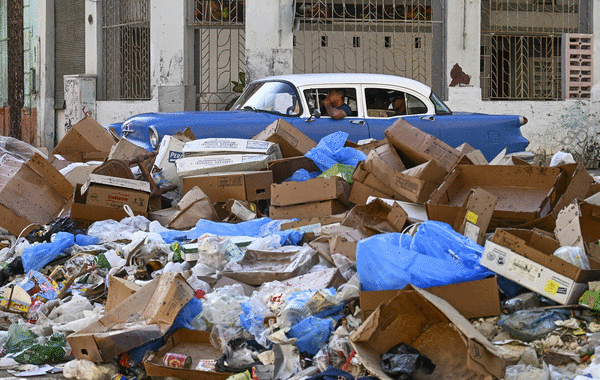
And all over Havana, neighborhoods are covered in rotting garbage piles that haven’t been picked up for months.
The images have made it to social media and independent news outlets, highlighting the severity of the impact the Trump administration’s shutoff of oil shipments to the island — and the government’s resistance to any change — on average Cubans.
The prices of food and gas have skyrocketed seemingly overnight: a package of chicken now costs a month’s salary, 5,000 pesos, and a liter of gasoline up to 3,800. Two thirds of the country was without electricity at peak demand last week, and daily electricity cuts averaged more than 20 hours in many provinces.
Cubans were already facing extreme poverty, widespread shortages and daily blackouts when President Donald Trump cut the country’s oil supply from Venezuela and Mexico in a push to open negotiations that could lead to political and economic changes in the communist-run island.
On Saturday, Secretary of State Marco Rubio urged Cuban authorities to make economic reforms as a way out of the impasse. On Sunday, Trump confirmed negotiations were ongoing and again urged Cuban leaders to make a deal.
“Cuba is, right now, a failed nation,” he said. “We’re talking to Cuba right now. I have Marco Rubio talking to Cuba right now, and they should absolutely make a deal because it’s really a humanitarian threat.”
Asked if he would consider a military operation like the one to capture Venezuela’s strongman Nicolás Maduro last month, Trump said he didn’t want to answer.
“Why would I answer that?” he added. “If I was, it wouldn’t be a very tough operation, as you can figure, but I don’t think that’ll be necessary.”
But despite the increasing external and internal pressure to reform the island’s hardline Marxist economy, Cuban leaders have vowed to resist and have passed another round of severe austerity measures for the population to endure while denying that the country is about to collapse.
“I believe that the Cuban regime right now is in the classic phase of denial,” said Sebastian Arcos, the interim director of Florida International University’s Cuba Research Institute, in a recent event discussing the situation on the island. “They cannot accept that the strategic situation has changed and that things are different, and they’re not going back to what they used to be. This is the first stage of grief.”
Meanwhile, the situation on the island is deteriorating quickly.
At the FIU event, Jorge Piñón, who heads the University of Texas’ Latin America and Caribbean Energy Program, said Cuba’s oil reserves might dry up in a matter of weeks.
“Cuba’s electric power sector is totally collapsed,” he said. “If by March you don’t see an oil cargo ship on the horizon coming either into Havana or Cienfuegos, they will have reached ‘zero.’”
Already, cargo transports, trains and buses connecting the provinces, as well as public transportation services in Havana and other cities, have been reduced to a minimum. Private business owners are complaining that they can’t get their imported supplies delivered from ports.
As the country’s crisis worsened in recent years, residents in Havana had to walk and live on streets covered by mounds of garbage because authorities said there was not enough fuel for pickups — but also because the government did not buy enough trash containers, or pay enough to the trash-collection employees, and because most garbage trucks were out of service, Cuba’s own state media reported earlier this month.
Now, the current energy crisis has made the situation so much worse that residents, sickened by the stench and the flies, have started burning the garbage, covering parts of Havana with unhealthy blankets of smoke, Cuban independent news outlet 14ymedio reported.
The fuel shortage has had a devastating impact on tourism too, one of the country’s key sources of revenue. After Cuba reported running out of jet fuel, several international airlines suspended flights to the island. Many workers in the tourism industry have been told not to go to work in hotels in Cuba’s keys, Varadero, Guardalavaca and other tourist destinations, and tourists have been moved to other facilities, as the government and the Cuban military, which owns many of Cuba’s hotels, moved to shut many of them down.
What makes the population so vulnerable at this time is that the country was already at its worst economically since the early days of the revolution, and a humanitarian crisis was unfolding. Cubans were dying because of diseases linked to poor sanitary conditions and lack of medications, were going without electricity most of the day and were struggling to find affordable food. Some experts say it’s the worst crisis since the end of the independence wars from Spain in the 19th century, which left the country in ruins.
The economic crisis, a deep economic contraction that has lasted years, has largely resulted from the failure of the socialist economic model, a hard-currency-hungry military stashing billions of dollars in its accounts, and years of Cuban leaders dragging their feet on urgently needed economic reforms. The COVID-19 pandemic and the tightening of U.S. sanctions under the first Trump administration also played a part.
That Cuban leaders are willing “to drown an entire people in the name of an ideology proves they are fanatics,” said a source in communication with Cuban officials who asked for anonymity to discuss the interactions. “Every day that passes, they sink deeper into a hole,” the person said, noting that the country’s economy is practically paralyzed. “The damage from zero tourism is enormous.”
Two Miami Herald sources in communication with Cuban officials said they have given little private indication they are willing to negotiate substantial changes on how they run the country, despite public U.S. offers of dialogue. The sources said they were left with the impression that there are no current negotiations between the two governments, in line with what Cuban officials have publicly said.
Their intransigence has proved unpopular. Even voices close to the government are publicly calling for change — if not for a democratic transition.
“Reform and overcome the crisis, or not reform and collapse — that is the Cuban dilemma,” reads the title of a piece penned by Carlos Alzugaray, a retired Cuban diplomat who lives on the island and has for years push for the Cuban government to adopt a Chinese-style, market-oriented economic model. Alzugaray criticized Cuba’s handpicked leader, Miguel Díaz-Canel, for not announcing major reforms at a recent press conference in which he instead called for more sacrifice.
“The demand for reforms, primarily economic but also political, is a natural consequence of the times we live in,” Alzugaray wrote in the pro-government blog La Joven Cuba. “This is especially true when we see on the national television news that our leaders, with a few exceptions, continue to repeat past formulas and refuse not only to change, but also to acknowledge the numerous mistakes they have clearly made.”
While Cuban leaders dig in, their choices about what to preserve and what to cut speak to the government’s immediate priorities: securing its survival.
In the much-criticized television appearance, Diaz-Canel said that the defense of the country was paramount and announced military exercises every Saturday. Images shared by the Revolutionary Armed Forces Ministry show troop movements and displays of Soviet-era helicopters, tanks, surface-to-air missile systems and armored vehicles — an expensive and futile show of force, given the overwhelming superiority of the U.S. military.
In the meantime, all scheduled surgeries have been canceled across the country because, as the minister of health put it, operations “demand electricity.”
“Surgical activity levels usually require more beds for therapy, additional observation beds,” the minister, José Ángel Portal Miranda, said on Cuban television earlier this week, adding that the plan is to reduce the hospitals’ staff and patients’ hospital stays.
He ominously cited the “experience we had with COVID” as a model to follow. At the time, and under his watch, the country’s health system all but collapsed, and the number of deaths from the combined effects of the virus, the suspension of surgeries and the lack of medication is estimated at 55,204, the highest in Latin America.
Despite assurances by Portal Miranda that transportation for patients needing dialysis would not be affected, Norge Ernesto Díaz Blak, an activist who delivers aid sent by his social media followers to those in need in Holguín, said several such patients in that province have reached out to him for help after they said authorities told them they would no longer offer transportation to get the treatment.
Hunger is likely to spread, too, as Díaz-Canel warned that the government was preparing for a scenario in which food could not be delivered, and people would have to live on locally produced food.
“Here in Havana, we will eat junk, garbage … we will drink a lot of sewer water and eat a lot of rubble,” replied in a video Lumey Guzmán, a Cuban social-media content creator.
Debate grows in Miami
Cuban Americans in Miami who have been helping their relatives on the island by paying for medicines, food and other necessities to be delivered to them in the country will see their options shrink fast too. Miami-based companies that deliver food in Cuba, such as Cubamax, Supermarket 23 and Katapulk, have suspended home deliveries.
Aware of the acute situation, the State Department recently announced it will send another $6 million in assistance to people in eastern Cuba who were hit hard by Hurricane Melissa last year. Rubio also said Saturday the U.S. was willing to continue expanding the delivery of aid to the Cuban people through the Catholic Church, though “that’s not a long-term solution to the problems on the island,” he added.
But Cuban American representatives in Congress from Miami and local politicians and activists want the Trump administration to take more drastic measures in what they say would amount to a final nudge to speed up the collapse of the Cuban government.
“The communist regime is on its knees. This is not the time to blink,” U.S. Rep. Carlos Gimenez said in an editorial published on Fox News. “It’s time to finish the job — by enforcing the law, applying maximum pressure and standing proudly on the side of freedom.”
Gimenez asked the Trump administration to halt flights and money remittances to Cuba and recently wrote to Delta Air Lines and American Airlines, urging them to stop flying to the island. Gimenez, along with U.S. Reps. Mario Diaz-Balart and María Elvira Salazar, wrote to the departments of the Treasury and Commerce to ask for a review of all licenses to U.S. companies doing business with Cuba.
But Joe Garcia, a Democratic former congressman from Miami, said that stance could backfire as Cuban Americans begin worrying about their relatives on the island. Cuban Americans have left hundreds of comments on social media — and a similar amount of crying emojis — lamenting that U.S.-based online grocery stores have halted food deliveries to the island.
What the Miami members of Congress propose, he added, “would increase the pain suffered by the Cuban people, the suffering of those least able to withstand the ineffectiveness and inefficiency of the Cuban government.”
Cuba’s diplomats have been promoting on social media criticism comparing Trump’s policy towards Cuba to that of Israel in Gaza, in what some Cuba observers see as a strategy to blame the humanitarian crisis entirely on the United States and create a public-opinion crisis that would put pressure on the administration. Progressive International, a far-left organization, is organizing a flotilla with humanitarian aid to Cuba, mimicking tactics employed by activists reacting to the war in Gaza.
The problem is that Trump might not be moved by such a strategy, one of the sources in touch with Cuban officials said, noting the president kept supporting Israel despite accusations it was committing genocide against the Palestinians in Gaza.
Meanwhile, expectations that change is coming to the island are so high that last week rumors of an impending official announcement from the Cuban government spread like wildfire through social media.
It turned out to be misinformation peddled by various influencers, including some from Miami.
_____
©2026 Miami Herald. Visit miamiherald.com. Distributed by Tribune Content Agency, LLC.






Comments