Iran-US nuclear talks adjourn amid military drills in strait
Published in News & Features
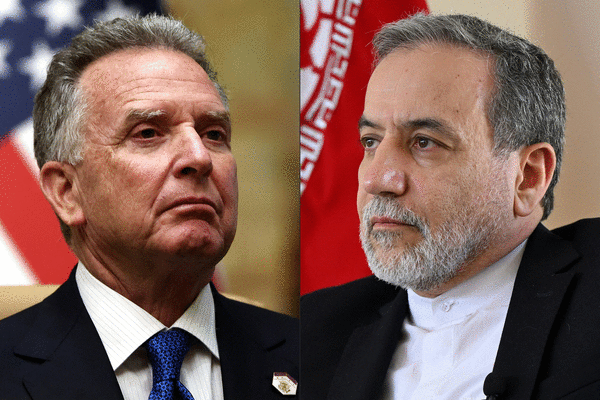
Iran said its diplomats are prepared to stay in Geneva for days or weeks to finalize a nuclear deal with the U.S., as the Islamic Revolutionary Guard Corps resumed navy drills in a critical shipping lane for oil.
The military exercises in the Persian Gulf, which Iranian state TV said would partly close the Strait of Hormuz for several hours, came shortly before Iranian Foreign Minister Abbas Araghchi and U.S. Special Envoy Steve Witkoff ended a second round of indirect talks in Switzerland on Tuesday.
Negotiations are expected to continue in the “near future” after the two sides return to their capitals for consultations, state-run Press TV reported.
Success in the talks could pave the way for a landmark agreement between Tehran and Washington that would lift a slew of tough sanctions on Iran’s oil industry and wider economy in exchange for major restrictions on its nuclear program.
The Iranian delegation is “ready to stay longer to finalize any agreement, several days or even weeks,” Iran’s Foreign Ministry Spokesman Esmail Baghaei said of the talks in Geneva, according to the semi-official Iranian Students’ News Agency.
“We hope to see the same level of seriousness and good faith from the American delegation,” Baghaei said shortly before the second round of talks ended. He added that time was “extremely important and vital” for Iran and that the Islamic Republic was “focused on results.”
While oil nudged slightly higher on news of the Iranian drills, the increase wasn’t consistent with concerns about serious disruption to shipments from the world’s top oil-producing region. Iran has threatened to fully close the Strait of Hormuz in the past but has never done so.
“The main transit routes of the Strait of Hormuz are under the control of the IRGC Navy, and Iran has no red lines when it comes to safeguarding security in this region,” state TV said.
The drills started on Monday and are focused on delivering a “decisive” response to security threats. The IRGC is monitoring the strait continuously and plans to unveil additional equipment soon to boost its military capacities there, Navy commander Alireza Tangsiri is quoted as saying, according to the semi-official Mehr news agency.
Earlier on Tuesday, Iran’s Supreme Leader Ayatollah Ali Khamenei stepped up his warnings that the U.S. will suffer if it strikes the Middle Eastern country, as President Donald Trump has repeatedly threatened if the sides can’t reach a deal.
“They keep saying: ‘We sent a warship towards Iran,’” Khamenei said. “Well, a warship is certainly a dangerous weapon, but more dangerous than a warship is the weapon that can sink this warship to the bottom of the sea.”
The talks in Geneva, mediated by Oman, started at around 10:00 a.m. local time and lasted around 3.5 hours. After the last round of talks, held in Oman on Feb. 6, both sides described them as “good.” Officials haven’t yet commented on the outcome of Tuesday’s session.
The negotiations have gained urgency since Trump deployed a second aircraft carrier to the region amid warnings of a possible strike on Iran if talks — which could drag on for weeks — fail to produce a compromise.
Brent is up almost 13% this year, largely because of the U.S.-Iran tensions and the prospect of a war in the oil-rich region.
Several tanker industry veterans said Iran’s military drills hadn’t prompted any fresh guidance to shipping in the past few days that they’re aware of. They said they didn’t anticipate a disruption to oil shipments.
The U.S. team is led by Witkoff and Trump’s son-in-law Jared Kushner. Trump said on Monday that Iran wants to make a deal and that he’ll be indirectly involved in the discussions.
Israel is pushing for the negotiations to include limits on the range of Tehran’s ballistic missiles, but Iran has so far dismissed that as a red line.
During a visit to Tel Aviv on Monday, U.S. Republican Senator Lindsey Graham said Washington was “weeks, not months” away from a decision between diplomacy and military action against Iran.
“We are negotiating with our finger on the trigger,” Jalal Dehqani Firouzabadi, the head of Iran’s Strategic Council on Foreign Relations, told the semi-official Iranian Students’ News Agency. “Iran is making every effort to prevent war, and diplomacy is part of that effort, but has no hesitation in defending itself.”
---------
—With assistance from Eltaf Najafizada, Dan Williams and Carla Canivete.
©2026 Bloomberg L.P. Visit bloomberg.com. Distributed by Tribune Content Agency, LLC.





Comments