Lebanon pressing on with bid to disarm Hezbollah, premier says
Published in News & Features
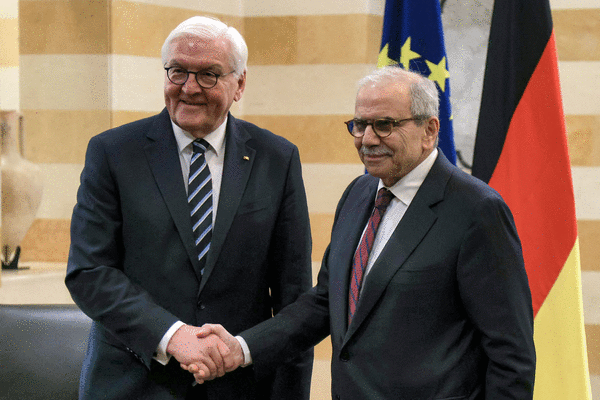
Lebanon’s government signaled it’s open to expanding its role in the U.S.-led task force monitoring the ceasefire between Israel and Hezbollah and stepping up efforts to disarm the Iran-backed militia.
More Lebanese civilian experts can be added to the committee “when need be,” Prime Minister Nawaf Salam told Bloomberg in an interview. He gave the example of “lawyers, topographers” who might consult on border demarcations and other unresolved issues between Israel and Lebanon, which have no formal diplomatic relations.
The premier also said he’ll be briefed Monday on the next phase of the Lebanese army’s plan to demilitarize the country’s south, where Hezbollah held sway for decades until arch-foe Israel killed many of the Islamist group’s leaders in late 2024.
“We are not seeking confrontation with Hezbollah, but we are not going to be intimidated by anyone,” Salam said at the Munich Security Conference, which ended on Sunday. Hezbollah, designated a terrorist organization by the U.S. and others, vows it won’t lay down its weapons.
Salam’s government has a tough task trying to assert state control in Lebanon, a Middle Eastern country of some 6 million people that’s approximately the size of the U.S. state of Connecticut and has often been a proxy battlefield for the region’s major powers.
The U.S.-backed truce between Israel and Hezbollah is being monitored by a so-called mechanism committee established in November 2024 that includes representatives from Israel, Lebanon, France and a United Nations peacekeeping force.
It was formed after an all-out war of roughly three months that saw Israeli troops entering southern Lebanon and which left thousands of people dead, mostly in Lebanon, among them Hezbollah’s long-standing secretary-general, Hassan Nasrallah. The war was triggered by months of Hezbollah missile and drone attacks on Israel, carried out in solidarity with Hamas in Gaza.
The truce has officially held, though Israel conducts regular strikes against what it says are Hezbollah operatives and sites. Israeli and some U.S. government officials accuse Lebanon’s army of not doing enough to decommission Hezbollah, which they say is reconstituting its arsenal with Iranian help.
For its part, Lebanon’s government says Israel has killed about 400 people, mostly civilians, and the Jewish state’s refusal to withdraw from five outposts in Lebanon is complicating local efforts to disarm Hezbollah.
Last month, the Lebanese army said it demobilized the area between the Litani river and Israeli border, where Hezbollah had built up significant infrastructure. The next phase centers on territory stretching north to the Awali river. The area includes Palestinian camps where Hamas has a presence.
Some in Washington have been pressing Lebanon to hold direct talks with Israel, with a view of normalizing relations between two states that have officially been at war since the state of Israel’s creation in 1948.
In December, Lebanon appointed Simon Karam, a former ambassador to the U.S., to the ceasefire committee and he held talks with Uri Resnick, an Israeli national security council official, in the presence of American officials.
Salam drew a distinction between current discussions over security and borders, and any move toward a permanent peace deal.
“We did it before — we did it when negotiating the limitations of the maritime boundaries,” said Salam, referring to the U.S.-guaranteed agreement in 2022. “We have no problem, it’s not taboo.”
©2026 Bloomberg L.P. Visit bloomberg.com. Distributed by Tribune Content Agency, LLC.





Comments