University of Denver braces for up to a $30 million budget shortfall next year
Published in News & Features
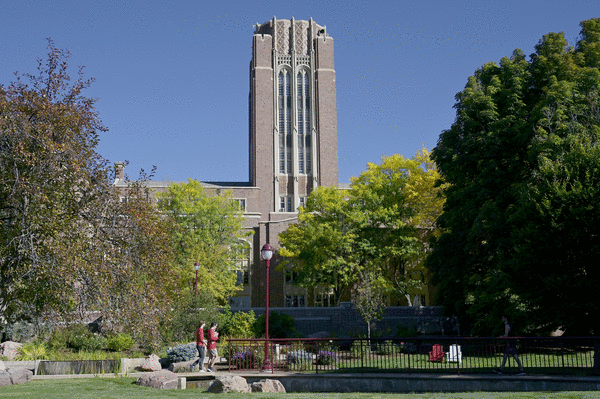
DENVER — University of Denver leaders this week warned employees that “necessary reductions lie ahead” as they project a revenue shortfall of $20 million to $30 million in the next fiscal year, due in part to drops in international students and the overall campus population.
“These are difficult challenges, but they are not insurmountable for DU, a university that has demonstrated amazing resiliency over its history,” Elizabeth G. Loboa, DU’s provost and executive vice chancellor, and Mark DeLorenzo, senior vice chancellor of business and financial affairs, wrote in a memo sent Wednesday to campus staff.
Loboa and DeLorenzo acknowledged the private research university projected a budget shortfall of about $6 million in the current fiscal year, which ends June 30. Not only has the university narrowed that shortfall by more than $4 million, but, they wrote, they are confident the remaining gap will be closed by the end of the fiscal year “through prudent and thoughtful expense reduction measures without impacting the operations of our campus.”
However, the university — which has an operating budget of more than $550 million a year — expects a shortfall more than three times what it had predicted this year for the 2027 fiscal year, which starts July 1, they wrote.
“We are still several months away from finalizing a balanced budget for fiscal year 2027, and leaders in both academic and non-academic departments are exploring revenue growth and expense reduction initiatives to help achieve that objective, while continuing to provide an outstanding student experience,” DU spokesperson Jon Stone said Friday.
DU leaders attribute the $20 million to $30 million revenue shortfall to several factors, including an overall student population decline as a result of graduating “an unusually large” senior class this spring and a potential decline in graduate student enrollment “driven by national trends, the uncertainties related to graduate student loan funding options and the ability of international students to attend DU.”
Six hundred international students enrolled in fall 2025 compared to 745 the year prior, Stone said. Total student enrollment was down about 10% from fall 2025 to the previous year, dropping to 11,499 students from 12,812, according to DU data.
President Donald Trump’s administration has proven particularly hostile toward international students, with actions such as the sudden revocation of student visas last year, threats of immigration detention, social media monitoring and travel bans.
In September, DU Chancellor Jeremy Haefner announced the university was doing away with practices and programs supporting students of color and other marginalized scholars out of fear that the school could lose federal funding under a presidential administration hostile toward diversity. Haefner told The Denver Post at the time that the university was not “kowtowing” to the federal government and still considered diversity a core value.
The memo sent to DU staff this week assured employees that academic and non-academic units were “vigorously pursuing enrollment and revenue growth indicators,” but that additional expense reductions must be planned to balance DU’s budget. The memo didn’t detail those reductions, but said they would be university-wide in non-academic, administrative and academic units.
Loboa and DeLorenzo praised the university’s 30% increase in undergraduate applications and 12% increase in graduate applications.
“Getting those admitted students to matriculate will be especially important this year, and your partnership in that effort makes a meaningful difference,” they wrote. DU is “navigating significant demographic changes and market shifts,” they added, and must prepare to teach a smaller student body than in the past decade.
In 2024, The Post reported that DU faced an $11 million budget deficit, which Haefner described at the time as “a very difficult time for the university.” That budget shortfall led to the elimination of eight administration staff positions, 15 staff positions in the College of Arts, Humanities and Social Sciences, and an undisclosed number of vacant roles.
“Because recent revenue declines have not been matched with equivalent ongoing expense reductions, our total university operating margin — revenues less expenses — is now negative, limiting our ability to reinvest in our mission on campus,” Loboa and DeLorenzo wrote. “…While necessary reductions lie ahead, we are equally committed to leaning into market demands and making targeted, strategic investments that position DU for long-term success.”
©2026 MediaNews Group, Inc. Visit at denverpost.com. Distributed by Tribune Content Agency, LLC.






Comments