Haiti's presidential council relinquishes power; prime minister to run country for now
Published in News & Features
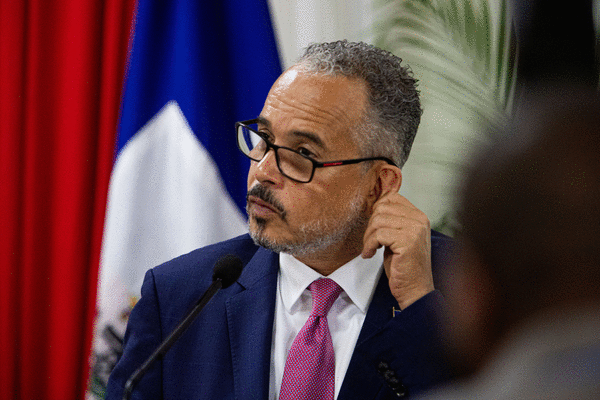
Haiti closed a vexing chapter in its ongoing political transition on Saturday, doing so in a subdued ceremony marking the end of the turbulent mandate of its nine-member presidential council and leaving the gang-ravaged country in the hands of it single, unelected prime minister and his Cabinet.
During the ceremony marking the end of the Transitional Presidential Council at the Villa d’Accueil in Pétion-Ville, Prime Minister Alix Didier Fils-Aimé offered brief remarks, saying he would save a more lengthy speech for an address to the nation later in the day, to take place after holding his first Cabinet meeting as the country’s sole leader.
“The presidential council has fulfilled its mission by paving the way for a governance focused on security and electoral reforms,” he said, expressing his gratitude in the packed room, where members of the foreign diplomatic corps sat on the front row and ministers on the other side. “Today, we are aware of the challenges and… the government that I have the honor to lead will get to work.”
Fils-Aimé was joined on stage by five of the nine members of the transitional council, including non-voting observers Régine Abraham, the group’s only woman, and Frinel Joseph as well as three voting members, Emmanuel Vertilaire, Smith Augustin and Laurent Saint-Cyr, the council’s head at the end of its term.
Absent were two prominent council members and former heads of the rotating presidency: Edgard Leblanc Fils and Fritz Alphonse Jean. Council member Louis Gérald Gilles made a brief appearance near the end of the ceremony, while Voltaire arrived early and left before its conclusion. Three of the four had actively been seeking to establish a new presidential entity to oversee governance after the council’s term expired. All four were involved in efforts to oust Fils-Aimé in recent weeks, leading the Trump administration to revoke their U.S. visas, along with Augustin’s.
Earlier in his tenure as coordinator of the rotating presidency, Voltaire dismissed Prime Minister Garry Conille and Foreign Minister Dominique Dupuy, moves that deepened political turmoil and eroded public confidence. In the end, no bicameral or parallel governing structure emerged, and power now rests solely with the prime minister and the cabinet, a fact Saint-Cyr acknowledged in his speech.
“Now the council of ministers, under the direction of the prime minister, will take charge,” he said. “The call is clear: Security, political dialogue, elections and general stability.”
Failure, he told Fils-Aimé — who still lacks a formal governing pact despite the backing of the United States and other foreign nations — is not an option.
In the prime minister’s first act after the ceremony, he named new mayors for Port-au-Prince and Pétion-Ville, both of whom were close to some members of the council, and Gressier. Police also reopened a sub-station at Carrefour Airport.
In his Cabinet meeting, Fils-Aimé announced he would be acting finance minister because the current one, Alfred Metellus, had resigned from the post. Metellus was the choice of members of the presidential council to replace Fils-Aimé as prime minister, straining relations between the two men.
The uncertainty of the day led many businesses to close and kept many Haitians off the streets. Despite the unusually empty roads, there were no reported incidents of violence.
Saturday’s ceremony coincided with the 40th anniversary of the fall of the country’s brutal Duvalier dictatorship, a significant moment in Haiti’s history. Saint-Cyr paid homage to those who lost their lives in the struggles for democracy and those who continue to fight, he said, by making difficult decisions and risking their lives “because they are convinced this country deserves freedom, peace and a better life for everyone.”
Saint-Cyr acknowledged the transitional council’s failures: Members left office without handing power over to an elected president, as their governing accord had demanded, instead ushering in another transition.
“It was a very difficult exercise,” he said. “It was replete with obstacles.”
Still, he insisted all had not been in vain. The council set the stage for improved security and elections, which last took place in Haiti in 2016, he said.
“We stopped the country from falling into chaos. The state is not collapsed,” said Saint-Cyr. “Institutions continue to function, and the government remains in place.”
Regarding his six months at the helm, he noted the appointment of a new police chief after he took over in August as coordinator; the mobilization of funds for the security forces, which includes private military contractors using explosive drones to flush out gangs, and the lobbying at the United Nations and elsewhere to transform the Kenya-led multinational security support mission into a more robust Gang Suppression Force.
“Today, the fear sits in the camp of criminal gangs,” he said, underscoring the intensified police operations and improved coordination between the Haiti National Police and the country’s small army. “They all understand, they don’t have any other choice: Drop their guns or die.”
Like other council members, Saint-Cyr had argued for the creation of a dual executive to lead the country during this third phase of the transition, which began after the July 7, 2021, assassination of President Jovenel Moïse plunged Haiti deeper into chaos.
But the council’s tainted legacy — marred by accusations of corruption, poor governance, undue enrichment and political maneuvering — combined with an inability by Haiti’s political and civil society leaders to come to an agreement, led Washington and other international partners to press for a single governing authority: the prime minister.
Haiti has been here before. After the assassination of Moïse, his chosen successor, Prime Minister Ariel Henry, also governed with strong American support. He was eventually forced to resign as armed groups coalesced into a unified front and attempted to seize control of the capital while Henry was stranded abroad.
“Haiti can't continue to live in crisis and instability or in permanent conflict,” Saint-Cyr said, noting that in recent days consensus had been developing among all the country’s forces for a dual executive.
“I would encourage the PM to take all the necessary steps for the political dialogue to continue in serenity and respect,” he said. “We ought to find a solid political accord.”
©2026 Miami Herald. Visit miamiherald.com. Distributed by Tribune Content Agency, LLC.




Comments