Veteran ICE officer went from fearing for his life to taking a life
Published in News & Features
Jonathan Ross feared he was going to die.
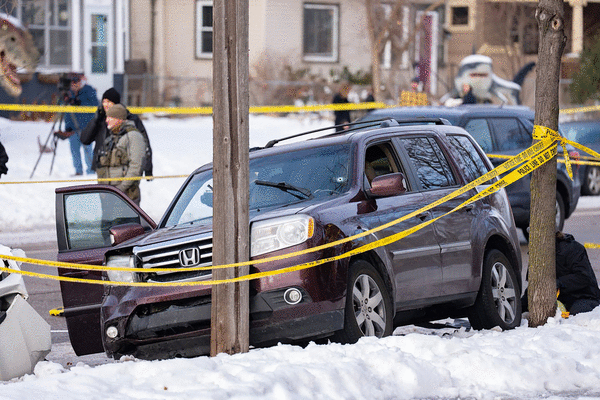
The man he was attempting to arrest last June refused to get out of his car and instead stepped on the gas while Ross’ arm was wedged in the window.
As the driver swerved down a Bloomington street Ross clung to the outside of the car, desperately trying to avoid being run over.
After being dragged about 100 yards, Ross finally broke free.
What was expected to be a relatively routine apprehension of an undocumented immigrant in a quiet residential neighborhood left the veteran agent bruised and bloodied. Ross’ battered arm required 33 stitches.
Nearly seven months later, Ross was back on duty with thousands of other immigration agents in Minnesota. On a Minneapolis street, he made a split-second decision that left a protester, Renee Good, dead. The shooting sparked a national fury over immigration agents’ use of force, one reinforced by the Jan. 24 killing of Alex Pretti in Minneapolis by the U.S. Border Patrol.
Now the June dragging incident is getting new scrutiny as lawyers and investigators work to understand Ross’ actions in the killing of Good. Should the shooting be considered self-defense or murder? Did Ross receive any counseling after the near-deadly dragging incident last June, and how quickly did Ross return to active duty? Do his actions that day offer clues as to what sort of agent he was before he landed in the international spotlight?
Ross, who has long served in dangerous and demanding government jobs, is reportedly in hiding after the shooting.
The U.S. Attorney’s Office has said it’s not investigating Ross for killing Good. The Federal Bureau of Investigation (FBI) shut out state criminal investigators from an inquiry into Good’s killing, but the Hennepin County attorney and state attorney general are conducting their own investigation.
Department of Homeland Security Assistant Secretary Tricia McLaughlin said in a recent statement to the Star Tribune that it would review Ross’ shooting of Good, as it does in “every incident” involving the “discharge of any ICE firearm.”
Last week, the man convicted in December for dragging Ross asked a federal court for access to the government interview of Ross after the Good shooting.
The man’s attorney indicated in a court filing that Ross’s statements could be used at a possible retrial, or at his sentencing. “Evidence derived from this interview could have bearing on Ross’s motive or intent” in the earlier incident. The attorney also asked for a full record of Ross’ training history.
Court records from the dragging trial do not indicate any incidents involving questionable conduct by Ross.
While Ross may have again legitimately feared for his life before he fired his gun, most police departments discourage shooting at moving vehicles, legal experts say. And Ross policed the southwest border at a time when an outside panel specifically instructed patrol officers to refrain from shooting at moving vehicles.
Ross, a Chaska resident, could not be reached to comment. Minneapolis attorney Chris Madel, who has provided legal counsel to him, declined to comment.
Ross, 43, has been familiar with guns and civil turmoil much of his adult life, serving lengthy stints in the Indiana Army National Guard, the U.S. Border Patrol and most recently U.S. Immigration and Customs Enforcement (ICE).
He graduated from a Peoria, Ill., high school in 2001. A few months later he headed to Anderson University, a school affiliated with an evangelical Christian denomination located about 45 miles northeast of Indianapolis. He reportedly continues to practice his faith. His father told the Daily Mail last month that his son is a “committed, conservative Christian.”
Shortly after the 9/11 terrorist attacks gripped the country, Ross joined the Indiana Army National Guard. He got married in October 2004, a month before he deployed to Iraq, but divorced just over a year later — around the time he returned, Indiana court records show.
Ross’s Indiana guard unit, the 138th Signal Battalion, was stationed in Ramadi for at least part of the time he was there, according to a local Indiana press report and a guard member who served in Iraq in 2005 but did not know Ross.
Heavy fighting embroiled Ramadi at the time. The 138th battalion set up and supported communications between U.S. bases around Ramadi, said Tom Bunnell, a former battalion member who lives in Indiana. “We were kind of like the Indiana Bell of Iraq.”
Ross went to Iraq as a specialist in installing and operating communications equipment. The communications teams needed armed protection shuttling between bases, said Bunnell. “We would have to self-secure our own convoys.”
The Indiana Army National Guard said Ross was a convoy team gunner, which he confirmed in court testimony last year.
After returning from Iraq, Ross completed his studies in psychology and business administration at Anderson University in May 2007 and left the Indiana guard in 2008.
Soon after college, Ross landed a job with the Border Patrol near El Paso, Texas.
He patrolled the southwest border, searching for migrants, smugglers and terrorists. He also served as a field intelligence agent, according to his court testimony, focusing on drug cartels and smuggling.
For eight years, Ross worked in the sprawling El Paso sector as the Border Patrol hired thousands of new agents and came under increasing scrutiny for use of force, including several fatal shootings in the southwest.
In 2013, an Arizona Republic investigation found that Border Patrol and Customs and Border Protection officers had been involved in 42 use-of-force deaths since 2005, many of them cloaked in secrecy. None of the agents were known to have been disciplined.
The Border Patrol commissioned an independent panel of law enforcement leaders to review 67 deadly force cases from 2010 through 2012. The panel had several concerns, including agents firing at moving vehicles, a practice that merited a “significant change.”
Border patrol agents shouldn’t shoot at moving vehicles unless an officer’s life is in danger “by means other than the moving vehicle,” the panel concluded in 2013. Agents should also be trained “to get out the way of oncoming vehicles as opposed to intentionally assuming a position in the path of such vehicles.”
Ross joined ICE in 2015, moving to Minnesota and working out of the agency’s St. Paul office. He and his second wife and their two elementary school-aged children settled into a new house in Chaska, paying $460,000.
The two-story home is nestled on a quiet street that ends in a cul-de-sac. Two neighbors say until recently a “Don’t Tread on Me” flag flew outside the home. The 1775 banner of a coiled rattlesnake — known as the Gadsen flag — has been embraced by anti-government advocates and was flown during the siege on the U.S. Capitol on Jan. 6, 2021.
One neighbor, who wished to remain anonymous for fear of retribution, said Ross’s yard sported several political signs for Republican candidates during the 2024 election. He had a large Donald Trump banner hanging from his back deck, facing a public trail, the neighbor said.
Ross, in December court testimony, said he worked in “fugitive operations” for ICE’s Enforcement and Removal Operations, pursuing “higher value targets” in Minnesota. He’s also an ICE SWAT team member and a firearms instructor for the agency.
ICE and Homeland Security officials have refused to identify Ross as Good’s shooter, but they have said the agent involved in the encounter is an expert marksman and experienced agent who “has been serving his country his entire life.”
As an ICE team leader working with other federal agencies, Ross executed arrest warrants on undocumented immigrants. That’s what he was doing — with support from two FBI officers — last June.
Their target was Roberto Munoz-Guatemala, an undocumented immigrant from Mexico who’d been convicted in 2023 of fourth-degree criminal sexual conduct. The victim was his 16-year-old stepdaughter, state court records say.
The federal agents planned to apprehend Munoz-Guatemala after he left his Bloomington home around 8 a.m. An FBI agent supporting Ross began tailing Munoz-Guatemala. Ross, driving an unmarked Chevy Tahoe, joined the pursuit.
Ross testified he and the FBI agent turned on their police lights, but Munoz-Guatemala kept driving for nine or 10 blocks until Ross managed to box in his vehicle.
Ross, during his border patrol and ICE career, testified he had pursued fleeing suspects and had conducted “hundreds” of traffic stops. This one quickly went awry.
Ross testified he approached Munoz-Guatemala’s car with his pistol drawn — as he was trained to do — because the driver had failed to yield. He said he holstered it after Munoz-Guatemala complied with demands to put his hands up.
Munoz-Guatemala lowered his driver’s side window a few inches and held up an identification document. Ross testified he ordered him to roll down the window completely. Munoz-Guatemala didn’t, so Ross warned that he would break the rear driver’s side window. And he did, reaching into the car, aiming to unlock the front door.
Munoz-Guatemala hit the gas. While being dragged, Ross fired his Taser into Munoz-Guatemala’s head and shoulder. But he continued driving, weaving back and forth, court documents say.
At Munoz-Guatemala’s trial for assaulting a federal officer, Ross testified he tried to extricate himself and keep his legs from getting swept under the vehicle. “I was fearing for my life,” he said.
After breaking free, Ross testified he felt “pretty excruciating pain” and was “bleeding quite a bit.” An FBI agent applied a tourniquet to his arm.
Ross called Bloomington Police soon after the dragging, asking them to apprehend Munoz-Guatemala, who had fled again. “We’re going to charge him federally for this shit,” Ross told a police dispatcher.
When police arrived on the scene, there were no ICE observers, or even gawkers. Ross was sitting on the curb, a long gash on one arm, road rash on both arms and blood on his tactical vest, according to police reports and dashcam footage.
His wounds later got infected and oozed a green pus for about a week, Ross testified.
Munoz-Guatemala testified he didn’t know Ross was a law enforcement agent and didn’t realize he was dragging Ross. He was convicted by a federal jury in December.
Ross was back on duty during the trial but it’s not clear when he returned to work.
A federal official close to the dragging investigation said Ross never discussed his return-to-work requirements and never mentioned being off duty. But the official questioned whether Ross was ready to be back on the streets again after fearing for his life in June.
“The last time he had been near a car like that he had been badly injured,” the official said. “And I wondered if that played a factor and informed his actions” in the encounter with Good.
McLaughlin, the DHS spokeswoman, said flatly that Ross was ready to be back at work but she declined to respond to questions about return-to-work policies for injured officers.
Law enforcement return-to-work procedures vary depending on an injury’s severity, though doctor’s clearances are commonly required before officers can return to active duty.
Police experts say it’s difficult to know if Ross was ready to be working in January with few facts known about his mental state after the June incident.
Some police departments require or suggest psychological assessments for officers involved in a “critical incident” — a police shooting, a bad injury or exposure to children being hurt, said Marc Brown, lead instructor for the Excellence in Policing and Public Safety Program at the University of South Carolina’s law school.
“Law enforcement is still trying to catch up with the trauma officers are exposed to,” said Brown, who’s also a former police officer and Homeland Security Department training instructor. “We don’t know whether he (Ross) was ready or wasn’t, but once he is back in operational practice, the agency has determined he is ready.”
The Trump administration’s Operation Metro Surge began in December and quickly became the largest immigrant deportation campaign of its kind. Residents mobilized to observe agents’ tactics and warn immigrants of their presence.
Around 9:30 a.m. Jan. 7, a din of whistles and shouting erupted over an ICE presence near Portland Avenue and 34th Street in south Minneapolis. Good, who lived nearby, had positioned her SUV perpendicularly across part of Portland Avenue, a busy thoroughfare.
Video footage shows Ross parked his SUV a few feet from Good’s vehicle and climbed out. Ross casually circled Good in her car. She greeted him pleasantly, while her spouse — who had exited the vehicle — taunted Ross from the street.
Two other ICE agents parked their truck several feet from Good’s driver’s side door. They exited their vehicle and commanded Good to exit her car. She refused.
Good put her SUV in reverse, backed up briefly and then moved forward. Ross, who was in front of Good’s car recording with his cellphone, pulled his gun and fired. All three shots — two of which zipped through the open driver’s side window — hit Good.
Immediately after the shots, a male voice in a cellphone video taken at the scene can be heard muttering, “Fucking bitch.”
When asked by CNN journalist Jake Tapper in an interview if the voice was Ross’s, Homeland Security Secretary Kristi Noem said “it could be.”
Without naming Ross, Noem said the agent acted in self-defense and accused Good of using her vehicle as a weapon. Videos of the incident don’t appear to show that Good tried to run over Ross.
“Jon Ross struck me as a very reasonable man — not a bully and not prone to violence,” said the federal source close to the dragging incident. “It’s hard for me to reconcile the man I met with the man in that video.”
Two of Ross’s neighbors said there’s been no sign that Ross and his family have been living in their Chaska home in the aftermath of Good’s killing.
_____
(Matt DeLong, Mary Jo Webster, Liz Sawyer and Jeff Day of the Minnesota Star Tribune contributed to this story.)
_____
©2026 The Minnesota Star Tribune. Visit startribune.com. Distributed by Tribune Content Agency, LLC




Comments