Minnesota refugees and immigrants are hiding in 'a prison of fear'
Published in News & Features

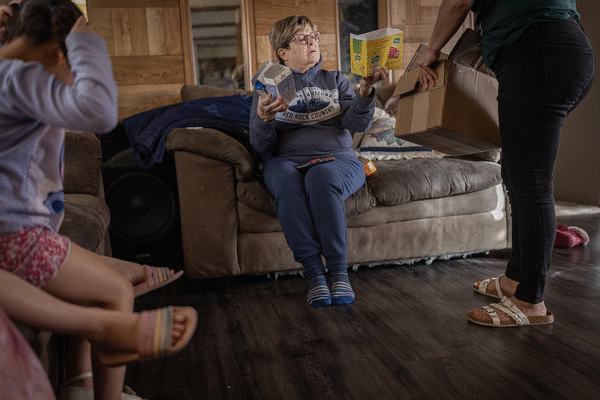

MANKATO, Minn. — The pickup truck with Texas plates rolled slowly past as the driver looked at the home, then his phone, before turning the corner.
Inside the mobile home, two families — three adults and six children — huddled behind drawn curtains and locked doors, waiting for the feared pounding on the door. Minutes passed before they could exhale, safe from federal agents — for now.
Across Minnesota, thousands of immigrants and refugees, many of them legal residents, have been hiding for weeks from U.S. Department of Homeland Security agents deployed to the state in the largest immigration enforcement operation in history.
Immigrants and refugees interviewed by the Minnesota Star Tribune say they fear being detained, fear being separated from loved ones, and fear being physically hurt by federal agents.
As a result, many restaurants are short-staffed or closing altogether. Sales have plummeted at small businesses. And attendance at schools has dropped sharply as more kids opt to stay home.
Besides detaining undocumented immigrants as part of Operation Metro Surge, the Department of Homeland Security also launched Operation PARRIS in January to detain and “re-examine” refugees who were admitted to the U.S. legally but have not yet gotten green cards. It applies to an estimated 5,600 Minnesota refugees who have gone through a robust screening process and are on the pathway to citizenship.
In the Mankato home, one of the mothers (who asked that her name not be used) said through an interpreter that the family is here legally and is waiting to be granted asylum. They have lived and worked in Minnesota for three years.
They are hiding anyway. For the past month, they haven’t left their two-bedroom mobile home. Weeks-old snow covers two of the three cars parked outside. There is no hot water; the water heater has been broken for weeks.
“These are things we are living. The kids don’t sleep. We don’t sleep. We are even afraid to take out the garbage,” the mother said.
Willmar parents reassure their children
It’s the middle of the afternoon, but 11-year-old Allison’s room in Willmar is as dark as night.
The shades are firmly shut, the lights switched off. As the girl holds her baby brother in the darkness, her mother, Erika, who came to the U.S. four years ago from Honduras and has an open asylum case, watches and worries from the threshold of the bedroom door.
Like other immigrant children across the state, Erika’s daughter has asked questions that her parents have difficulty answering: Can she go back to school soon? Why are federal agents detaining people? What if our family gets separated?
Erika worries Allison is getting depressed, staying inside her room with the shades drawn and the door closed. Her friends at school made clay sculptures recently. If life were normal, Allison said she knows exactly what she would have sculpted: a butterfly.
Erika tries to reassure Allison, but it’s becoming harder, she said, because she’s scared, too.
Also in Willmar, Diana Alvarado Reyes, a U.S. citizen originally from Honduras, said she gets hard questions from her 7-year-old son.
He asked her whether they should leave the country, and why they have to be afraid “if we’re not bad people, if we go to church.”
Said Reyes: “It’s hard for us to give them some explanation. We don’t know how they’re going to take it, but we’re just trying to do our best.”
Like Reyes, her children are U.S. citizens, but she said doesn’t trust that her family is safe or that federal agents are only going after criminals, which is what the Trump administration has claimed. She cited videos of ICE agents using heavy-handed tactics and detaining U.S. citizens. Local activists and officials have alleged agents are using racial profiling — which federal officials deny.
‘Hiding in the shadows’
K, who didn’t want to give his full name out of fear, is a legal resident seeking asylum from genocide and civil war in Ethiopia. A doctor in his home country, K said he’s now enrolled in an MBA program. He said he has no criminal history.
But he’s been unable to go to class or work. Fear of being detained by ICE has kept him shut up in his apartment for the past three weeks. He can’t even go grocery shopping, he said.
“I am a prisoner in my apartment,” said the 30-year-old North St. Paul resident. “I am hiding in the shadows, not because I have committed a crime, but because the streets of Minnesota have begun to look terrifyingly similar to the war zone I escaped.”
He said he came to America more than three years ago because he “believed in its fundamental promise: that liberty, safety and due process are inalienable rights.”
Yet, in spite of following the law, paying taxes and his rent, and receiving no government aid, K said he’s trapped “in a nightmare.”
ICE’s tactics, he said, are the ones used by government forces in Ethiopia: checkpoints, warrantless searches, profiling based on skin color or accent and arrests for nothing more than being in the wrong place at the wrong time.
K, who is receiving treatment for PTSD at the Center for Victims of Torture, said: “This is not the freedom I sought. This is a prison of fear.”
The center’s Scott Roehm said detaining legal asylum-seekers and transferring detainees out of state “is a singular, wholesale attack on human rights.”
“There is an inherent cruelty to it,” he said. “There’s an inherent bigotry to it. I also think there’s a thought this demonstrates power. But I think it demonstrates weakness.”
Federal officials did not immediately respond to a request for comment.
Roehm said he’s not surprised that thousands of residents are hiding.
“Nobody is safe from what’s happening right now. Nobody,” he said. “It’s a climate of terror, and you’re seeing more people recognize that.”
So far, Roehm said, the only defense is filing lawsuits as soon as possible, and continuing to alert the news media and elected officials about encounters with ICE.
Several legal groups and five refugees did just that, filing a class action lawsuit in January over Operation PARRIS, alleging it violated the Constitution and is detaining refugees who are lawfully in Minnesota. In late January, a judge granted a temporary restraining order, and ordered the immediate release of refugees currently detained under the policy.
In announcing Operation PARRIS, federal officials said it would help root out fraud in Minnesota and is “part of a broader strategy to implement enhanced screening standards.”
K said he still hopes to be granted asylum, but there’s a backlog of cases.
Helping those who are in hiding
Across the state, Minnesotans are rallying to organize food drives and fundraisers to support families who are in hiding or unable to go the grocery store themselves. Schools, offices and places of worship have transformed into makeshift food shelves to collect and distribute groceries, diapers and other essentials to immigrant families.
Before the recent ICE surge in Minnesota, E, who also didn’t want to be named for fear of being detained, worked in human resources for a Mankato-area meatpacking company as a liaison to immigrants from Mexico.
He’s worked in the Mankato area for four years. But after his work permit expired in September, E has been a volunteer community organizer, part of a team of hundreds helping residents get the things they need while in hiding, such as food, medicine and school materials, and tracking ICE’s movements.
E, who said he has no criminal record, has applied for another work permit. In the meantime, the 34-year-old is also in danger of being detained and running out of the money.
The need for help is only growing, he said. In September, about 1,000 area residents lost their work permits. This coming July, another 3,000 will be without work and subject to being detained, he said.
When their money runs out, he said, people will no longer be able to hide from ICE. “I’m just hoping we can make it,” he said.
A woman from Colombia plays with her 5-year-old daughter at their home in Mankato.
--------
—Elizabeth Flores and Susan Du of the Minnesota Star Tribune contributed to this story.
_____
©2026 The Minnesota Star Tribune. Visit at startribune.com. Distributed by Tribune Content Agency, LLC.






Comments