An estimated 8,000 cold-stunned iguanas removed from parts of Florida
Published in News & Features
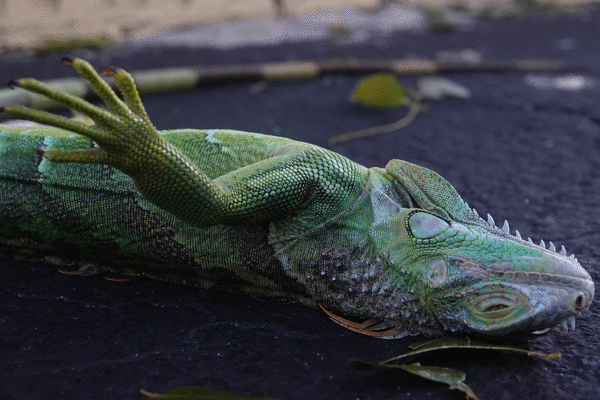
ORLANDO, Fla. — An estimated 8,000 invasive green iguanas were removed from various Florida communities this week after a record-breaking freeze event that sent overnight temperatures down to the mid-30s for two nights in a row.
On Wednesday, the Florida Fish and Wildlife and Conservation Commission released official numbers for its iguana drop-off sites. All told, the five sites collected 5,195 dead or cold-stunned iguanas. The drop-off sites were in Marathon, Sunrise, Tequesta, Fort Myers and Lakeland.
The FWC suspended rules prohibiting possession of iguanas by the general public for a few days to allow people to transport the reptiles to collection sites, which are now closed.
The combined total when adding up FWC numbers with those of just a few private iguana removal companies was well over 8,000.
Pompano Beach’s IggyTrap said they collected a total of 800 iguanas on Sunday, Feb. 1, and an additional 700 Monday and Tuesday, for a total of 1,500 for the week.
The company Iguana Control, which covers the east coast of Florida, from Palm Beach County to Key West, collected at least 1,300 from various clients, such as municipalities and HOAs all over South Florida.
Trapper Dan Andrade of American Iguana Management said he captured 400 iguanas on his own, and his haul went into the FWC’s total.
Additionally, dozens of municipalities and other iguana control companies were on the job during the cold snap, meaning the tally of collected iguanas likely is higher.
“We rounded up 50 that first morning here at the zoo alone,” said Zoo Miami’s wildlife expert and communications director Ron Magill.
“It’s certainly a significant number,” said Magill of the 8,000-plus lizards that have been collected. “But I think there are still a lot of iguanas left, and I think it speaks to the number of these animals that are actually in our environment. As soon as it starts warming up again, people are going to start seeing iguanas and wonder, ‘Gosh, we eliminated thousands, and we’re still seeing lots more.’”
The state considers the green iguana, which hail from the tropical regions of Central and South American, to be an invasive species.
They’ve become nearly ubiquitous in the region, and damage seawalls, levees, gardens, agriculture and other human endeavors. They also harm native protected species such as gopher tortoise and burrowing owls when they commandeer their dens.
The invasive lizards get into the dens of protected species such as gopher tortoises and burrowing owls, and compete for food with native wildlife. “They also produce a tremendous amount of (fecal) waste,” said Magill. “People with swimming pools know that.”
Magill theorizes that Florida’s iguanas are adapting from generation to generation to better handle the cold. “They know to get into the water, they know to burrow underground. … The ones that are learning to get into a protective environment are passing on their genes.”
_____
©2026 Orlando Sentinel. Visit at orlandosentinel.com. Distributed by Tribune Content Agency, LLC.






Comments