More oversight proposed for Idaho virtual schools after stunning spending report
Published in News & Features
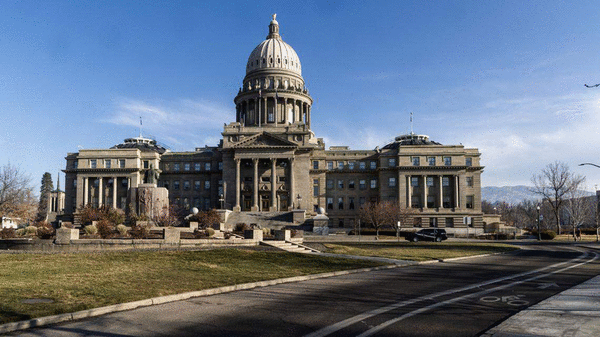
Idaho lawmakers could add more accountability measures for virtual public schools across the state after a report last year found gaps in oversight that led to families using public funds for costs such as Disney+ subscriptions and trampoline parks.
The bill, sponsored by a bipartisan group of lawmakers, seeks to fix some of the concerns identified in the report.
“This bill will provide clarity, transparency and accountability to the processes that virtuals follow,” Rep. Douglas Pickett, R-Oakley, one of the sponsors of the bill, told lawmakers Wednesday in the House Education committee.
The bill would require virtual schools to ensure contracts with education service providers — which some work with to provide curriculum and other resources — are approved by a board. Under the bill, curricular materials also would have to meet state content standards and teachers would be required to hold a certificate.
The bill also provides more accountability around the use of supplemental learning funds, which some of Idaho’s virtual schools pay to families each year to help them buy enrichment materials and other learning resources, such as technology, art and science supplies and books. The report released last year from the Office of Performance Evaluations found the money’s use wasn’t addressed in state law, which led to inconsistencies and ambiguity on what it can be used for.
Under the bill, virtual schools and education service providers would be barred from paying state funds directly to parents of enrolled students and the funds would need to be spent through direct order by the school — except in certain situations.
The bill includes a short list of eligible expenses, such as computer hardware, internet access, textbooks, testing fees, therapies and other expenses and services approved by the State Board of Education. The bill directs the Board of Education to come up with rules relating to supplemental learning funds, including a list of eligible educational expenses.
Bill comes after report raised concerns
After OPE released its report on virtual schools — and specifically, the Idaho Home Learning Academy, Idaho’s largest virtual charter school — state officials raised concerns about the use of supplemental learning funds.
During the 2024-25 school year, families at Idaho Home Learning Academy received more than $12 million in taxpayer money for supplemental learning funds, the OPE report said. Other virtual schools across the state also offer families supplemental learning funds of varying amounts, according to the report.
During his State of the State address last month, Gov. Brad Little proposed cutting millions of dollars for supplemental learning funds.
The governor’s budget recommendation cited the OPE report and said it found “inefficiencies” in the virtual public school funding model. It called for a $23 million cut “while strengthening accountability and long-term sustainability.” The proposal eliminates the supplemental learning funds for all online schools across the state — about $20 million — and nixes about $3 million in transportation funding for virtual schools.
Parents surveyed in the OPE report said the supplemental learning funds have been a major driver in their decision to enroll in the virtual academy, and more than 70% said they would disenroll if the money went away.
The bill proposed Wednesday does not address the funding model for virtual schools. Public schools in Idaho receive funding largely based on average daily attendance, but virtual schools have more flexibility around how to calculate attendance. The Idaho Home Learning Academy, for example, requires students to submit at least one assignment for each of their classes per week and to check in with their teacher every other week to be counted as present for a two-week period. The report identified this as “a much lower threshold” than the requirements for a brick-and-mortar school.
State Superintendent Debbie Critchfield in her response to the report said it highlighted the need to modernize the state’s funding formula. Over the past decade, lawmakers have made efforts to rewrite the state’s 30-year-old education funding formula, but have not agreed upon a way to do it.
Virtual schools have grown increasingly popular in Idaho in recent years. The Idaho Home Learning Academy launched about 10 years ago with around 250 students and has climbed to nearly 8,000 students.
_____
©2026 The Idaho Statesman. Visit idahostatesman.com. Distributed by Tribune Content Agency, LLC.






Comments