Homan says 700 agents will leave Minnesota, eyes end of Operation Metro Surge
Published in News & Features
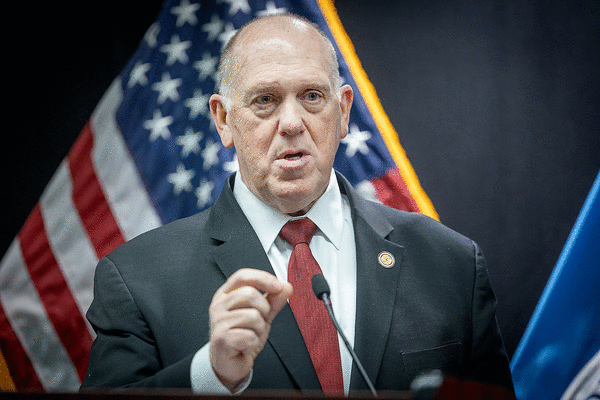
MINNEAPOLIS — White House border czar Tom Homan said Wednesday that after getting “unprecedented” cooperation from Minnesota political and law enforcement leaders, the Trump administration is withdrawing 700 federal law enforcement personnel from the state “effective today.”
Homan then said that if Minnesotans want to end Operation Metro Surge and see the other 2,000 agents who remain in the state leave, activists must stop “impeding” Immigration and Customs Enforcement and Customs and Border Protection agents from doing their job.
“Protest, but stop impeding,” Homan said. “Because we will arrest you.”
“I will not let our officers be put at risk,” Homan added.
The shift in focus to protesters as the primary impediment to the end of Operation Metro Surge came a week after Homan said the primary hurdle was access to county jails.
Homan said the removal of the 700 agents was a direct result of Minnesota counties giving federal officers better access to county jails. It was unclear whether jails, including the Hennepin County jail, which the Trump administration has targeted, will actually change anything — or whether this is a political solution allowing various interests to save face while de-escalating.
Several Democratic leaders including Gov. Tim Walz, Minneapolis Mayor Jacob Frey and Minnesota Attorney General Keith Ellison welcomed the news of the reduction of agents but said as long as Operation Metro Surge remains, public safety is compromised in Minnesota.
Walz’s office called for a speedier drawdown, state-led investigations into the federal killings of Good and Pretti and “an end to this campaign of retribution.”
Still, Homan painted a picture of robust cooperation. He said of all the requests he has made of state officials to cooperate with the Trump administration — including from Walz, Frey and Ellison — he has yet to hear them answer, “No.”
“I’m actually amazed at the cooperation and agreements we have already talked about,” Homan said. “And the willingness to work with us.”
Homan said if cooperation continues, his plan is to pull out all additional federal agents from Minnesota and return to the “normal operational footprint” of 150 border patrol agents who are permanently stationed here.
As protesters chanted, held signs and blew whistles outside the Whipple Federal Building on Wednesday morning, Homan spoke inside about how the drawdown now rested on the shoulders of Minnesota’s citizens. He said that in the past month 158 people have been arrested for assaulting, impeding or interfering with federal officers and several have been prosecuted, including nine people for their role in an anti-ICE demonstration in a St. Paul church service Jan. 18.
He pointed to roadblocks erected in Minneapolis last weekend as part of the problem. The barricades on Cedar Avenue in south Minneapolis were ultimately cleared by a Minneapolis Public Works team with the help of Minneapolis police.
“You’re not going to stop ICE, you’re not going to stop Border Patrol,” Homan said. “The only thing you’re doing is irritating your community.”
Rosie Averritt, an organizer of the barricades, said they were meant to slow traffic so citizens could track ICE officers.
“Basically, the point is to check if a vehicle looks like it might be an ICE vehicle, and we check it out,” she said. “Usually it’s not too hard to see when it’s ICE.”
Homan didn’t entirely absolve the federal government for its role in escalating tensions on the streets, where citizens have documented federal agents smashing out car windows, threatening observers and pepper-spraying detainees at close range. On top of that, numerous law enforcement officials have said that racial profiling and indiscriminate immigration enforcement has taken place — including against off-duty police.
While labeling Operation Metro Surge a “great operation” and praising its officers for initiating deportation proceedings against illegal immigrants with serious criminal histories, Homan added, “Was it a perfect operation? No. No.”
Nothing ignited that resistance more than the killings of Renee Good and Alex Pretti — the two 37-year-old Minnesota residents who were shot and killed by federal agents last month while protesting immigration enforcement.
The Minnesota Star Tribune reported on Feb. 3 that Homan and James Stuart, the executive director of the Minnesota Sheriffs’ Association, have been negotiating a deal for county jails to cooperate with federal immigration officials.
“I will confirm that what you’re talking about is spot-on,” Stuart said in an interview. “We do think that it is a very viable solution to close some of the gaps. If we can find individuals who have committed crimes, if we’re able to have a secure and safe custody transfer rather than doing it on the streets, to us it seems like common sense.”
Documents obtained by the Star Tribune show the general terms and conditions of what is known as a basic ordering agreement, or BOA. It states that county jails would provide ICE with “reasonable access to all detainees or inmates” for the purpose of interviews related to immigration enforcement.
The Minnesota Sheriffs’ Association, the Minnesota County Attorneys Association and Homan met on Monday, Feb. 2, to discuss a legal framework that would allow county jails to hold immigration enforcement targets for up to 48 hours after their scheduled releases from state custody.
That wording might seem innocuous, but it would undercut what has been the state’s practice during the second Trump administration. And it’s certain to alarm activists and attorneys opposed to the immigration crackdown.
Stuart, a former Anoka County sheriff awaiting Senate confirmation as President Donald Trump’s nominee for U.S. Marshal in Minnesota, said that if the county jails can help in Operation Metro Surge, he doesn’t see a reason not to cooperate.
“If there is a desire for a drawdown, honestly, I would be perplexed as to why anyone would be objecting to us trying to find a solution,” Stuart said. “I think this is a very workable solution.”
Hennepin County Attorney Mary Moriarty said in a statement Wednesday that the BOA is a direct violation of state law and the idea that the federal government would “offer to pay county sheriffs to violate state law is outrageous.”
Homan did not specify if counties have already signed on to agreements to cooperate with federal immigration officials. When asked if the Hennepin and Ramsey county jails — among the state’s largest — were part of a new cooperation agreement, Homan said, “There are only a few we are still in consultation with, but this is unprecedented cooperation.”
The Hennepin County Sheriff’s Office said Wednesday that it hasn’t changed any policies around immigration enforcement.
From January through October 2025, about a third of ICE arrests in Minnesota came from people already in custody, with county jails providing the largest amount, according to figures from the Deportation Data Project analyzed by the Star Tribune.
Yet, since Operation Metro Surge began in December, Trump administration officials have used county and state jails as a proxy for arguments that so-called sanctuary policies were impeding their ability to enforce federal immigration laws.
The claim was refuted loudly by state corrections officials, who went so far as to launch a website called “Combatting DHS Misinformation,” but the importance of county jails has flown largely under the radar of public discourse.
Homan said any new agreement between the federal government and the counties are not breaking any laws and that his goal is to “end this surge, as soon as we can.”
While sheriffs across Minnesota have denied that they have ever impeded ICE from accessing immigration targets, Homan said that greater access to the jails mixed with a dwindling list of immigration targets and the streamlining of operations is what’s leading to the need for fewer federal agents in Minnesota.
He said jail access means only one or two officers are needed to detain a target of immigration enforcement “rather than eight or 10 officers going into the community.”
“This is smart law enforcement, not less law enforcement,” Homan said.
_____
(Jeff Hargarten of the Minnesota Star Tribune contributed to this story.)
_____
©2026 The Minnesota Star Tribune. Visit startribune.com. Distributed by Tribune Content Agency, LLC






Comments