US jet shoots down Iranian drone near carrier in Arabian Sea
Published in News & Features
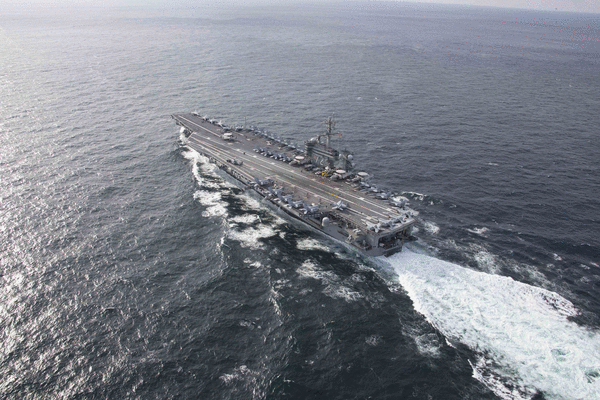
WASHINGTON — The U.S. Navy shot down an Iranian drone headed toward a U.S. aircraft carrier in the Arabian Sea, spooking oil markets amid heightened tensions between Washington and Tehran.
A U.S. F-35C warplane shot down the drone in self-defense as the unmanned aircraft “aggressively approached” the USS Abraham Lincoln with “unclear intent,” U.S. Central Command said in a statement on Tuesday. No American service members were harmed and no U.S. equipment was damaged, CentCom said.
Oil prices spiked to a session-high on the report as investors weighed the risk of a broader escalation in the Middle East, which provides about a third of the world’s crude. Prices pared some of those gains after White House Press Secretary Karoline Leavitt confirmed that U.S.-Iran talks involving Trump’s Middle East envoy Steve Witkoff are still scheduled for Friday.
“As for the president, he remains committed to always pursuing diplomacy first, but in order for diplomacy to work, of course, it takes two to tango,” she said on Fox News, adding that meetings later this week “are still scheduled as of right now, but of course, the president has always a range of options on the table — and that includes the use of military force.”
The drone incident caps weeks of heightened tensions between the U.S. and Iran, with President Donald Trump threatening airstrikes over Tehran’s violent crackdown on Iranian protesters. Trump then repeatedly cited a U.S. Navy “armada” approaching the Middle East as leverage to force Iran to curb its nuclear program in a new round of negotiations.
The shot-down drone interrupts a flurry of diplomatic activity in recent days after Trump on Monday signaled there could be a new nuclear deal, while warning that “bad things would happen” if talks don’t yield anything.
Iranian Foreign Minister Abbas Araghchi has said the Islamic Republic is ready for diplomacy but urged restraint in “threats, intimidation or pressure” from the U.S.
The move came just hours after an oil tanker that’s part of a U.S.-military fuel procurement program was hailed by small armed ships in the Strait of Hormuz off Iran’s coast, underscoring renewed risks to maritime traffic in the region.
“These moves risk pushing President Trump off the diplomatic path and back toward a military option,” said Becca Wasser, defense lead for Bloomberg Economics. “That’s a dangerous play at a time when the U.S. has amassed significant firepower in the Middle East.”
The incident also follows a warning last week from CentCom, which warned Iran against overflying U.S. vessels or training weapons at American forces. In that Friday evening statement, the command acknowledged Iran’s right to conduct a live-fire naval exercise in the Strait of Hormuz, but also urged the Islamic Revolutionary Guard Corps to do so “in a manner that is safe, professional and avoids unnecessary risk to freedom of navigation for international maritime traffic.”
CentCom reported a separate incident hours after the drone was shot down on Tuesday, alleging Iran’s Islamic Revolutionary Guard Corps “harassed” a U.S. merchant vessel transiting in international waters in the Strait of Hormuz. Two IRGC boats and a drone approached the U.S. vessel “at high speeds and threatened to board and seize the tanker” before a U.S. guided-missile destroyer in the area escorted the U.S. vessel to safety, CentCom reported.
“Continued Iranian harassment and threats in international waters and airspace will not be tolerated,” according to Tuesday’s statement. “Iran’s unnecessary aggression near U.S. forces, regional partners and commercial vessels increases risks of collision, miscalculation, and regional destabilization.”
-------
—With assistance from Jen Judson.
©2026 Bloomberg L.P. Visit bloomberg.com. Distributed by Tribune Content Agency, LLC.






Comments