Maryland House passes midcycle redistricting map; legislative clash looms
Published in News & Features
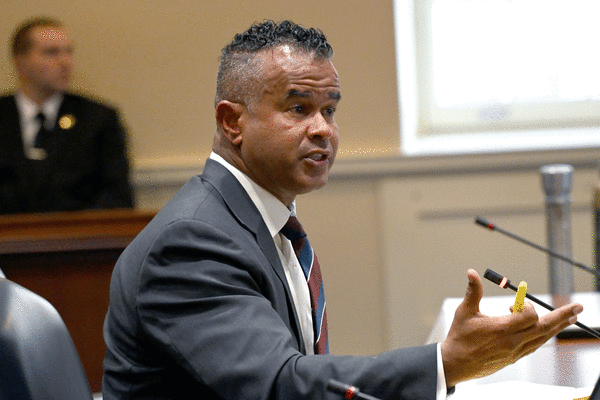
BALTIMORE — In a 99-37 vote Monday, the Maryland House of Delegates passed House Bill 488, fast-tracking a new congressional redistricting map to the Senate and setting the stage for a potential clash between Senate President Bill Ferguson and Gov. Wes Moore.
The bill, sponsored by Charles County Delegate C.T. Wilson, a Democrat, would implement new congressional boundaries recently recommended by Moore’s Redistricting Advisory Committee. The map would significantly reshape the 1st and 3rd congressional districts and could put Rep. Andy Harris, the state’s lone Republican member of Congress, at a substantial electoral disadvantage.
The House vote came days after the Rules and Executive Nominations Committee advanced the bill following testimony from Moore, who has strongly backed the proposal, and about 400 Marylanders who testified either in person or virtually.
Following the vote, Moore applauded the House for passing the map.
“What we’re seeing unfold in Minneapolis is a reminder that when a federal administration pushes the bounds of its power, the country needs a real check — and Congress must be able to serve that role,” Moore said in a statement Monday night. “Now it’s time for the Maryland State Senate to do what Marylanders expect and democracy demands: take up this map, debate it, improve it if needed — and vote.”
Moore and Wilson have framed the midcycle redistricting effort as a necessary response to President Donald Trump’s policies and redistricting efforts in other states, arguing the proposal is aimed at protecting minority voices and keeping Maryland competitive at the federal level.
“This is not about getting eight Democrats,” Wilson said during the final floor debate Monday. “It’s about getting eight members of Congress — Republican or Democrat — willing to stand up against this poorly veiled autocratic kleptocracy and fight for this state, because that’s what the majority of Marylanders want.”
The legislation has now been heard three times on the House floor, where Republicans mounted sustained opposition, offering multiple amendments. None secured the two-thirds majority required under Maryland law.
Among them was an amendment offered by House Minority Leader Jason Buckel, which Republicans described as a safeguard against what they characterized as unfair, mid-cycle redistricting. The proposal — portions of which were introduced separately as House Bill 482 — would have required lawmakers to prioritize contiguous districts, natural boundaries, and shared communities of interest when drawing congressional lines. It failed last Wednesday by a 39-vote margin.
“The maps didn’t shock me. I knew,” Buckel said Monday. “I knew you wanted to rig the game to make sure you win. But not only do you want to do that, you want to take a position that the standards that apply to each and every one of you don’t apply to Congress.” He accused Democrats of attempting to eliminate long-standing redistricting principles, adding, “You’re smart enough to know that if you impose those standards on the map you want to push, it won’t work.”
Partisan fight spills across chamber lines
All three debates featured heated exchanges across party lines, echoing arguments raised earlier in committee. Republicans accused Democrats of advancing the map for partisan reasons rather than voter protection, frequently pointing to comparisons with Republican-led redistricting efforts in states such as Texas.
“Mid-cycle partisan redistricting is a terrible idea, no matter who does it,” Buckel said Monday. “Period, full stop. Quote me all you want — tell the folks in Texas, tell the folks in Missouri, tell the folks in California, too. It’s a bad idea.”
Other Republicans echoed that criticism. Delegate Lauren Arikan said the legislation contradicts Democrats’ stated reasoning. “You’re passing a bill claiming you don’t care about what anybody else is doing, even though this entire bill is based on what somebody else in another state is doing,” she said. “At the end of the day, the people are going to pay here.”
Del. Jesse Pippy took aim at comparisons to Texas, saying, “I’m going to quote Queen Bey(oncé): This ain’t Texas. I am tired of hearing about other states. You don’t like what other states do, so you do the same thing here. Is that what we’re doing now? Is that the argument?” He added that Maryland Democrats have long benefited from favorable district lines, saying, “News flash, you’ve been doing it already ... for 30 years you’ve been gerrymandering Republican voices out of this state.”
Top Maryland Democrats have repeatedly rejected that characterization, insisting the proposal is rooted in protecting voting rights and minimizing legal risk. Delegate David Moon said his support for mid-decade redistricting predates the governor’s involvement. “This is not about the governor’s motivations,” Moon said. “I’ve been calling for mid-decade redistricting for months — well before the governor did.”
Like many Democrats Monday, Moon framed the proposal as a response to actions taken by larger states. “What we were having is a situation of a small state being bullied by a large state, Texas,” he said. “Asking only Maryland to stand down is a preposterous situation when we know Texas is going to do this again.”
Delegate Melissa Wells also defended the measure, tying it to broader concerns about federal power. “This chamber exists to be the people’s voice — to push back when power is exercised without regard for real-world consequences,” she said, arguing the federal government has deprioritized Maryland’s workforce. “Maryland cannot afford to be passive ... Redistricting is part of that response. It is how we strengthen representation and protect the people’s branch of government.”
In addition to offering amendments, House Republicans attempted to slow the bill’s progress by invoking House Rule 53, which allows any member — with the support of at least four others — to delay consideration of a bill or amendment for one day during the first 65 days of the session. After day 65, the delay is limited to one hour and may be challenged.
With the legislation now headed to the Senate, House Republicans are increasingly looking to Senate President Bill Ferguson — a Baltimore City Democrat, who has openly questioned the timing and legality of mid-decade redistricting — as their last viable chance to halt the proposal.
Ferguson has repeatedly expressed skepticism about reopening congressional maps so soon after Maryland’s last redistricting cycle, which resulted in a court-ordered redraw after a judge struck down a Democratic-backed map as an unconstitutional partisan gerrymander.
“We believe it is best to take the option that provides the strongest protection against federal intervention,” Ferguson told reporters Friday, emphasizing that the Senate must prioritize passing a balanced budget, improving affordability, and growing the state’s economy.
While Ferguson has stopped short of explicitly committing to block the bill, he has said his position on mid-cycle redistricting will not change this session and has suggested the Senate is largely united. Buckel told The Sun he does not anticipate the bill advancing further in the legislative process once it reaches the upper chamber.
_____
©2026 Baltimore Sun. Visit baltimoresun.com. Distributed by Tribune Content Agency, LLC.





Comments