Venezuelan regime to close dreaded Helicoide prison, announces amnesty bill
Published in News & Features
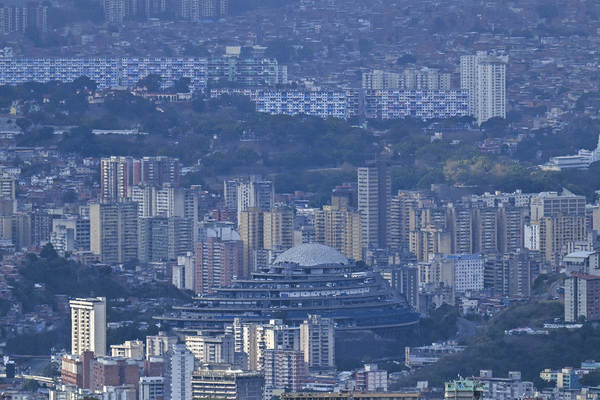
Venezuela’s acting president, Delcy Rodríguez, announced Friday that El Helicoide, one of the country’s most notorious detention centers, which became emblematic for abuse and torture, will be shut down and converted into a social and sports services center, while also confirming that a bill for a general amnesty for political prisoners will be sent to the regime-controlled National Assembly.
The announcements were made during a solemn session marking the opening of the 2026 judicial year at the Supreme Court of Justice, at an official ceremony closed to the media.
“We have decided that the facilities of El Helicoide, which today serve as a detention center, will be transformed into a social, sports, cultural and commercial center for police families and the communities surrounding this complex,” Rodríguez announced.
Previously, she had asked the National Assembly to approve the general amnesty law “to promote coexistence in Venezuela,” Rodríguez said. “I ask everyone that no one impose violence or revenge, so that we can all live with respect.”
Rodríguez said the initiative is intended to go beyond the partial releases that have taken place since early January and could benefit hundreds of political prisoners who remain incarcerated within Venezuela’s judicial system.
El Helicoide, a massive concrete structure in Caracas shaped like a three-sided pyramid, is owned by the Venezuelan state and has long been used by the Bolivarian National Intelligence Service as a detention and interrogation facility for common and political prisoners. Originally conceived in the late 1950s as an ambitious shopping mall, the project was never completed and was later repurposed by security forces.
During the administration of former strongman Nicolás Maduro, El Helicoide became one of the most emblematic symbols of political repression in Venezuela. Former detainees and human rights organizations have documented systematic torture and severe abuses inside the facility, including beatings, electric shocks, suspension by limbs, prolonged stress positions and other degrading treatment.
Rodríguez did not provide a timeline for the closure or conversion of the site, but said the government was committed to transforming it into a space for community use and to combating corruption within the justice system.
Her remarks came as non-governmental organizations reported additional releases of political prisoners. The human rights group Foro Penal said Friday that Arturo Gallino Rullier, who holds U.S. and Peruvian nationalities, had been released from detention and was traveling to the United States.
Foro Penal’s president, Alfredo Romero, said Gallino was detained on Nov. 29, 2025, and held at El Rodeo I prison in Miranda state, north of Caracas.
As of Thursday, Foro Penal had confirmed the release of 302 political prisoners since Jan. 8, when authorities announced the liberation of an unspecified “significant number” of detainees, days after a U.S. military operation captured Maduro and his wife, Cilia Flores. The government, however, says more than 600 prisoners have been freed during the same period.
Other human rights organizations stress that most of those released do not enjoy full freedom. Martha Tineo, coordinator of the group Justice, Encounter and Forgiveness, told the EFE news agency this week that former detainees remain subject to alternative measures, including bans on leaving the country, restrictions on speaking to the media and mandatory periodic court appearances.
This week, Interior Minister Diosdado Cabello said that 808 people had been freed since “before December,” without providing dates, while denying that Venezuela holds political prisoners.
According to Rodríguez, the proposed amnesty law would erase criminal cases and convictions for those covered, making it a broader measure than the releases carried out so far. She said the law would exclude individuals convicted of homicide, drug trafficking and common crimes.
The interim president said the decision had been discussed in advance with Maduro before his capture, and stressed that the aim is to foster “respect and peace” in Venezuelan society.
Following Maduro’s apprehension by U.S. forces, the socialist government under Rodríguez has taken steps — though often slowly — to align with a Washington-backed stabilization plan aimed at reviving Venezuela’s economy and political system. Those measures include the release of hundreds of political prisoners and preparations to allow U.S. companies to reenter Venezuela’s oil sector with fewer restrictions.
For years, the ruling socialist movement has used political prisoners as a bargaining tool, amid a pattern of arbitrary detentions, partial releases and prisoner exchanges tied to political negotiations. Human-rights organizations have warned that new arrests continue even as some detainees are freed.
The announcements come amid heightened political tension following Maduro’s capture and ongoing domestic and international negotiations over Venezuela’s institutional future.
©2026 Miami Herald. Visit miamiherald.com. Distributed by Tribune Content Agency, LLC.






Comments