As Obama center opening approaches, foundation is touting short-term rentals
Published in News & Features
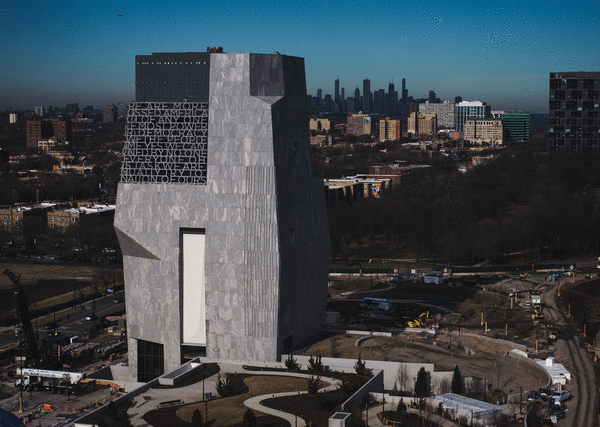
As former President Barack Obama’s namesake foundation prepares to roll out the welcome mat to huge crowds of tourists flocking to the South Side when the Obama Presidential Center opens its doors in a few months, it is promoting Airbnb, a company with close ties to the Obama family that has faced international protests for its impact on local rents and housing supply.
“(We’re) committed to making sure that South Side residents and entrepreneurs are ready to take full advantage of this influx of new visitors,” Valerie Jarrett, CEO of the Obama Foundation, said in a December release announcing a series of community tourism prep sessions.
But for residents and organizers who have fretted about gentrification in Woodlawn and South Shore and pressed for housing protections since Obama announced Jackson Park as the site of his museum in 2016, the Obama organization pitching more short-term rentals as a good way to deal with tourism adds to their conviction that the center will exacerbate housing shortages and raise rents.
Ald. Desmon Yancy, 5th, worries about a future in which large numbers of short-term rentals become part of the landscape near the Obama center. He said he’s already seen outside investors snap up units in buildings where condo associations have dissolved.
If landlords and investors see so-called home sharing as more lucrative than renting, “it could make the community more transient, because you’ll have folks who’ll be seeking this additional income and, probably because property taxes are so high, they need the money,” Yancy said. The most recent round of residential bills went up 49% in Woodlawn compared with the year before, and 36% in South Shore.
“We already know there’s a shortage of stock. We know it exists on the South Side, and South Shore and Woodlawn are ground zero for what used to be affordable and now isn’t,” Yancy said, a phenomenon he doesn’t blame on the presidential center alone.
Obama center boosters and current short-term rental hosts say the concerns are overblown. New hosts will not only get to make some side money from a spare room or empty apartment unit, but also show off the positives of the South Side to new visitors. They anticipate the market to stay will be relatively small, and unlike more crowded and built-up tourist hot spots, Woodlawn and South Shore have plenty of vacant space and renovation-ready units for fresh development, they say.
As part of the series of prep sessions that kicked off this month, the foundation announced in December it would host training sessions to help “local residents earn extra income by sharing their homes with Obama Presidential Center visitors,” in partnership with Airbnb. The next session is Feb. 18.
The company — and tourists generally — have been the target of protests by locals with complaints about affordability impacts in Mexico City, Madrid and Amsterdam. Hosts booking with short-term tourists instead of renting to locals limits the supply of units, pushing up demand and in turn, rental costs.
A 2019 Harvard study found “a 1% increase in Airbnb listings is causally associated with a 0.018% increase in rental rates and a 0.026% increase in house prices,” with steeper impacts in neighborhoods with fewer owner-occupied homes.
Woodlawn and South Shore are only 25% owner-occupied, according to the DePaul University Institute for Housing Studies, lower than the city’s overall 45%.
Airbnb has argued it’s been scapegoated, that hotels are helping drive overtourism but Airbnb bears the brunt of criticism.
In Chicago, the complaints haven’t been limited to cost, but also go to quality of life.
Aldermen representing Lincoln Park and other lakefront neighborhoods have complained off and on for years that investors operating short-term rentals turned swaths of their wards into ad hoc hotel districts packed with partying tourists heading to Cubs games in the summer months and veritable ghost towns in the winter.
The city has passed a slew of regulations: no single-night stays, caps on the number of short-term rentals in multiunit buildings, and dedicated city taxes that fund services for homeless people. Entire buildings can also move to bar short-term stays. Even so, some aldermen have pushed for precinct-by-precinct bans.
The leader of the Obama Foundation’s partner organization, the Emerald South Economic Development Collaborative, said he’s heard nothing but enthusiasm from locals about the opportunity to open their homes and show off their favorite restaurants and businesses.
“We don’t have hotels in our community and so people that I talk to in the community are excited that this is going to be an economic development for the area,” said Ghian Foreman, Emerald South’s president and CEO. A new hotel just south of the Obama Presidential Center did win initial city sign-off last summer.
“People thinking about a spare room … people that are thinking about buying real estate and taking advantage of all of the visitors that are coming, and people who are interested in doing community tours, like they have Airbnb experiences,” Foreman said. “I’ve heard the gamut, I’ve not heard one person worried about it.”
Foundation spokeswoman Emily Bittner said in a statement that the presidential center will “not only help transform the way the world sees the South Side, but also spur investment that transforms residents’ economic opportunities.”
“We have heard from countless neighbors that they want to be able to capitalize on the opening of the center, and look forward to partnering with them,” Bittner’s statement said.
Robin Carter, an Airbnb host and landlord who is a college friend of Foreman, is one of those neighbors. She lives in Kenwood and has properties in both South Shore and Woodlawn, renting out some units and posting others on Airbnb.
“I just see the Obama center as a shining light in the community, that it’s going to provide a tremendous amount of value. I hope visitors leave not just inspired by the center but with a deeper appreciation for people, the history of the neighborhood and literally the spirit of the South Side,” she said, adding that she hopes an influx of visitors bring the same amenities that North Side lakefront communities have enjoyed for years.
With the Obama center’s arrival, Carter is considering converting her traditional rental space to Airbnb. “You can make as much as you’d make in rent in two weekends, it’s a no-brainer,” she said, citing burgeoning tax bills adding hundreds of dollars to her monthly cost.
“Tenants are great, don’t get me wrong, but sometimes tenants can be challenging, particularly those that decide they don’t want to pay you rent,” Carter said. “Because there’s so many rights for tenants, if you get in a situation where you have a less than desirable tenant it costs so much to remove people from your homes.”
Airbnb’s leaders have been longtime supporters of the Obamas. Then-President Obama tapped company co-founder Brian Chesky as part of his administration’s entrepreneurship outreach team in Cuba, and Chesky later donated $100 million to sponsor the Obama Foundation’s two-year Voyager Scholarship. Obama’s former press secretary Jay Carney is Airbnb’s global head of policy and communications.
Last May, Chesky appeared on “IMO,” the former first lady’s podcast with her brother, Craig Robinson, where Michelle Obama introduced Chesky as a “dear, dear” friend.
“If I had a son, I’d want my son to be Brian,” she said. During that interview, Chesky said he owed part of the company’s early success to Barack Obama: Airbnb’s major launch came during the 2008 convention cycle, when the company raised money by selling novelty cereal, “Obama O’s.”
Though the center isn’t set to open until June, a handful of Airbnb listers already touting proximity to the University of Chicago are also noting in their listings that the Obama center is nearby. About 50 units within a mile radius of the center are already registered on the city’s Shared Housing Portal and eligible to post on websites like Airbnb, VRBO and HomeAway.
Public city data does not make clear whether that figure is accelerating, but it does show dozens of entire buildings have opted out. About 35 buildings in the same mile radius have also prohibited residents from listing their condos or apartments on short-term lodging platforms, keeping hundreds of units off the apps.
Yancy said others are operating in a gray area and offering their places up on Peerspace, which is designed for hourly bookings for photo shoots, events or parties.
Rebecca Braithwaite, 77, has been listing a room on Airbnb for 11 years, after her daughter left for New York City.
She’s a superhost with a nearly perfect rating. At her current rate, a four-night stay over the weekend of June 19 would run a guest $685.
Of all the shared units listed on the city’s registry, Braithwaite’s is the closest to Obama’s towering museum. The vast majority of her guests over the years have been parents visiting children or attending a conference at the University of Chicago. Some wedding guests have booked with her because her home is halfway between Rockefeller Chapel on campus and the Museum of Science and Industry, where receptions are sometimes hosted, Braithwaite said.
“I don’t get a lot of tourists. Up until now no one wanted to pay to be close” to the MSI, she said. She doesn’t expect a flood of visitors, but noted presidential centers can be draws for history buffs. “I imagine in the beginning people will want to go to the Obama center. For the summer I’ll probably be booked up.”
Braithwaite has one request for Obama Foundation officials: “I only wish they would put the dates out there, because university graduation is the first weekend in June.”
_____
©2026 Chicago Tribune. Visit chicagotribune.com. Distributed by Tribune Content Agency, LLC.






Comments