Petition urges Orlando to protect Lake Eola swans as city says it's 'reevaluating' program
Published in News & Features
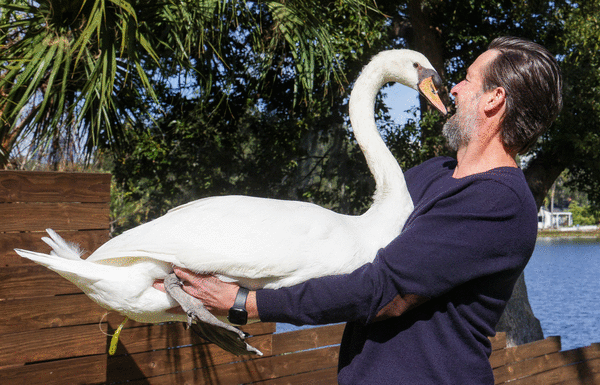
ORLANDO, Fla. — Andrew Marshall has ruffled some feathers in his volunteer role caring for Lake Eola’s swans. Now, following the deaths of dozens of those swans over the past month, he’s demanding more be done to protect them.
A petition he started after an avian flu outbreak erupted in late December urges the city to create a full advisory board to monitor the birds’ health, as well as to conduct more testing, clean up the water, and reduce litter. He also wants to make sure baby cygnets can’t be trapped in the lake, with no good way to get on land.
“There’s no direct oversight for the swans themselves,” said Marshall, who has headed the Lake Eola Swan Docent Program for the past five years. “The swans are iconic to Orlando at this point. They’re used as an economic driver as well, which I think is dichotomous to the fact that there’s not a single person or a team that watches out for them.”
So far, 37 birds have died at the lake from the highly transmissible virus, including 29 mute swans. Of those, 25 were owned by the city, and four others were transients that flew into the park at some point.
The avian flu virus has no vaccine, and experts consulted by the city and others interviewed by The Orlando Sentinel say the best practice is to allow the disease to run its course, with the thought that surviving birds would develop immunity.
But there’s also concern the virus may be spreading beyond Eola.
A Pekin duck was found dead at Lake Davis this week and tested positive in a necropsy, Marshall said. The city sent a news release urging caution for residents who frequent that lake, located less than a mile south of Eola and one of the city’s most scenic water basins.
About 975 avian flu infections have been reported in Florida since 2022, when the disease was reintroduced to the U.S., with 58 coming in Orange County, a state database shows. However, only birds that receive a necropsy are recorded. For example, just three from Lake Eola’s most recent outbreak are counted.
Marshall said he stopped going to Eola in early January, out of fear he could bring the virus to his home on Lake Copeland, where he has transformed his own property into a haven for his two swans, Lola and Angel.
On a recent afternoon, the pair of mutes roamed the tiered backyard. Nearby, a mating pair of wild swans that live on the lake peered over the fence. Lola and Angel have access to a sliver of the lake south of downtown, which is fenced-off from the wild fowl.
Lola, a roughly 5-year-old mute swan, was rescued from Lake Eola, where she was rejected by her mother as a cygnet before being rescued by park rangers. Despite their efforts to reunite her with her siblings on the lake, she was rejected and bullied, and eventually taken in by Marshall and his wife, PJ.
Angel, about 2 years old, had developed a condition called Angel Wing Syndrome as a cygnet, which prevents a swan from flying. The Marshalls rescued her from Lake Copeland so she wouldn’t be harmed by her parents, a mating pair of swans who still live there.
Despite the smaller flock now at Lake Eola, reduced to just more than 40 from a high of 80 in recent years, Marshall said the city shouldn’t purchase more birds to replenish it. Instead, he said, it should improve conditions for the ones that remain. But Marshall said he questions whether a swan program can be sustainable into the future.
“I think it’s possible, but there are many municipalities that have had this and stopped the program because it’s not sustainable,” he said. “Is it sustainable? Potentially, with an extreme amount of change in their environment and their care.”
City officials say the recent outbreak – the second in three years – has prompted a review of its swan program, taking into consideration the critiques outlined in Marshall’s petition, which has garnered about 2,000 signatures.
“The city and its staff are saddened by the tragic loss of swans at Lake Eola, and in response, are actively reevaluating the Lake Eola Swan Program to ensure the highest standards of care for the city’s beloved swans and identify opportunities to strengthen best practices,” said Ashley Papagni, a city spokesperson.
Orlando has veterinarians who advise officials on the swans when asked and conduct annual health checkups, though they aren’t full-time with the city. The Florida Fish and Wildlife Conservation Commission is also consulted on the program, she said.
Marshall’s petition pitches an advisory board comprised of a volunteer, a vet and staff members from relevant city departments, which would meet quarterly at the park to review the conditions.
It also calls for more thorough testing of the water. Marshall said at least one previous necropsy had revealed elevated levels of copper, which he suspects could have seeped into the soil beneath the water and then was consumed by the birds, which feed on underwater vegetation.
The lake also needs more places for cygnets to get out of the water to rest or to escape territorial disputes, Marshall said. Because of the high sea wall, they often are confined to the water, where the feeders are only in one portion of the lake and are placed too high for some babies to eat consistently.
“As part of the review, we are evaluating the feeding process and swan access through natural inclines created with tree branches, while assessing the evolving needs of the swans,” Papagni said.
She said parks staff removes trash and debris from the park daily, and the water is tested quarterly by environmental specialists and monthly by the University of Florida’s LAKEWATCH volunteers. Testing results are available online through Orange County’s Water Atlas.
Swans have lived on Lake Eola, a water-filled sinkhole, for more than 100 years. But Orlando only implemented a care program about 15 years ago, said City Commissioner Patty Sheehan, whose district includes the park.
She said the city intends to “hear out” Marshall and other advocates at Monday’s City Council meeting and decide how to move forward.
©2026 Orlando Sentinel. Visit orlandosentinel.com. Distributed by Tribune Content Agency, LLC.






Comments