Delcy Rodriguez denies report she betrayed Maduro, telling US he had to go
Published in News & Features
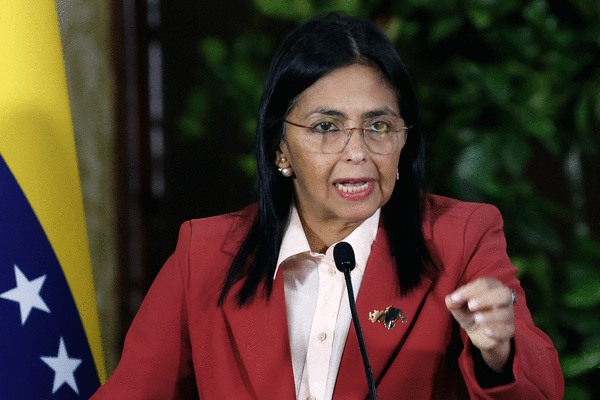
The Venezuelan regime is rejecting as “fake” a report by the British newspaper The Guardian that reported that acting President Delcy Rodríguez had privately pledged cooperation to the Trump administration ahead of the U.S. military operation that captured strongman Nicolás Maduro earlier this month.
On the official X account of Miraflores, the presidential palace, authorities posted late on Thursday an image of The Guardian’s headline stamped with a red label reading “fake,” without offering further details or addressing the substance of the report.
The Guardian article, published this week, cited four sources involved at high levels in the discussions who said Rodríguez and her brother, National Assembly President Jorge Rodríguez, had secretly assured U.S. and Qatari officials through intermediaries that they would cooperate with Washington once Maduro was removed from power.
According to the newspaper, the Rodríguez siblings did not actively assist the U.S. military operation carried out on Jan. 3, but signaled in advance that they would “welcome Maduro’s departure” and help manage the political aftermath.
The sources emphasized that the assurances stopped short of direct participation in what they described as a U.S.-led raid, drawing a distinction between post-operation cooperation and active involvement in Maduro’s capture.
Rodríguez, who was sworn in as acting president on Jan. 5 — two days after Maduro’s capture — had served as vice president throughout much of his tenure and was among his closest allies. Her elevation followed a ruling by the Constitutional Chamber of Venezuela’s Supreme Tribunal of Justice.
The Guardian reported that communications between Rodríguez and U.S. officials began in the fall and continued after a phone call in late November between President Donald Trump and Maduro, during which Trump demanded that Maduro leave power voluntarily. Maduro rejected the demand, according to the report.
By December, one American involved in the talks told the newspaper that Rodríguez had sent a clear message to Washington. “Delcy was communicating, ‘Maduro needs to go,’” the source said. Another person familiar with the messages quoted Rodríguez as saying, “I’ll work with whatever is the aftermath.”
The newspaper said Qatari officials played a role as intermediaries in the discussions, citing Rodríguez’s close personal ties with Qatar’s ruling family. Qatar, a key U.S. ally, used its access in Washington to facilitate discreet negotiations, according to two of the sources cited.
The Guardian also reported that Secretary of State and National Security Adviser Marco Rubio, initially skeptical about engaging with senior figures from Maduro’s inner circle, came to see Rodríguez’s assurances as a potential way to prevent instability following Maduro’s removal.
Reuters reported separately on Sunday that Interior Minister Diosdado Cabello, who oversees Venezuela’s police and security forces, had also been in discussions with U.S. officials months before the operation, highlighting the breadth of contacts between Washington and senior figures in the Maduro-era leadership.
The Venezuelan regime did not respond to emailed questions from The Guardian regarding its reporting. The White House also did not respond to detailed questions, according to the newspaper.
The Guardian noted that the alleged back-channel communications unfolded alongside formal talks between U.S. officials and Maduro’s representatives. Maduro himself met with Richard Grenell, a senior Trump adviser, less than two weeks after Trump’s inauguration to discuss U.S. prisoners held in Venezuela, who were later released.
According to sources cited by the newspaper, Trump administration officials also held regular discussions with Delcy and Jorge Rodríguez on logistical issues such as biweekly deportation flights returning Venezuelan migrants from the United States, the destinations of those flights, the status of Venezuelans imprisoned in El Salvador, and the possible release of political detainees.
In October, The Miami Herald reported on abortive negotiations — also involving Qatar — in which Rodríguez proposed leading a transitional government if Maduro agreed to step aside and retire to a prearranged safe haven. Rodríguez publicly denounced that report at the time, but the Guardian said some U.S. officials came to view her as more pragmatic than previously assumed.
The British newspaper portrayed Rodríguez as a complex figure with personal quirks and an ability to build rapport, citing sources who described her interest in champagne, table tennis and informal interactions with foreign dignitaries. Several sources told the Guardian that her openness to working with U.S. oil companies and her familiarity with American energy executives made her an attractive alternative for Washington.
“Delcy is the most committed to working with U.S. oil,” one ally told the newspaper.
The Guardian also reported that Mauricio Claver-Carone, a former Trump special envoy for Latin America who remains influential in Republican foreign policy circles, was a key supporter of engaging with Rodríguez. Claver-Carone declined to comment.
According to the Guardian, the Rodríguez siblings did not engage in discussions with U.S. officials behind Maduro’s back until late fall. After Maduro’s November call with Trump failed to produce an agreement, sources said it became clear that he would not step down voluntarily.
Even then, Rodríguez’s position remained cautious. “She feared him,” one official familiar with the discussions told the newspaper, emphasizing that she did not agree to actively betray Maduro.
When U.S. helicopters entered Caracas in the early hours of Jan. 3, Rodríguez was not seen publicly. Rumors circulated that she had fled to Moscow, but two sources cited by the Guardian said she was on Margarita Island, a Venezuelan resort destination.
Hours after the operation, Trump appeared to confirm that contacts with Rodríguez had taken place. He told The New York Post that she was “onboard,” adding: “We’ve spoken to her numerous times, and she understands — she understands.”
The Venezuelan regime has not publicly addressed those remarks.
The dispute over the Guardian report comes amid mounting official criticism in Venezuela over the U.S. military operation itself.
Attorney General Tarek William Saab said Thursday that the Jan. 3 operation resulted in as many as 120 deaths, including civilians and military personnel. Speaking at an event broadcast by the TV network Globovisión, Saab described the incursion as “an unprecedented event” and a “massacre” carried out “outside all legality.”
He alleged that U.S. forces used bombers, missile-armed helicopters and chemical weapons, striking residential areas and killing elderly people, women and children. Saab said the operation violated the U.S. Constitution as well as international human rights law, including conventions overseen by the United Nations, the International Court of Justice and the International Criminal Court.
“In a context far removed from what a world of peace should be, these events occurred, and that cannot be dismissed,” Saab said.
The attorney general also referred to the upcoming court appearance of Maduro and his wife, Cilia Flores, in New York in March, where both face narcoterrorism charges. Saab urged the U.S. justice system to reconsider what he described as “absolutely incoherent and implausible” accusations.
©2026 Miami Herald. Visit miamiherald.com. Distributed by Tribune Content Agency, LLC.





Comments