'This is personal': Bill to create Charlie Kirk Day in Florida generates debate
Published in News & Features
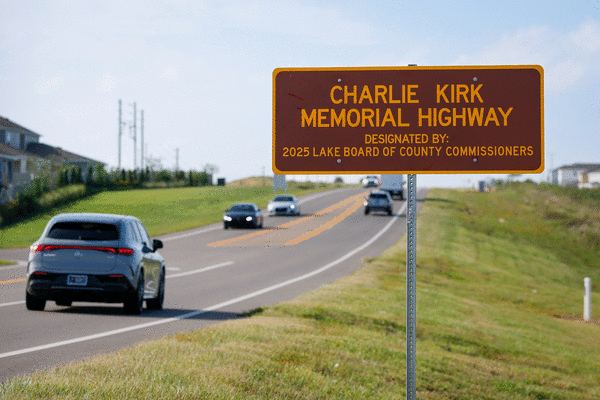
A Republican-backed bill to enshrine a “Charlie Kirk Day of Remembrance” advanced in the Florida Senate on Wednesday — but only after emotionally charged rebukes from Democrats and Black activists who condemned honoring the slain conservative leader, whom they say promoted divisive and discriminatory rhetoric.
The bill, filed by Sen. Jonathan Martin, about a month after Kirk’s September killing, passed 6-2 along party lines in the Senate Committee on Education Postsecondary. It would designate Oct. 14 — Kirk’s birthday — as a day of remembrance in Florida Statutes. If enacted, the measure would go into effect July 1.
Martin, a Lee County Republican, emphasized on Wednesday that the proposal would not create a state holiday, mandate school closures or impact local governments’ budgets. Instead, he said, it “simply recognizes contributions that shaped a generation.” He credited Kirk with promoting open debates on college campuses and helping “build a movement of young leaders who are active in promoting limited government, free speech and American values.”
The legislation is one of several Republican-led bills across Florida to memorialize Kirk, who was assassinated while speaking with students at Utah Valley University. Another proposal, sponsored by Sen. Ana Maria Rodriguez, R-Doral, would rename a stretch of Southwest 107th Avenue near Florida International University as Charlie Kirk Memorial Avenue.
Another pair of GOP-backed bills would redesignate prominent roads at Florida’s 40 public universities and colleges in Kirk’s honor. The original House version, filed by Pasco County Republican Rep. Kevin Steele, would withhold funding from schools that fail to comply within a set timeframe.
Separately, New College of Florida — led by former GOP House Speaker Richard Corcoran — plans to erect a donor-funded statue of Kirk on its Sarasota campus.
Kirk rose to prominence as the founder and face of Turning Point USA, a conservative nonprofit founded in 2012 that aims to organize right-leaning students. The organization boasts more than 2,000 high school college chapters nationwide, including roughly 100 in Florida. In the wake of Kirk’s killing, Gov. Ron DeSantis announced a partnership with Turning Point to ensure high school students could establish chapters.
Supporters argue Kirk was instrumental in reshaping conservative youth politics, frequently staging feisty campus debates around hot-button policy and culture war issues. Florida Republicans backing the memorial measures say his assassination — carried out while he was exercising his First Amendment rights on a college campus — represents a broader threat to political discourse.
Democrats and progressive activists, while almost unanimously condemning Kirk’s killing, object to memorializing a figure whose past statements included attacks on the Civil Rights Act, criticism of Martin Luther King Jr. and claims that prominent Black leaders — including Miami-raised Supreme Court Justice Ketanji Brown Jackson — only attained their positions because of affirmative action.
That divide was on full display during Wednesday’s committee hearing.
Martin, the bill’s Republican sponsor, faced pointed questions from Democratic colleagues about whether honoring Kirk in statute was appropriate given his lack of public office, his record of inflammatory statements about civil rights and Black leaders and the precedent such a designation would set for elevating partisan political figures.
Senate Minority Leader Lori Berman questioned the standards used to establish statutory days of remembrance, noting that Florida’s list includes figures like Presidents Abraham Lincoln and Ronald Reagan, as well as Confederate leaders Jefferson Davis and Robert E. Lee.
“Do you think Charlie Kirk belongs on a list with famous military personnel and a president of the United States?” Berman asked.
Martin responded that while Kirk never held public office, his influence was national in scope, citing widespread calls to memorialize him and Kirk’s heavily attended funeral as evidence of his reach. The bill, he said, “transcends (Kirk’s) views politically” and instead reflects the importance of defending public discourse.
Berman pushed back, warning that the measure could open the door to memorializing “media personalities, podcasters” and “political influencers.” She asked: “So having a well-known name like the Kardashians and a packed funeral should be qualifications for having a day of remembrance?”
Martin countered that Kirk’s assassination was an attempt not only to silence him but to intimidate an entire political movement. “We don’t have to agree with the guy,” Martin said of Kirk. “But we can agree that we can’t allow one criminal assassin to quiet public debate.”
State Sen. Shevrin Jones, D-Miami Gardens, proposed an 11th-hour amendment to also recognize George Floyd — who shares an Oct. 14 birthday with Kirk — framing the debate as one of “selective remembrance.” Jones cited Kirk’s past comments about Black women in leadership, reading aloud a 2023 remark in which Kirk suggested prominent Black women had used affirmative action to “steal a white person’s slot.”
“This is not abstract. This is personal,” Jones said, noting that he serves alongside Black women lawmakers and is Black himself. While condemning Kirk’s murder, Jones argued honoring him in statute risks legitimizing rhetoric that many Floridians find degrading and discriminatory.
Raising his voice in closing remarks, Jones said, “I hope to God y’all pray that you all look at history, and history looks at you in a way that either tells you, ‘Thank you,’ or history looks at you in a way and asks you, ‘Why, what and who were you progressing?’”
“I can tell you this: This is not progressing no one, nobody in my community,” Jones added. “This is not progressing anybody.”
Republicans on the committee defended the bill as a stand for free expression. Vice Chair Sen. Corey Simon, a Tallahassee Republican who is also Black, said Kirk’s campus appearances encouraged dialogue in places where conservative voices often felt marginalized.
“When conversations stop, bullets start,” Simon said. “I didn’t agree with everything Charlie Kirk said, but the courage to stand up and have those discussions should be commended.”
The Floyd amendment failed, and the bill advanced, setting up further debate as it moves through the Legislature. The bill now must pass through the Senate Committee on Fiscal Policy before heading to a full Senate vote. A House companion bill has yet to be moved to a committee vote.
_____
©2026 Miami Herald. Visit miamiherald.com. Distributed by Tribune Content Agency, LLC.





Comments