Should Congress limit Trump's ability to launch a military strike? Rep. Kiley's not sure
Published in News & Features
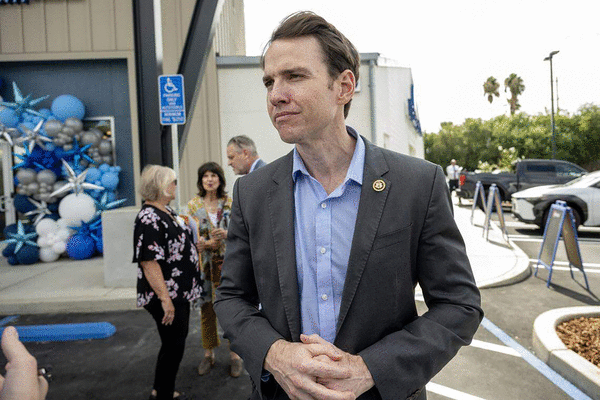
WASHINGTON — The Senate this week plans to debate an effort to limit President Donald Trump from engaging in any United States military involvement in Venezuela unless Congress agrees. Rep. Kevin Kiley’s not sure putting such limits on executive action is a good idea.
“I believe Congress needs to be centrally involved going forward when it comes to U.S. policy on Venezuela,” he said at his weekly Monday news conference.
Asked if he backed the Senate’s effort to invoke the Vietnam-era War Powers Resolution to require congressional consent for further military action in the South American country, Kiley said, “I’m looking at it.”
The Senate voted to advance the measure last week 52 to 47, with five Republicans joining 45 Democrats and two independents.
Members of both parties had questions about the military strike that resulted in the capture of deposed Venezuelan leader Nicolas Maduro and his wife, Cilia Flores, who were taken to the United States to stand trial on drug-related charges.
If the Senate bid is approved, it would go to the House, where the GOP has a tiny majority. A swing of two votes could get the effort passed, as long as all Democrats went along.
Kiley’s reelection
Kiley is in a vulnerable political position. His current congressional district, which stretches from the eastern Sacramento suburbs across the state and down to Death Valley, has been cut into six pieces by last year’s Proposition 50.
The second-term congressman, easily reelected last year in his Republican-leaning district, has not said where he will run this year.
He has been a loyal Republican with his votes, but has been highly critical lately of GOP House leadership for its handling of extending enhanced health insurance premium credits, used by consumers who buy coverage through the Affordable Care Act’s marketplace.
Kiley has been among the leaders pushing for a one or two year extension of the subsidies, which expired Dec. 31. He did, though, vote against a three-year extension last week.
The Jan. 3 U.S. strike against Venezuela poses another political challenge.
Kiley could wind up running against Rep. Ami Bera, D-Sacramento, a member of the House Foreign Affairs Committee.
“The decision to launch military strikes without congressional input, support, or authorization is deeply concerning and illegal,” Bera said. He called Maduro “an illegitimate leader who has inflicted hardship on the people of Venezuela.”
But Trump, Bera said, “has failed to present a clear and credible strategy for governance or democratic transition in Venezuela. He is drawing our nation into another open-ended conflict and risking a repeat of failed nation-building efforts.”
Limiting Trump’s power
The War Powers Resolution, which dates to 1973 after presidents escalated U.S. involvement in Vietnam, says a president can launch an attack in an emergency and notify Congress within 48 hours.
He can engage in military action for 60 days, plus a 30-day withdrawal period, unless Congress agrees otherwise.
The Trump administration has said that its strike in Venezuela was a law enforcement action. The president in a Truth Social post last week called the resolution unconstitutional and said the five Republican senators who voted to advance the measure “should never be elected to office again.”
Kiley supported ousting Maduro.
“The world is in an immeasurably better place with him no longer in power,” Kiley said of Maduro. “Certainly the people of Venezuela have the potential now to determine their own destiny, to become a democratic country, to become a prosperous country.”
But invoking the War Powers Resolution is another matter, Kiley said.
“There are a lot of questions surrounding the War Powers Act,” he said, echoing concerns that have been expressed for years by members of both parties.
“The specific use of a War Powers Resolution in this context could have the effect, if it were to actually become law, of limiting the ability of our executive branch to respond to events in real time if necessary to protect Americans,” Kiley said. “That’s certainly a major consideration. It’s a complicated issue, so I’m studying it.”
Asked how Congress could be “centrally involved” in U.S.-Venezuela policy, Kiley said it could be involved in decisions about the role of the U.S. in helping Venezuela transition to a free and democratic country. He attended briefings last week on the situation by Secretary of Defense Pete Hegseth, Secretary of State Marco Rubio and others.
Kiley said he could not discuss details since the briefings were classified.
_____
©2026 The Sacramento Bee. Visit sacbee.com. Distributed by Tribune Content Agency, LLC.





Comments