UC sets new record in California student enrollment as it weathers Trump challenges
Published in News & Features
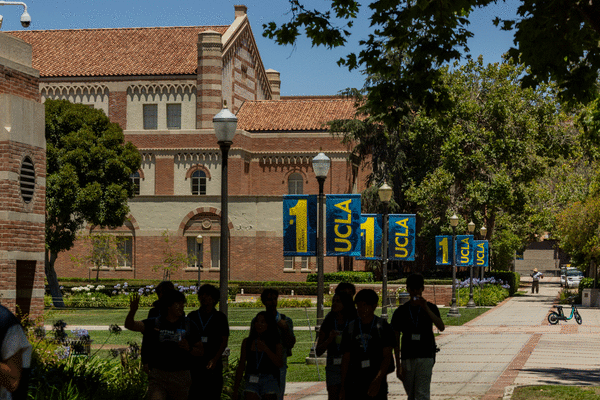
LOS ANGELES — The University of California enrolled a record number of Californians in fall 2025, according to data released Thursday, touting the vitality and popularity of a system under attack by the Trump administration and grappling with federal funding cuts and state budget belt-tightening.
More than 301,000 students attended one of UC's 10 campuses over the fall — the largest number in its history, with a year-over-year increase of 1,686 students. The total included more than 200,000 California resident undergraduates, an increase of 1,796 students.
At 42,232, first-year California undergraduates made up about 80% of the total 52,611 first-year students, representing an increase of 264 from 2024.
"These numbers reflect California's commitment to academic excellence, access, and innovation, values that have made the University of California the world's greatest research university," UC President James B. Milliken said in a statement. "The value of a UC degree is abundantly clear. An investment in UC is the best investment in the future of our students, California's workforce, and the state's economy."
Most race, gender demographics remain stable
Across the board, UC campuses largely maintained — with some small gains or dips — enrollment demographics by gender, race and residency status, including international students.
Continuing a long-term trend, new female undergraduates outnumbered men, 28,301 to 22,747. Also, more Latino, Native Hawaiian or Pacific Islander, Asian American and white first-year undergraduates enrolled than in 2024.
But there were slight decreases in Black and Native Americans among first-year students. Across the nine undergraduate campuses — the 10th campus, San Francisco, has only graduate programs — there were 2,471 new first-year Black students, compared with 2,493 in 2024. For Native American students, the figure was 319, compared with 346 a year prior.
Despite restrictions on foreign students that include a full or partial travel ban on 39 nations and increased vetting, the overall UC international student enrollment remained relatively stable. The scrutiny includes social media screenings by U.S. visa authorities that seek out pro-Palestinian content deemed antisemitic.
Overall, foreigners at all levels of study numbered 34,498, a decrease of 499. Most of that decline was among graduate students.
More international students among new undergraduates
But the number of new undergraduate internationals — including transfers — grew by roughly 21% to 7,292.
That growth is in part due to UC offering admission to more internationals because campuses were unsure of how many would enroll amid restrictions. Last year, 3,263 more first-year international students were offered seats, an increase of 17% over 2024.
When it released data in July on admission offers, UC said that the higher number reflected the "rising uncertainty of their likelihood of enrollment" and that the share of accepted international students who choose to enroll is generally "substantially lower" than that of California residents.
UC Berkeley saw the biggest jump in new internationals, from 594 to 1,282. At UCLA, the group increased by 818 to 1,006. Davis and Irvine saw slight declines.
Overall for all undergraduates, UC Riverside had the largest growth — 22,600 to 24,034.
One area of study popular with international graduate students — computer science — saw a small decline across UC. There were 5,443 graduate students enrolled in programs in 2024, compared with 5,184 in 2025.
In addition to Trump administration restrictions, UC's considerations in offering seats to more international students factored in their higher tuition costs as another potential obstacle. In 2024, the UC Board of Regents approved a 10% increase of the "nonresident" tuition fee from $34,200 to $37,602.
UC began adding more out-of-state students, who pay higher tuition, after funding cuts during the Great Recession. In recent years, under public pressure and amid state budget deals, it has steadily increased California admissions and enrollment.
"A UC degree, that has proven to pay dividends, is the gold standard for public higher education," Han Mi Yoon-Wu, UC's associate vice provost for systemwide undergraduate admissions, said in a statement. "We want every Californian to know that a UC degree is possible for them. This year's enrollment numbers demonstrate once again that the University of California is here to drive social and economic mobility for all Californians."
Trump challenges
Thursday's data release comes amid a challenging moment for UC as admission practices and college reliance on higher tuition from international students face criticism nationally.
In recent years, UC has touted the racial and ethnic mix of its enrolled students as a growing reflection of California demographics. The point of pride has come despite attacks on diversity programs nationwide, and the Supreme Court ruled in 2023 that affirmative action in college admissions was unconstitutional.
In California, Proposition 209, approved by voters in 1996, banned the consideration of race in admission to public education institutions. Over the years, UC has moved to recruit a diversity of students and, in the early 2000s, launched two major reforms. One focuses on an admission guarantee to top-performing students statewide and at most California high schools. The other evaluates applicants using a comprehensive review process — including special talents, how a student compares with peers in their high school, and geographic location — in addition to grades and coursework.
Trump administration accusations that UC campuses have illegally used race in admissions factored into the federal grant cuts and $1.2-billion fine imposed on UCLA last year.
UC has vigorously defended it admissions practices and said it abides by state and federal laws.
The cuts and fine are currently blocked under court orders, but UC officials say they are open to negotiations with the White House to prevent additional cuts and investigations.
Nationally, data released by more than a dozen elite universities have shown that colleges, in the absence of affirmative action, are enrolling more low-income students who are eligible for Pell Grants. The grants do not have to be repaid.
Princeton's first-year undergraduate class made history this year for having the most low-income students ever — a quarter are eligible for Pell Grants. Yale, Duke, Johns Hopkins and MIT have also set the similar records over the last two years.
At UC, the overall data are different, showing a drop in Pell recipients. Across campuses, there were 84,780 recipients in the fall of 2025. In fall 2024, the number was 86,888. Only one campus, Riverside, saw a boost, from 11,045 to 11,778.
©2026 Los Angeles Times. Visit at latimes.com. Distributed by Tribune Content Agency, LLC.






Comments