Gov. Ron DeSantis orders special legislative session to change Florida congressional districts
Published in News & Features
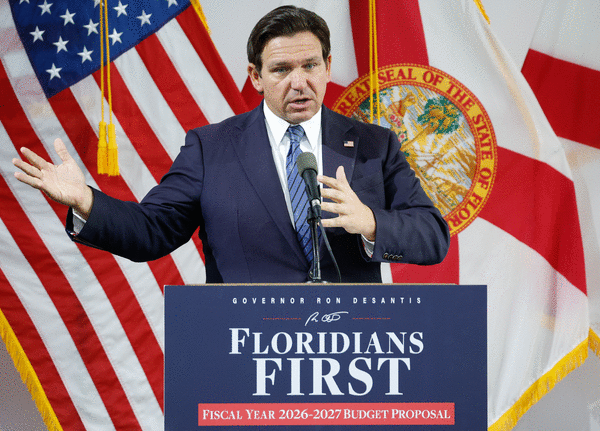
FORT LAUDERDALE, Fla. — Gov. Ron DeSantis said Wednesday he would order the Florida Legislature to convene for a special session to redraw the state’s congressional districts before the 2026 election.
His move formally places Florida in line with the national Republican effort, demanded last year by President Donald Trump, to have states change the boundaries of their congressional districts in ways to get more Republicans and fewer Democrats elected.
The special session, from April 20 through April 24, comes after the scheduled adjournment of the regular legislative session. DeSantis’ timetable would delay the normal timetable for congressional hopefuls to officially qualify as candidates for the August primaries.
Faced with the looming midterm elections, in which a president’s party usually loses seats in the House of Representatives, Trump started a frenzy by states to redistrict by asking Texas to redraw congressional boundaries in an attempt to retain Republican control of the U.S. House.
The move didn’t stop with Texas. In November, California voters responded by approving a change to its congressional districts in a way designed to elect more Democrats and offset what Texas did. And other states have taken up the unusual effort to change districts in the middle of a decade.
Normally, boundaries are redrawn every 10 years to reflect population changes uncovered in the decennial census.
DeSantis, in making the announcement Wednesday, disclaimed any political motivation.
He portrayed the move as something the state would have to do since he expects the U.S. Supreme Court to overturn longstanding legal interpretations of the Voting Rights Act under which states have created congressional districts designed to ensure minority voters can elect minority group members to the House.
DeSantis said that’s improper, and he believes that the conservative majority on the Supreme Court will uphold his view in a pending case from Louisiana.
He gave another reason: that the state’s population has shifted since the 2020 Census provided population data. So he wants to employ another unusual move: make adjustments to the population data without waiting for the 2030 Census.
Senate Democratic Leader Lori Berman of Palm Beach County and House Democratic Leader Fentrice Driskell scoffed at DeSantis’ purported reasons for changing the state’s congressional districts.
The real reason, they said, is politics and a desire to do what Trump wants.
“No matter what pretext the governor offers for mid-decade redistricting — and he has offered nearly half a dozen in an attempt to find one that sticks — what he wants the Legislature to do is clearly illegal. Florida’s Fair Districts Amendment strictly prohibits any maps from being drawn for partisan reasons, and regardless of any bluster from the governor’s office, the only reason we’re having this unprecedented conversation about drawing new maps is because Donald Trump demanded it,” Berman said.
Voters added the Fair Districts Amendments to the Florida Constitution in an attempt to make the redrawing of congressional and state legislative districts less political. “The redistricting process is meant to serve the people, not the politicians,” Berman said.
DeSantis, in his official proclamation calling the special session, wrote that “there is no legal impediment to exercising the authority to redraw congressional district boundaries mid-decade.” He didn’t address the suggestion that his move is aimed at helping Republicans.
South Florida would likely see the biggest changes from redistricting in ways that could completely overhaul the region’s representation in the House.
Using the rationale of undoing the districts drawn to enhance minority group voting power would put the 20th Congressional District in Broward and Palm Beach counties at the top of the list of districts that would be recrafted.
But to do that, all the districts that border on the 20th District would have to be changed since every square inch of the state has to go in a district.
That means the Republicans who control the state Legislature could make changes in multiple South Florida districts currently represented by Democrats with the effect of making it difficult or impossible for them to win reelection.
Currently the state has 28 congressional districts.
The state is already, according to independent analyses, gerrymandered in a way that produces extra Republican victories. Of the 28 districts, 20 are currently held by Republicans and eight by Democrats.
Five of the Democrats are in South Florida:
— U.S. Rep. Sheila Cherfilus-McCormick, District 20, Broward and Palm Beach counties.
— U.S. Rep. Lois Frankel, District 22, Palm Beach County.
— U.S. Rep. Jared Moskowitz, District 23, Broward and Palm Beach counties.
— U.S. Rep. Debbie Wasserman Schultz, District 25, Broward County.
— U.S. Rep. Frederica Wilson, District 24, Miami-Dade and Broward counties.
Moskowitz’s district, in particular, could be vulnerable. It is the most competitive district in the state, and is the easiest one to change in a way that would make it more Republican by adding territory in Palm Beach County and removing territory in Broward.
-----------
©2026 South Florida Sun Sentinel. Visit at sun-sentinel.com. Distributed by Tribune Content Agency, LLC.






Comments