Yemen sees clashes, airstrikes as Saudi-UAE tensions escalate
Published in News & Features
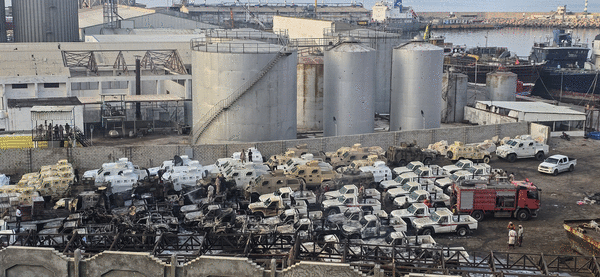
The Saudi Arabia-led coalition in Yemen carried out airstrikes against a rival group supported by the United Arab Emirates as the rift between the two Gulf powerhouses deepens over the conflict in the neighboring country.
Hostilities erupted after the Saudi-backed National Shield Forces said Friday it would “peacefully” take over bases from the Southern Transitional Council, or STC, in Hadramout, Yemen’s largest province near the border with Saudi Arabia.
The STC said its forces clashed with the Saudi-backed group as they entered the area and airstrikes hit some of their bases.
“We confronted the first aggression and forced them to retreat and then the Saudi air force intervened to support them,” Anwar Al-Tamimi, spokesperson for the STC, told Al Jazeera.
A spokesperson for the Yemeni government confirmed the airstrikes to the pan-Arab television network.
The STC, a secessionist group backed by the UAE, seized control of two provinces including Hadramout last month in a surprise attack that was quickly rejected by Saudi Arabia and the internationally-recognized government in Yemen. The two sides compete for influence in the country, which sits at the crossroads of vital shipping lanes and on the edge of a major energy-exporting region.
Earlier this week, Saudi Arabia accused the UAE of “pressuring” the STC to launch attacks near its border, describing that as a “red line” and demanding the Gulf state withdraw within 24 hours. Abu Dhabi announced it would pull out forces and denied allegations of trying to risk Riyadh’s security.
The Houthis, an Iran-backed militant group, controls about one-third of Yemen’s territory, including the capital Sana’a.
Friday’s fighting signals that simmering tensions between Saudi Arabia and the UAE are heightening and could exacerbate the civil war in Yemen that’s been raging for over a decade. Both countries joined an Arab coalition in 2015 to help the Yemeni government counter the Houthis, who had overrun Sana’a and other strategic regions.
The UAE gradually reduced its participation while the Houthis grew stronger, and a tentative ceasefire was agreed to in 2022.
Aside from statements on state-run news agencies and social media posts by opponents and proponents, Saudi and Emirati officials remained silent.
The crisis in Yemen is the biggest between the Gulf Cooperation Council allies since the 2017 boycott of Qatar.
“This is a dangerous moment for the GCC, and once again, the grouping has a great interest in de-escalating a potential crisis,” wrote Michael Ratney, a senior adviser with the Middle East Program at the Center for Strategic and International Studies in Washington. “Each day it goes on is a gift to Iran and other GCC adversaries in the region.”
©2026 Bloomberg L.P. Visit bloomberg.com. Distributed by Tribune Content Agency, LLC.





Comments