Merz rejects 'doomsayers' ahead of decisive year for Germany
Published in News & Features
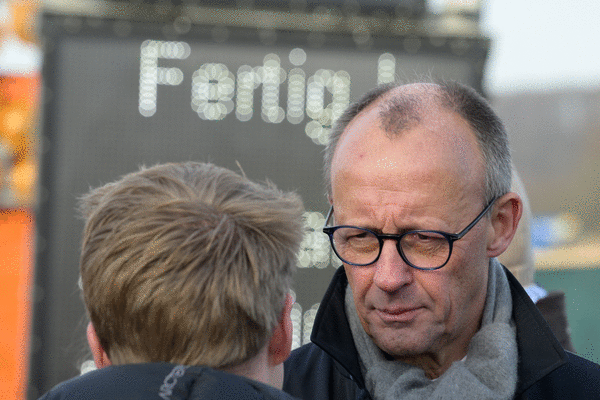
Chancellor Friedrich Merz urged Germans to ignore “scaremongers and doomsayers” and trust in the country’s ability to overcome its numerous challenges, including mounting Russian aggression and geopolitical upheaval.
The conservative leader, whose coalition with the Social Democrats has been in power for about eight months, said he’s confident the economic reforms his government has set in motion will bear fruit “even if it takes some time,” and that 2026 can be a “decisive year” for Germany and Europe.
“Let us place our trust in ourselves and our democratic processes,” Merz said in his inaugural New Year’s address published Wednesday.
“Yes, these processes are laborious and contentious at times,” he added. “But this is the only way we can we achieve results that are supported by a broad majority.”
Merz has been struggling to convince voters that his unwieldy alliance with the SPD can make good on pledges to revive the economy, protect the nation from domestic and external threats and tackle irregular migration — an issue that has helped lift the far-right Alternative for Germany (AfD) into first place in some opinion polls.
While much of the chancellor’s attention has been taken up with Russia’s war on Ukraine and President Donald Trump’s assault on the global order, his government has also tightened restrictions on immigration and asylum in an effort to check the AfD’s rise ahead of a series of regional votes next year.
Five of Germany’s 16 federal states hold elections in 2026, including September ballots in the former communist eastern regions of Saxony-Anhalt and Mecklenburg-Western Pomerania.
Recent polls show the AfD leading comfortably in both states on 40% and 38% respectively, giving it a chance of leading a state government for the first time since its formation in 2013.
That would be a major political jolt for Europe’s biggest economy and spell the effective end of a “firewall” that mainstream parties erected to keep the AfD out of power. The next national election is due in early 2029, while there are also votes next year in the western states of Baden-Wuerttemberg and Rhineland-Palatinate in March and the capital Berlin in September.
Merz didn’t mention the regional ballots or the AfD in his televised New Year address, though his allusion to “scaremongers and doomsayers” is clearly a reference to the party, whose lawmakers he has regularly berated in similar terms. He has vowed never to cooperate with the AfD in any form.
If it does secure a position in government in at least one federal state, it would for the first time send representatives to the Bundesrat — the upper house where the 16 regions are represented — giving it a vote on legislation presented by Merz’s cabinet.
It could also have implications for Germany’s internal security, according to Holger Münch, the head of Germany’s federal criminal police.
The AfD, which has close ties to Trump’s MAGA movement, is challenging its categorization this year by the domestic intelligence agency as right-wing extremist, which grants authorities enhanced powers to monitor the party as a potential threat to democracy.
In an interview with the Tagesspiegel newspaper this week, Münch warned that if the AfD gained access to sensitive data and information as part of a regional administration, it could affect cooperation among intelligence services.
“We need to consider how openly we could then handle information within the organization,” Münch said.
On the war in Ukraine, Merz used his address to reiterate a warning that Russia’s invasion of its western neighbor “poses a direct threat” to European freedom and security.
“We are seeing more and more clearly that Russia’s aggression was, and is, part of a plan targeted against the whole of Europe,” Merz said.
He also lamented a “return to protectionism in the global economy” and complained that Germany’s dependence on raw materials is “increasingly being wielded as a political lever” against the country’s interests.
“At the same time, our partnership with the United States of America, which has long been the reliable guarantor of our security, is changing,” said Merz, who turned 70 in November.
“For us Europeans, this means that we must defend and assert our interests much more strongly by ourselves.”
©2025 Bloomberg L.P. Visit bloomberg.com. Distributed by Tribune Content Agency, LLC.



Comments