Haiti's beleaguered police, army get elite French training as gang crisis deepens
Published in News & Features
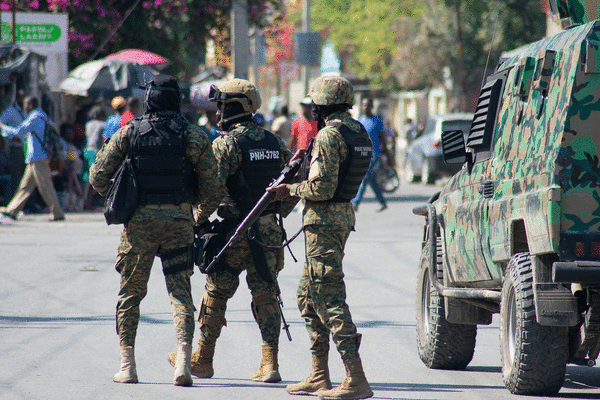
Earlier this year, as members of the United Nations Security Council gathered for one of their regular briefings on Haiti, the discussion followed a familiar pattern: the rapid expansion of armed gangs, their increasingly guerrilla-style tactics and the country’s worsening humanitarian crisis.
But in the report presented by Secretary-General António Guterres another concern stood out — one that some experts fear is being overlooked in the effort to fight the country’s powerful gangs with a larger and more lethal international force: the condition of Haiti’s national police.
“The abrupt shift in the security landscape in recent years in Haiti has placed unprecedented strain on the police force,” the report said, noting that the agency has been forced to move from managing civil unrest to conducting complex anti-gang operations.
Current recruitment, training and procurement efforts, the U.N. report warned, are failing to meet those demands, a challenge compounded by a sharp rise in police attrition.
That assessment is helping fuel growing calls from Haitian observers and international partners for the government to invest more heavily in its own security institutions. It has also shaped the approach of at least one key donor: France.
A longtime strategic partner of Haiti with a deeply fraught shared history — including the indemnity the Caribbean nation was forced to pay for winning its independence — France has traditionally been reluctant to deploy boots on the ground. Still, it has come under quiet criticism for the limited size of its financial contribution to the new United Nations–backed Gang Suppression Force and its predecessor, the Kenya-led Multinational Security Support mission.
The country, which just announced an additional 3 million euros to a U.N.-controlled trust fund for the new force, previously pledged about $9 million euros overall for the Kenya-led mission, including language training. In comparison, Germany recently pledged 30 million euros to the gang suppression mission following an initial 10 million euros to the Kenya force. The pledges make Germany the third-largest contributor to the international effort after the United States and Canada.
France’s diplomats say that while they support the international community’s push to help Haiti battle gangs, they also see the need to help rebuild the long-term capacity of its under-equipped, under-resourced and outgunned security forces, particularly the Haiti National Police.
“We are very much in support, politically, also financially, of the new” international force, said Antoine Michon, France’s ambassador to Port-au-Prince. “It’s super important that they deploy quickly. But we are also insisting that Haiti has to invest in its own forces, in numbers, in logistics, and, of course, in capacity.”
France, he added, is ready to support those efforts through training,” but they have to put the resources in as well.”
In April, Haiti’s Transitional Presidential Council allocated approximately around $275 million to security and stabilizing efforts, a so-called “war budget.” The funds were aimed at bolstering police and the country’s military capabilities, reinforcing border protections and supporting social programs. Despite the fanfare most of the funds went unspent.
Haiti, Michon said, needs an overall security policy — which isn’t just about putting “boots on the ground, which they clearly need,” but also encompasses other measures like controlling the flow of illegal arms, intelligence gathering and tackling drug trafficking and illicit flows of money.
France has been expanding its bilateral cooperation, focusing heavily on the Haiti National Police. That support includes experts with its French Financial Brigade who over the last year have been working with Haiti’s Bureau of Financial and Economic Affairs. The unit within the Central Directorate of the Judicial Police investigates financial crimes, corruption and money laundering. Support is also going to Haiti’s anti-drug trafficking unit, the Brigade for the Fight Against Drug Trafficking. The unit, which once benefitted siginificantly from the U.S. Drug Enforcement Administration’s presence in Haiti before the agency shuttered its office in Port-au-Prince, receives French training on how to do investigations and operations for agents.
“There’s a lot of mentoring,” Michon said.
One key partner in France’s effort, he said, is the elite tactical unit known as RAID.
“We’re bringing the best … the elite units of the French police,” said Michon, referring to the French National Police Recherche, Assistance, Intervention and Dissuasion, which for the past three years has been training members of Haiti’s specialized units in the fight against gangs.
The French units “are not retirees or contractors,” like in some other training programs, the ambassador said, but active officers bringing real-world experiences and highly valued skills. Those include hostage negotiators, sharpshooters and cops who are “actively involved in operations” against narco-traffickers.
“It’s real training...and it significantly improves their ability to protect themselves,” Michon said about Haiti’s national police officers, who have lost dozens of their colleagues this year to gang attacks.
Haitian officers who complete the training are often recognizable by the RAID logo on their arm, a symbol of pride among graduates, he said.
This year, France also provided about four tons of equipment for Haitian police anti-gang units. That includes ballistics for training as well as fir fighting gangs. There is already one French police officer embedded inside the Haitian police, and efforts are underway to get a second officer with expertise in drug trafficking, which is rapidly emerging as a key concern as gangs entrench themselves along strategic corridors to control transit routes for drugs and arms.
“With that presence, we are bringing a contribution that nobody else brings,” the diplomat stressed.
Help to Haiti’s army
Recently, the cooperation has expanded to include training members of Haiti’s Armed Forces, which has about 1,000 soldiers.
The delopment comes amid increased calls that Haiti needs a second security force to deal with gangs, and the need to increase the size of the army, whic faces limited U.S. recognition, restrictions on access to weapons and equipment and opposition over past human rights abuses.
Under the French initiative, soldiers who have attended basic training in Mexico are deployed to Martinique, where they are offered training over a two-week period in groups of 25. “We take people who are already in place and bring them to another level,” Michon said.
So far, about 100 soldiers have undergone the specialized training, with another 100 targeted for next year. Meanwhile, last year, 400 Haitian police officers took part in the RAID-led training.
The numbers are modest, reflecting the limited size of Haiti’s security apparatus.
The Haitian National Police is said to have somewhere between 10,000 and 12,000 officers, a number that is well below the U.N.’s recommended minimum of 25,000.
Recently the Haitian government, in partnership with the State Department’s Bureau of International Narcotics and Law Enforcement Affairs,launched a large-scale program to recruit, train and deploy. Known as the P4000 program, it has a benchmark of adding 4,000 police officers in 16 months, which would be a significant boost, considering the country currently graduates about 600 cadets a year.
©2025 Miami Herald. Visit at miamiherald.com. Distributed by Tribune Content Agency, LLC.




Comments