Budget shortfall less than expected in Kentucky; Beshear to share reduction plan
Published in News & Features
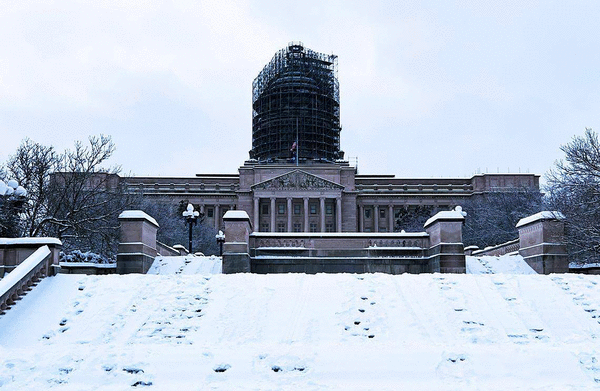
LEXINGTON, Ky. — A group of economists predicts Kentucky will soon see a revenue shortfall, one that is about half of what they projected three months ago for the fiscal year ending June 30, 2026. From now until the middle of 2028, the state’s income will likely see shy, moderate growth, the economists said.
Optimistic, pessimistic and control forecasts made by experts from the Office of State Budget Director and the Consensus Forecasting Group about the state’s revenues will guide the Kentucky General Assembly next year as it crafts the state’s next two-year budget.
The forecasts and impending budget session have caused a fraught back and forth between Democratic Gov. Andy Beshear and the Republican-led legislature this fall as the executive and General Assembly disagree about how to make up for a roughly $156 million shortfall and decide whether to continue cutting personal income tax rates.
During the Consensus Forecasting Group’s September meeting — requested by Beshear as he warned a shortfall was likely — economists predicted the state would have a revenue shortfall of $305 million. On Tuesday, the same group, using more data and an additional quarter of receipts, projected the shortfall would come in at around $156 million.
Sen. Chris McDaniel, R-Ryland Heights, who chairs the body’s budget committee and is set to co-chair the General Assembly’s budget preparation and submission committee in January, expressed confusion in September at Beshear’s insistence the group of economists meet ahead of schedule.
On Tuesday following the Consensus Forecast Group’s meeting, McDaniel said in a statement their analysis was an important part of the budget process.
“What’s clear is that this forecast appears far less severe than what the governor projected in September,” he said. “His earlier outlook was extremely pessimistic, and today’s data suggests a more measured and realistic picture of Kentucky’s fiscal position.”
Speaker of the House David Osborne, R-Prospect, said in a statement the Tuesday forecasts were more informed than those from September and said the General Assembly will “rely on actual data and demonstrable evidence instead of political rhetoric and pandering.”
Kentucky’s General Fund will end this fiscal year June 30, 2026, with about $15.5 billion, the economists predict. In the next two fiscal years, the state’s revenue will have slow growth of about 2.5% to roughly $15.9 billion in fiscal year 2027 and then $16.2 billion in fiscal year 2028, they said.
During the previous fiscal year that ended June 30, 2025, the state reported actual revenues of $15.7 billion. Projections made by the forecasting group for the current fiscal year are about $150 million more than the previous set of forecasts requested by Beshear.
Earlier this fall, the governor said a shortfall was all but expected due to the uncertainty of federal tariff policy impacting consumer spending and general economic activity and continued cuts to the state’s personal income tax rate. On Jan. 1, the rate will decrease to 3.5%.
The state’s personal income tax rate was 5% before a 2022 bill put Kentucky on its path to zero. Eliminating the tax has been a priority for the GOP-led legislature as a way to entice businesses to locate in the Bluegrass State, increase the state’s economic competitiveness and give Kentuckians more individual financial freedom.
To continue decreasing the rate by half a percentage point, the state has to meet several benchmarks at the end of every fiscal year: the state’s Budget Reserve Trust Fund — better known as the “rainy day” fund — must be at least 10% of General Fund revenues. In addition, revenue in the previous fiscal year must equal more than the state’s spending, even if the tax rate had been an entire point lower.
Kentucky fell just $7.5 million in revenue short of the mark it set for itself to continue cutting from 3.5% to 3% in 2027. Already, Republican legislators are in disagreement over whether the triggers were hit.
In November at the Kentucky Chamber of Commerce’s legislative preview conference in Lexington, House of Representatives Majority Whip Jason Nemes, R-Middletown, said, “we did hit the triggers in Kentucky, and even if we didn’t — but we did — we should, we need to reduce the taxes anyway.”
At the same preview conference, Osborne said though it seems the state may have missed the triggers, the legislature, “can make policy however we want to make it, so it doesn’t really ultimately matter.”
McDaniel and other Senate Republican leaders, including Senate President Robert Stivers, R-Manchester, have been staunch in the General Assembly following its own rules, especially when it comes to making changes to the personal income tax rate.
When Beshear began anticipating a shortfall in September, he said revenues for FY26 were set to drop $359 million due to income tax cuts. The governor, like other Democrats, has expressed hesitance over continued cuts, but supported this year’s House Bill 1 that affirmed the 4% to 3.5% drop set to start Jan. 1, 2026.
The Kentucky Center for Economic Policy, a progressive think tank, has long opposed cuts to the state’s income tax, warning that a shortfall — and, eventually, cuts to services — would become inevitable.
“The forecast confirms that the legislature’s income tax cuts of recent years, in combination with a slowing national economy, are weakening revenues,” said Jason Bailey, the center’s executive director. “The budget is going to be incredibly tight as a result, especially given that Congress has shifted huge new costs to states for SNAP and Medicaid through HR 1 that passed this summer.”
In a statement to the Herald-Leader, Beshear said state law requires budget reductions if there are significant revenue shortfalls and that he’d share more details Thursday during his weekly press conference. In addition, the state’s constitution requires a balanced budget in which spending aligns with revenue.
“After a strong couple of months for our Kentucky economy, the Consensus Forecasting Group has reduced the commonwealth’s projected revenue shortfall from $305 million to $156 million,” he said in the statement. “... Overall, we will be able to manage the shortfall and still provide necessary services to Kentuckians.”
©2025 Lexington Herald-Leader. Visit at kentucky.com. Distributed by Tribune Content Agency, LLC.





Comments