Proposed bill would apply 'red-flag' laws to domestic violence after Tamarac triple murder
Published in News & Features
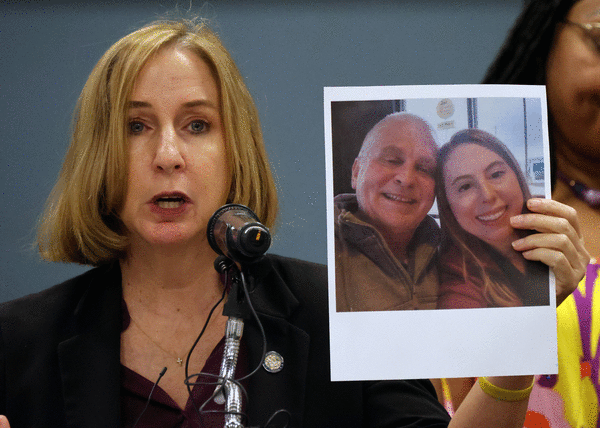
South Florida state Rep. Robin Bartleman has filed a bill that seeks to rectify what she and other advocates say is a gap in the legal system that makes it easy for domestic violence perpetrators with restraining orders to avoid surrendering their guns, a flaw highlighted by the February triple homicide in Tamarac.
Bartleman, D-Weston, cited South Florida Sun Sentinel reporting on the Tamarac murders and a separate investigation into serial abuse as part of the impetus for the bill, HB 729, which would apply the same methods for the confiscation of guns under Florida’s “red-flag” laws to domestic violence restraining orders, as well as enhance penalties for repeat offenders. State Sen. Tina Polsky, D-Boca Raton, has filed a companion bill, SB 858, in the Senate.
“Currently, while judges have the power to grant or issue an injunction to compel abusers to surrender their firearms, there is no clear enforcement mechanism,” Bartleman said Monday at a news conference announcing the proposed legislation. “I spoke to different members of the law enforcement community and there was no clear or consistent response to these orders.”
Mary Gingles had a restraining order in place against her estranged husband, Nathan, who is accused of shooting and killing her, her father David Ponzer, and a neighbor Andrew Ferrin, whose Tamarac home she had run into as she tried to escape in February, according to deputies. Like most restraining orders, the injunction a Broward judge had issued required Gingles to surrender his numerous guns. But he never did.
The Broward Sheriff’s Office deputy who served Gingles with the restraining order in December asked him over the phone if he had guns. Gingles said he did not, and no further action was taken.
The South Florida Sun Sentinel found that what happened with Nathan Gingles is common throughout South Florida, where the current law offers no defined mechanism enforcing the surrender of firearms in domestic violence cases. Instead, courts essentially operate on an honor system, relying on the alleged abuser to surrender their weapons and to tell the truth about having done so, according to advocates and attorneys.
“This bill will be able to bridge a gap that has long existed in domestic violence,” Linda Parker, the CEO of Women in Distress, said at Monday’s news conference. “In many municipalities, while we have the current system set up for guns to be removed, oftentimes police rely on the batterer to say ‘Okie dokie, I’m going to go ahead and surrender my guns.'”
The bill borrows the same language from Florida’s red-flag statute, which went into effect after the Parkland mass shooting and allows law enforcement officers to serve “risk protection orders” on those believed to pose significant harm to themselves or others. Similar to the red-flag statute, the proposed domestic violence bill would require law enforcement to request the immediate surrender of all weapons and allow officers to seek a search warrant if there is probable cause to believe an alleged abuser has not surrendered all of their weapons.
Also at the news conference were George David, the uncle of Andrew Ferrin; Broward School Board Member Debra Hixon, whose husband was killed in the Parkland mass shooting; and Christina La Ferrera and Bridget Knighton, both domestic violence survivors who had previously spoken to the Sun Sentinel about their struggles getting help from the legal system.
Knighton was shot eight times by her ex in 2021, according to police, despite the fact that there was a Broward County court-ordered injunction requiring him to surrender his guns and stay away from her.
“That restraining order is just a piece of paper and that’s all it is,” Knighton said at the news conference. “It will never stop a bullet. And we need remedies like this to correct what’s been wrong for so long.”
George David worked with Parker and Bartleman on the legislation, which he had begun drafting the day after his nephew was killed in Tamarac.
“Guns are a very serious thing,” he said Monday. “People treat them as if it’s something that we are supposed to all have, and that’s not in fact true. I’ve seen the devastation of what those guns have done, and it’s a horrible, terrible thing.”
The proposed legislation also comes amid a rise in “high lethality” domestic violence cases in Broward, according to Parker, who said the number increases every year. In addition to strengthening the laws surrounding guns, it would enhance penalties for repeat offenders, making a second conviction of violating an injunction against the same victim a felony instead of a misdemeanor. Another issue raised at the news conference was a lack of prosecutions when it comes to domestic violence, especially injunction violations.
A South Florida Sun Sentinel investigation found that an alleged serial batterer from Parkland was able to strangle and batter multiple women despite their warnings to law enforcement and in court. The Broward State Attorney’s Office dropped one of the criminal cases against Scott Matalon that might have resulted in more prison time, citing a lack of victim cooperation. He is expected to be released next year.
“I repeatedly warned the courts that Scott Matalon was a public safety risk,” one of the victims, Christina La Ferrera, said at Monday’s news conference, adding that “this legislation is a good step in the right direction, of fixing legislation that is archaic. And there are many more reforms that need to happen.”
The proposed bill could face challenges from gun advocates in the Republican-dominated Florida Legislature, where lawmakers have previously sought to repeal the existing red-flag law passed after Parkland and are currently seeking to loosen age restrictions for gun purchases. Bartleman and others emphasized Monday that they support the Second Amendment, and that the bill only seeks to ensure that an existing system is actually enforced.
“I know anything with guns in the Florida Legislature is a very touchy subject,” Bartleman told the Sun Sentinel. “But I’m not going to be able to put my head on my pillow at night if I don’t try to do this. What is the point of having judicial orders if we’re not going to enforce them? Why have a legal system?”
©2025 South Florida Sun Sentinel. Visit at sun-sentinel.com. Distributed by Tribune Content Agency, LLC.





Comments