Raided Chicago building's tenants move out after judge denies pleas for more time
Published in News & Features
CHICAGO — The gate around 7500 South Shore Drive sat open Thursday, the buzzer system needed to access the building unnecessary. The front door was open, plexiglass falling out of the metal frame, the only brace against the cold.
In Apartment 506, water stands on the wood floorboards. Tenant Alex Manning said it stems from the faulty radiator.
Each panel on the floor is so warped that it’s hard not to trip. There is a bowling-ball-size hole on the wall covered with crinkled and folded duct tape. It is connected to a unit that suffered fire damage in January. Though there is moisture throughout most of his apartment, Manning uses a space heater and the gas stove to stay warm.
Officials have called the South Shore building that federal immigration agents raided in a controversial middle-of-the-night operation “deplorable.” For Manning and the other dozens of residents still living in the troubled apartment complex, it is home.
But a court order on Monday mandated the structure be vacated by Friday. The court order specified that if a Friday exit weren’t possible, all tenants must vacate the property by next Friday, Dec. 19. Either way, residents were forced to pack.
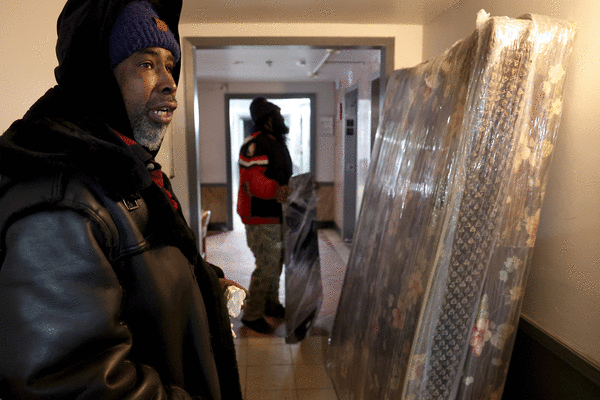
Thursday morning, Manning was in the back of the five-story brick building, talking to movers who are helping him and other tenants transition to new residences, temporary and otherwise.
“It’s been a very inhumane situation, also insulting that the city can find all these resources for people that come over here illegally,” Manning said. “For those who are actually living here have to deal with dire circumstances and are told to deal with it the best way you can. This is 13 days before Christmas — let that sink in. Happy holidays!”
While tenants requested another 60 days to remain in their homes, the court deemed the safety concerns the building presented as far outweighing an extension of relocation and denied the request. The term “deplorable conditions” was used in the denial of the request along with details such as gas leaks, a leaking boiler, insect infestation, exposed live electrical wiring, lack of heat and sewers flooding the building.
Two moving agencies were coordinating efforts as hired security looked on. Some movers worked with the Chicago Housing Authority, others worked with the organization Southside Together.
Some tenants who resided in the structure with housing vouchers said they had not yet learned which hotel they would be staying in until permanent options were made available.
Manning has lived in his apartment for two years. His last night at the building was Thursday, as he heads to a hotel for the next three weeks.
“This being two weeks before Christmas, the condition of the building was more important than the people in it,” Manning said. “While I’m in the hotel, I’m going to continue to navigate housing, after that there’s the opportunity to live with family and friends.”
Manning said that, given the amount of resources and being strategic in his search, he feels finding suitable housing isn’t going to be that hard. It’s about being persistent and dedicated.
Manning was one of dozens of residents at home the night of Sept. 30 when immigration agents dressed for combat rappelled from helicopters onto the building’s roof, broke through windows and stormed inside. Agents placed residents in zip ties and on buses or in the back of box trucks. Many Venezuelan migrants lived in the building and were taken in the raid.
The Department of Homeland Security said the raid was meant to target Tren de Aragua gang members. In the two months since, the government has provided no evidence to back that allegation and has offered little information about the 37 people who were arrested that night. The Tribune first reported that no public criminal charges have been filed against anyone in connection with the raid.
Meanwhile, the militarized operation distressed a complex already in crisis, as deteriorating living conditions plagued the building long before the arrival of agents. Since that harrowing night, living in the apartment building has been “strategically chaotic,” Manning said.
Caliph Williams, 45, is still looking for a place. He pointed to his phone on his sectional couch, saying a lot factors into the search, from affordability to the season that he’s searching. The cold doesn’t help. He said he’s taken to sleeping in the living room, closer to the heat in the kitchen. A shiny silver cooking pot sits atop two piles of items he’s taking with him.
“There was no work done on the property after the raid had taken place — they just didn’t do anything else,” Williams said. “My lights have been out since before Thanksgiving and they sent nobody out to do anything about it. They just cleaned the stairwells a few weeks ago. Those stairwells were flooded, the elevators not working, but we still had to go down through flooded stairwells and I was still paying rent.”
Two weeks ago, residents had been blindsided by a court order mandating that the decrepit complex be vacated. Maintaining the order has left them scrambling to find housing in bitterly cold weather, so residents — as part of the recently formed 7500 South Shore Tenants Union — filed an emergency motion requesting more time for and assistance with relocation.
But a Cook County judge denied those requests Monday, according to the union’s legal representation and community organizers who have been helping residents chart a path forward.
“At 7500 South Shore Drive, tenants are still fighting to be housed in decent, humane housing,” said Dixon Romeo, executive director of Southside Together, a grassroots organization that supports Black, low-income and working-class residents in South Side neighborhoods. “Our goal: How do we as people in the neighborhood come together and have the power to determine what happens to us versus being the victim of it?”
Southside Together organized a fundraiser to help tenants with relocation. As of Friday morning, roughly $10,000 was raised to spread across 37 tenant families. Romeo said the tenants’ organizing and media coverage helped with the fundraising — funds he said wouldn’t have materialized if tenants didn’t fight to get more time and visibility.
On Thursday morning, former residents returned to help friends or other renters. An octogenarian who has lived at the location for 25 years was helped by her nephew.
Two canvassers, Lanyah Griffin and Victoria Lovette, passed out flyers for a Chatham apartment building at 84th Street and Cottage Grove Ave, almost 4 miles away, to those moving out.
“It’s cold. They deserve somewhere to live. They don’t have money, can’t afford application fees, and they’re being forcefully moved out,” Lovette said.
©2025 Chicago Tribune. Visit chicagotribune.com. Distributed by Tribune Content Agency, LLC.






Comments