Thailand heads for early election as PM dissolves parliament
Published in News & Features
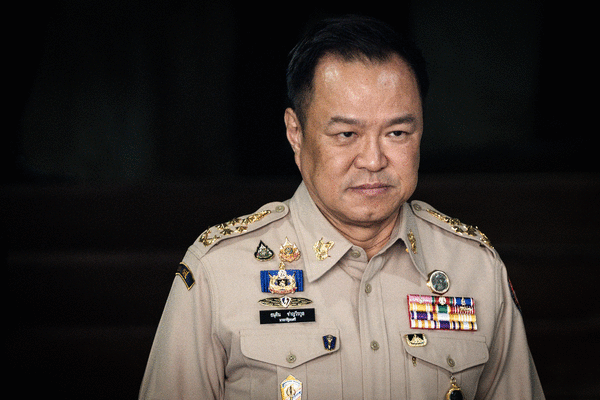
Thai Prime Minister Anutin Charnvirakul dissolved parliament, setting the stage for an early election after a key political party backing his minority government threatened to withdraw its support.
Anutin said in a Facebook post late on Thursday that he would “return power to the people.” Hours later, King Maha Vajiralongkorn endorsed the premier’s recommendation to dissolve the 500-member House of Representatives — a formality under the Thai constitution.
Under Thai rules, an election must now be held between 45 and 60 days after the house dissolution, meaning voters in the Southeast Asian nation will be headed to polling stations as early as the end of January.
The move to disband parliament came after speculation that the People’s Party, which had extended conditional support to Anutin’s government, would file a motion of no-confidence against him after its bid to ensure greater say for elected lawmakers in a planned constitution overhaul was thwarted. Such a step would have toppled Anutin’s coalition government.
Thailand’s economy has underperformed relative to its regional peers, growing a tepid 1.2% last quarter as rounds of political instability and border violence sap confidence. Severe flooding in the south and U.S. tariffs are expected to weigh further on growth.
It’s a fragile macroeconomic backdrop that’s been reflected in financial markets and the prospects of a policy paralysis in the run-up to the election are likely to further weigh on foreign investors, who have already pulled more than $3 billion from Thai stocks this year.
A rebound in Thai stocks from their mid-year lows is showing signs of fading amid a wave of capital flight by domestic investors and the SET Index still ranks among the world’s worst performing equity gauges for 2025, down around 13% over the past 12 months. It rose as much as 0.8% on Friday, trimming losses this week to 1.4%.
The baht has fared better, strengthening more than 7% this year against the dollar thanks to broad weakness in the greenback. The currency has also been buoyed by Thailand’s current account surplus and the baht’s close relationship to the gold price, which has soared this year.
Border skirmish
The hasty call for a new election comes amid a raging border conflict with Cambodia that’s seen almost a dozen Thai soldiers killed and an estimated 400,000 civilians displaced from the border areas. Anutin, who became the country’s third leader in two years in September, has taken a hard line in the clashes with Cambodia to tap into the nationalist sentiment that’s expected to benefit his conservative party in the next poll.
He has strongly backed his military in the Cambodia conflict after facing criticism for a slow and uneven response in dealing with some of the worst flooding in the south in decades.
And his gamble to bring forward a vote may pay off given the strong nationalist sentiment stoked by the renewed fighting with Cambodia, according to Titipol Phakdeewanich, a political science lecturer at Ubon Ratchathani University.
“Anutin has used nationalistic sentiment to mobilize support and his popularity has been on the rise,” Titipol said. “He risks it souring if he leaves it for longer.”
Trump pressure
But Anutin will have to deal with mounting international pressure to end the clashes with Cambodia. U.S. President Donald Trump has said he plans to call the leaders of Thailand and Cambodia to end the conflict like he did a few months ago by leveraging trade deals.
The elections are expected to be a showdown between Anutin’s Bhumjaithai Party and the progressive People’s Party led by Natthaphong Ruengpanyawut, the largest bloc in parliament. At stake is whether either side can win a majority and end a sequence of short-lived administrations in a country where growth lags that of neighbors across Southeast Asia.
A former business tycoon and champion of cannabis liberalization, Anutin came to power under a deal with the People’s Party that demanded his government back constitutional amendment efforts and set the stage for a referendum to replace the current 2017 constitution imposed by the then-ruling junta, as well as dissolve parliament within four months.
The People’s Party, which had led popularity surveys for five consecutive quarters, took a major hit in polls after it backed Anutin. It’s the successor to a previous political grouping that won the 2023 general election only to be blocked from power and later dissolved over its campaign to amend Thailand’s controversial royal defamation law.
Chaos erupted in the legislative chamber late on Thursday after Bhumjaithai’s lawmakers and conservative Senators voted against a clause that sought to grant elected lawmakers a greater say over charter amendments. The backtracking meant Anutin and his party didn’t uphold their end of the deal, People’s Party leader Natthaphong said.
Anutin came to power after former prime minister Paetongtarn Shinawatra of the Pheu Thai party was dismissed by the Constitutional Court for her handling of a border conflict with neighboring Cambodia. Her billionaire family has dominated Thai politics for most of this century: her father and aunt are also former premiers who were removed from power by a coup and court ruling respectively.
As prime minister, Anutin has rolled out cash payments and other stimulus measures for an economy that shrank 0.6% in the third quarter from the previous three months, on weak factory output and tourist arrivals.
--------
—With assistance from Cormac Mullen.
©2025 Bloomberg L.P. Visit bloomberg.com. Distributed by Tribune Content Agency, LLC.





Comments