Trump signs order seeking to limit state-level AI regulation
Published in News & Features
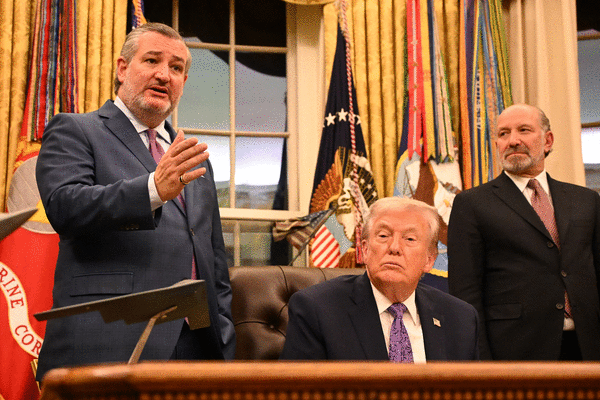
WASHINGTON — President Donald Trump signed an order aimed at thwarting state-level regulation of artificial intelligence, handing a policy win to tech industry leaders who have pressed for preemption of local rules.
Trump said the measure was necessary to bolster the emerging technology and counter a patchwork of state-level regulation the industry worries will hamper its growth.
“You have to have a central source of approval when they need approval. So things have to come to one source. They can’t go to California, New York and various other places,” Trump said Thursday during an event in the Oval Office.
While the text of the order was not immediately available, White House staff secretary Will Scharf said it takes action to “ensure that AI can operate within a single national framework in this country, as opposed to being subject to state-level regulation that could potentially cripple the industry.”
A draft of a potential order seen by Bloomberg last month would allow the Department of Justice to sue states over AI regulations it deems unconstitutional and threaten funding cuts to states with laws considered too burdensome or restrictive.
Championed by White House AI czar David Sacks, the directive culminates months of lobbying by AI companies led by OpenAI and Alphabet Inc.’s Google as well as venture capital giant Andreessen Horowitz. Executives including Nvidia Corp. Chief Executive Officer Jensen Huang have warned that state laws popping up across the country risk overwhelming a nascent industry and potentially harming US competitiveness with China in AI.
Trump said he had consulted with numerous tech industry leaders on the order and indicated Apple Inc. CEO Tim Cook, who has been visiting Washington this week, was among them.
“They won’t be able to do this. This will not be successful unless they have one source of approval or disapproval. Frankly, you can have disapproval too, but it’s one source. They can’t go to 50 different sources,” Trump said.
The president’s order marks the latest in a series of moves he’s taken to boost the AI industry since his return to the White House, including steps to make it easier to build infrastructure and increase energy supply for power-hungry data centers. He’s also sought to promote the export of American technology to global markets, including with his blessing for Saudi Arabia to buy advanced chips for the kingdom’s state-backed AI venture.
“It is pass/fail versus China,” Treasury Secretary Scott Bessent, who attended the signing, told reporters. “We have the lead, we’ve got to maintain it.”
The White House pivoted to the executive order after Trump officials and Republican lawmakers failed to include similar legislation preempting state AI laws in a must-pass defense bill earlier this month. A similar measure pausing state AI laws was rejected by the US Senate in July on a 99-1 vote.
US lawmakers have struggled for years to pass AI legislation, and there’s currently no federal standard governing the technology, leaving local authorities to fill that void.
As AI becomes a central part of daily life, taking on roles such as assessing job applications, identifying criminal suspects, handling medical claims and creating images nearly impossible to distinguish from genuine photos or video, state lawmakers have expressed eagerness to impose some rules of the road. Trump’s order will complicate those efforts, putting any state passing legislation into potential conflict with the Trump administration.
Tech companies have largely opposed state-level regulatory efforts, particularly in California and New York, that would hold companies accountable for harms caused by AI products like chatbots. Trump and his allies have touted the AI boom as a plus to the U.S. economy, even as it poses political challenges, including voter concerns that data centers are spiking energy bills and fears that the technology’s will spur job losses.
After a proposed draft of the order circulated widely in November, New York Gov. Kathy Hochul, a Democrat, assailed the effort, saying the White House was trying to “shield big corporations from taking basic steps to prevent potential harm from AI.” The order also pits Trump against some governors from his own Republican Party, including Ron DeSantis of Florida and Sarah Huckabee Sanders of Arkansas.
_____
(With assistance from Oma Seddiq, Maggie Eastland and Shirin Ghaffary.)
©2025 Bloomberg L.P. Visit bloomberg.com. Distributed by Tribune Content Agency, LLC.


Comments