Haiti secures major troop offers for new anti-gang fighting force
Published in News & Features
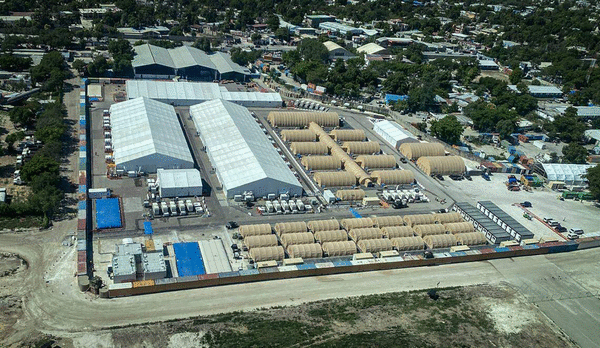
Haiti’s new Gang Suppression Force appears poised to meet its ambitious target of 5,500 troops, after a number of nations, including Chad and Bangladesh, offered to deploy soldiers, engineers and police offices to help the country’s beleaguered security forces combat armed gangs.
The strongest commitments during a conference Tuesday in New York came from African governments. Chad offered 1,500 soldiers, according to two sources familiar with the discussions but not authorized to speak. Additional commitments came from Sierra Leone, Burkina Fasso and the Gambia in West Africa and Burundi in East-Central Africa. Kenya, which was represented, currently has about 700 police officers on the ground in Haiti.
South Asian nations Bangladesh and Sri Lanka also stepped up. Both previously contributed troops in Haiti under the United Nations Stabilization mission in Haiti from 2004-17. While Sri Lanka offered to send a combat unit, Bangladesh, which once had an all-female police unit in Haiti, said its 1,500-commitment would include help to secure Haiti’s land and sea borders.
In a press statement on Wednesday, the office of Haiti Prime Minister Alix Didier Fils-Aimé said the meeting brought together partner countries around a common goal: to provide a decisive, robust response to the violence that threatens Haiti’s sovereignty and future.
“Participants unanimously reaffirmed that the mission... remains essential to restore the legitimate authority of the State, secure the territory and create the necessary conditions for a sustainable return to constitutional order,” he said. “This international engagement, encouraged by the active coordination of the United States and Canada, testifies to the recognition of the urgency and existential nature of the Haitian security crisis, as well as the shared confidence in the Haitian government’s roadmap.”
At present there are fewer than 1,000 foreign security forces in Haiti. They made up the Kenya-led Multinational Security Support Mission before it transitioned into the Gang Suppression Force after the United Nations Security Council’s unanimous approval in September. The resolution established a larger, more lethal force for 12 months, and called for the creation of a U.N. Haiti Support Office to handle logistics and help finance the operation with voluntary contributions.
As Tuesday’s discussions focused on fielding the 5,500 personnel envisioned for the force, the challenges were evident. Canada, which hosted the meeting, and France continued to resist calls to deploy their own troops, and despite a handful of financial commitments funding gaps remain.
A key objective of U.S. Secretary of State Marco Rubio — having a Latin American country lead the mission — also appeared out of reach. El Salvador and Guatemala said they would maintain their presence in Haiti, with Guatemala offering to double its deployment to 300. The only other Latin American country offering new troop deployments was Argentina, which proposed sending military engineers and a setting up a hospital. The Dominican Republic, which shares the island of Hispaniola with Haiti, offered expanded border control.
The lack of commitment by Latin American countries, according to a diplomatic source, stems from the U.S. drafted Concept of Operations, known as CONOPS. Ahead of the meeting, a number of nations had raised concerns about making commitments without a clear agreement on how the mission would operate, and on a U.S. directive that focused mainly on “killing” gang members, many of whom are youth. Canada, for example, stressed the need to protect women and girls, who are being subjected to horrific rapes by criminal gangs.
In the Caribbean region, The Bahamas, Belize and Jamaica said they would continue to send personnel, though their numbers remain limited. Jamaica noted that its ongoing recovery from Hurricane Melissa means it will not be able to deploy additional forces until next fall.
The new force is five times the size of the Kenya mission, which struggled to get funding and equipment. U.S. officials in attendance Tuesday stressed that the mission’s top priority will be to help Haiti regain control of its territory and establish conditions for elections. Haiti last held presidential elections in 2016.
©2025 Miami Herald. Visit at miamiherald.com. Distributed by Tribune Content Agency, LLC.





Comments