Ex-Illinois House Speaker Madigan latest state Democrat to pitch Trump for clemency
Published in News & Features
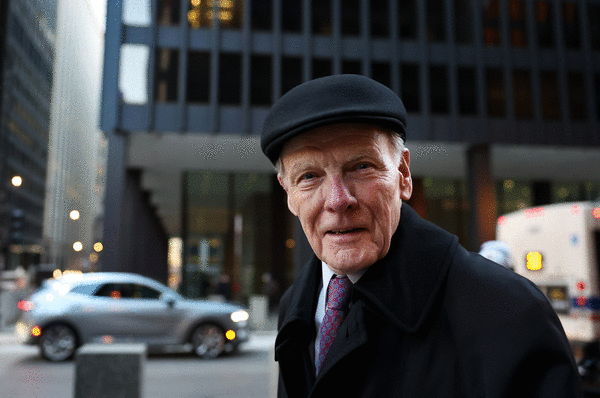
CHICAGO — Imprisoned former Illinois House Speaker Michael Madigan has become the latest high-profile state Democrat to officially ask President Donald Trump for clemency on a corruption conviction.
Madigan, who was convicted in February on a range of corruption counts, recently filed a clemency petition with Office of the Pardon Attorney that is still pending as of Tuesday, according to information on the office’s web site.
The entry says Madigan asked for a “pardon after completion of sentence,” but further details were not provided, meaning it’s unclear if Madigan has requested to be released from custody early.
The classification of Madigan’s request seemed odd on some counts. Typically, defendants still in custody are directed to file a different form seeking a commutation of sentence.
Also, since Madigan is currently not set to be released until he’s almost 90 years old, asking for a pardon after he leaves prison would hardly seem worth the effort.
The entry does not say exactly when the request was filed, but it appeared on the pardon attorney’s web site within the last week. Any specific information or documents submitted on Madigan’s behalf as part of the request is not public.
A spokesperson for the Justice Department, which includes the Office of the Pardon Attorney, confirmed Tuesday that the department had received the request from Madigan, but declined to comment further.
The Tribune also contacted several of Madigan’s current and former attorneys and none said they had a hand in filing the request or had any comment on who might have submitted it.
While the filing was the first official clemency request to surface in Madigan’s case, several sources told the Tribune that the former speaker also pursued relief from Trump through backchannels in Washington around the time of his sentencing in June, but no action was taken by the White House at the time.
News of the clemency request comes as the U.S Bureau of Prisons on Friday offered its first calculation of Madigan’s release date: March 3, 2032, shortly before what would be his 90th birthday. That’s based largely on the calculation for most federal inmates, who must serve 85% of their sentences.
Meanwhile, records show former Commonwealth Edison CEO Anne Pramaggiore, who was convicted in a scheme to bribe Madigan, has been paying a high-powered Washington lobbying firm to explore clemency options with the Trump White House.
Lobbying disclosure records submitted to the U.S. House of Representatives in October show Pramaggiore paid Crossroads Strategies LLC $80,000 this year for “advising on public policy and legislative matters relevant to the pardon process.”
Pramaggiore’s payments to Crossroads were first reported by the online news site NOTUS.
Pramaggiore, who like Madigan is appealing her conviction, had been set to report to prison last week but was granted a last-minute reprieve from U.S. District Judge Manish Shah due to recent hip surgery, court records show. The new deadline for her to report is Jan. 3.
Mark Herr, a spokesman for Pramaggiore, said in a statement to the Tribune that Pramaggiore is “exploring all avenues” to prevent being unjustly imprisoned. He noted underlying bribery conviction against Pramaggiore and her co-defendants were later thrown out, leaving only counts involving the Foreign Corrupt Practices Act.
“Ms. Pramaggiore faces two years in prison for ‘covering up’ a crime the Supreme Court says never was,” Herr said. “Even if she prevails on appeal, there is a real chance that she will have lost two years of her life while innocent.”
Madigan, 83, entered the medium-security federal facility near Morgantown, West Virginia, on Oct. 13 to begin serving his 7 1/2-year sentence.
But given his advanced age, Madigan could wind up serving far less time in an actual prison setting, as the First Step legislation that offers early release on home confinement for elderly or infirm inmates with non-violent convictions.
That’s what happened with Madigan’s former Democratic colleague, ex-Ald. Edward Burke, who served only about 10 months of his 2-year sentence for corruption in prison before being released on home confinement earlier this year.
Like Madigan, Burke had sought clemency from the Trump White House while in prison, asking for his sentence to be commuted, records show. That request was still pending when Burke was released from the low-security prison facility in Thomson, Illinois, in July, and has since been administratively closed, records show.
Burke’s custodial sentence officially ended two weeks ago, and he is now serving his one-year term of court-ordered supervised release, the federal equivalent to parole, records show.
He also was to pay $65,000 in restitution to the owners of the Burger King franchise he was convicted of shaking down, as well as a $2 million fine imposed by U.S. District Chief Judge Virginia Kendall.
Clemency petitions, which include requests for both full pardons and the commutation of federal sentences, can take months or years to resolve though the Office of the Pardon Attorney, which investigates requests before making recommendations to the White House.
Trump, however, has largely upended that process. During Trump’s first term, former Gov. Rod Blagojevich was able to woo the president after a yearslong media campaign claiming he’d been prosecuted by the same FBI and Justice Department officials who at the time were investigating Trump.
In February 2020, Trump commuted the 14-year sentence for Blagojevich on sweeping corruption charges, springing him from prison more than four years early. Then, shortly after regaining the White House this year, Trump issued Blagojevich a full pardon.
In his second term, Trump issued blanket pardons to more than 1,500 people charged in connection with the Jan. 6, 2021, riot at the U.S. Capitol. He’s also granted a number of controversial clemency petitions for other individuals, including former aides Rudy Giuliani and Mark Meadows, tech CEO Changpeng Zhao, who has ties to the Trump family’s cryptocurrency business, and former Honduran President Juan Orlando Hernández, who had been convicted of major narcotics trafficking charges.
Though he’s often made Chicago Democrats his personal punching bag, Trump has also shown the propensity to grant clemency to Democrats, including Blagojevich. Earlier this month, Trump pardoned Democratic Texas Rep. Henry Cuellar and his wife, saying the federal bribery and conspiracy case against them was the result of a “weaponized” justice system.
Madigan, who had a record run as speaker and served for years as the leader of the state Democratic Party, was convicted by a jury Feb. 12 on bribery conspiracy and other corruption charges. The jury found him guilty on 10 of 23 counts, including a multipronged scheme to accept and solicit payments from Commonwealth Edison to Madigan associates for do-nothing subcontracts.
Madigan also was convicted on six out of seven counts — including wire fraud and Travel Act violations — regarding a plan to get then-Chicago Ald. Daniel Solis, who testified at length in the trial, appointed to a state board.
The jury acquitted Madigan of several other schemes alleged in the indictment and deadlocked on other counts, including the overarching racketeering charge.
The same jury deadlocked on all counts involving his co-defendant, longtime confidant Michael McClain, and prosecutors later opted not to retry McClain and dropped the charges. McClain was convicted, however, in the parallel “ComEd Four” bribery case for much of the same conduct and has been sentenced to two years behind bars.
Meanwhile, Madigan’s appeal of his conviction is pending before the 7th Circuit U.S. Court of Appeals. The government’s response brief is due in January, and arguments should be scheduled sometime in early 2026.
____
©2025 Chicago Tribune. Visit at chicagotribune.com. Distributed by Tribune Content Agency, LLC.





Comments