Amid criticism from council, Minneapolis police chief defends nearly $20 million in overspending
Published in News & Features
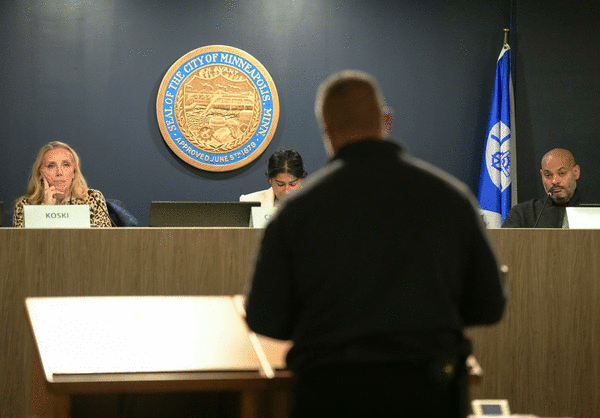
MINNEAPOLIS — Amid sharp criticism and questions from the Minneapolis City Council, Police Chief Brian O’Hara defended $19.6 million in overspending Monday, reiterating that it was costly to restore the department’s depleted ranks.
Six city departments were projected to run into the red by year end, but none came close to the Minneapolis Police Department’s double-digit shortfall.
The number caught the City Council off guard, sparking allegations of ‘negligence’ and ‘mismanagement' against MPD that some feared could hurt the city’s overall financial health.
“We shouldn’t have been surprised by a $19 million dollar overage,” Council President Elliott Payne chided law enforcement leaders. “We should have known this for months.”
Speaking before the council, O’Hara attributed the inflated costs to a rapid and successful hiring spree, paired with ballooning overtime, unbudgeted settlement agreement expenditures and contractual back pay.
“There’s no financial plan, really, to deal with having this many people come in the door this quickly‚“ O’Hara said during Monday’s Budget Committee meeting. He noted that most of the agency’s 174 new employees still need months or years of training before they‘ll become licensed police officers.
”This is a good problem to have," O’Hara continued, “... but it’s very expensive to pay the salaries for these folks, to pay for their tuition, and then still not get the operational benefit of actually having police officers on the street.”
Council members from the body’s progressive bloc pushed back, questioning why the balance sheets hadn’t set off alarm bells within the department earlier and resulted in spending reductions elsewhere.
Several chastised O’Hara and Office of Community Safety Commissioner Toddrick Barnette for a lack of oversight that they believe could threaten the city’s AAA bond rating.
“Who’s ultimately responsible for keeping the budget in check?” Council Member Katie Cashman asked Barnette. He assured her that his office met with Finance to ensure a more coordinated process for supervision next year.
Council Member Robin Wonsley said MPD’s $230 million budget is among the largest in the city, yet their department requires continuous “bailout.” She said the agency should not treat “taxpayer dollars like a bottomless pit.”
When pressed on why so many of this year’s costs were unanticipated, MPD Finance Director Vicki Troswick acknowledged several of their initial estimates for line items like back pay were not accurate.
She believed a newly formed supervisors union — offering employment protections to commanders, inspectors, deputy and assistant chiefs — would be around $350,000, not $2.5 million.
Payroll jumped from their second quarter financial report, which projected a $12 million overage, largely because of overtime, Troswick said. But those figures were calculated without a clear picture about the influx of new hires, and before several major incidents and prolonged enforcement details around schools and houses of worship.
“That’s something that we need to consider when looking at mitigation,” she said, noting that the 2026 budget may also present some challenges. “How far can we scale back overtime without affecting crime, which is one of our goals.”
Payne advised that the department begin those discussions immediately to get a handle on runaway spending.
“We know today that there’s going to be another overage. Let’s not pretend that it’s going to be a surprise a year from now,” he said. “Let’s get on top of that. Let’s be very transparent.”
The biggest driver of the budget-busting is $31 million in overtime — $3 million more than last year’s record-breaking total and $11.4 million more than what was planned.
The MPD has logged six straight years of record overtime since the 2020 police killing of George Floyd. Officers left MPD in droves, creating staffing shortfalls that shrank the force to the lowest level in at least four decades.
But overtime skyrocketed in the fall of 2022, when MPD began paying officers “critical staffing overtime” or “double time” — twice their hourly rate for overtime rather than the traditional time and a half — to cover staffing gaps and fill less desirable shifts.
An agreement with the police union allowing double time expires at the end of 2025, and Mayor Jacob Frey wants to end double-time pay next year, reducing overtime expenses by an estimated $3.64 million.
This year, O’Hara leaned on double time to meet minimum staffing requirements in all five precincts, prevent violence on July 4th and respond to multiple mass shootings, including the Annunciation Church tragedy.
Double time has been extremely lucrative for officers: Last year, 66 of MPD’s roughly 600 employees earned more than $100,000 in overtime alone, according to pay data. Eleven exceeded $200,000.
In 2024, the highest-paid MPD employee was a lieutenant who earned nearly $500,000, more than half of which came from overtime. That’s significantly more than O’Hara or Barnette — and higher than any other known salary in the city.
O’Hara told the Minnesota Star Tribune in July that an audit sparked an Internal Affairs investigation into at least three officers’ overtime because some were found to be violating department policy. By mid-August, a police spokesman told KSTP-TV that number had grown to six.
One of those employees, a civilian crime prevention specialist, was charged with wage theft last month for allegedly falsifying timecards and bilking the city out of $5,600 in overtime he never worked, sometimes at events that never occurred.
In an interview last week, O’Hara largely attributed the overspending to personnel costs, including a better-than-anticipated recruitment effort that netted more than 160 new hires. But the vast majority aren’t on the street yet. Those Community Service Officers, cadets and recruits all remain in the training pipeline to become sworn members.
In previous years, O’Hara was able to offset overtime costs with savings from vacant police positions. But with so many aspiring officers coming online, that pool is shrinking.
Despite nominal gains in the overall number of uniformed patrol officers, O’Hara told the Council that his department has logged “significantly reduced response times” across the city in 2025, including a two-minute improvement on Priority 1 calls.
“I think that’s a result of having filled the shifts and then also any additional managerial control to ensure that we’re responding as fast as possible,” he said. “So there has been a gain to residents of the city.”
On Friday, the council also made the following decisions related to public safety dollars:
During that conversation, Council Member Michael Rainville suggested his more progressive colleagues were defunding the police, to which Council Member Aurin Chowdhury noted the council has increased MPD’s budget every year since 2022. She called the allegation “tired” and “unnecessarily divisive.”
“That’s the opposite of defunding the police,” she said. “So let’s give it a break.”
The full council is expected to vote on the city budget Tuesday.
-----------
©2025 The Minnesota Star Tribune. Visit at startribune.com. Distributed by Tribune Content Agency, LLC.





Comments