Twin Cities districts vow to block ICE access to schools amid reports of agents near campuses
Published in News & Features
MINNEAPOLIS — As reports of federal immigration enforcement activity ripple across Minnesota, Twin Cities school districts are issuing unusually direct, and in some cases defiant, messages to families. Some are pledging to deny federal immigration agents access to school buildings; others are emphasizing student privacy and urging families to stay calm as uncertainty escalates.
The concerns intensified Thursday in St. Louis Park, where Superintendent Carlondrea Hines told families the district had briefly increased supervision around its schools after receiving reports that Immigration and Customs Enforcement, or ICE, agents might be nearby.
“At no time will ICE or other related law enforcement agents be allowed access to the school beyond the main office area without specific court documents legally requiring us to provide this access,” Hines wrote in an email to parents.
Kevin Vollmers, 48, posted a photo on Facebook of what appeared to be an ICE agent outside Aquila Elementary School, where his partner, Principal Maria Graver, leads a school with a large Somali and Latino student population.
He said teachers and staff walked about 100 children out of the building after a musical practice this week out of caution regarding the possibility of ICE’s presence in the area.
“What universe are we living in when hundreds of kids have to be ushered out to their families because it’s not safe for them outside the school walls?” he said.
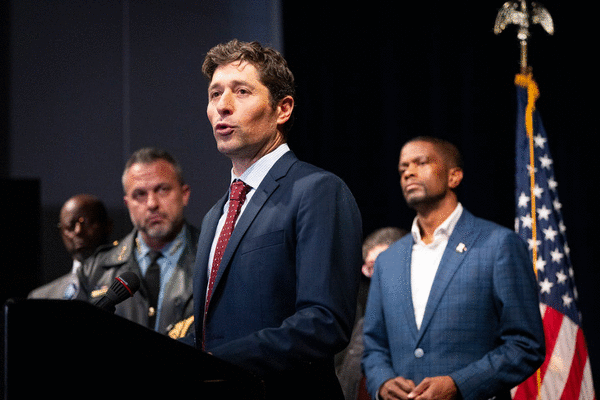
St. Louis Park’s alert was one of several messages sent across the metro this week as local officials brace for what Minneapolis Mayor Jacob Frey described Tuesday as “credible reports” that up to 100 federal immigration agents could be deployed to the Twin Cities with a focus on Somali residents. Minnesota is home to about 108,000 Somali residents — many concentrated in Minneapolis, St. Paul and first-ring suburb districts such as Hopkins and Roseville.
The warnings, paired with escalating rhetoric from President Donald Trump, have heightened anxiety among families and students arriving at school. District leaders say they are hearing from students afraid that ICE agents could appear at campuses or bus stops.
While district procedures and legal interpretations differ, their messages share a through line: reassurance for families experiencing intensified fear.
Schools emphasized they do not collect immigration status; federal agents cannot access students without going through administrators; and districts are bound by state and federal law to protect student privacy.
The moment is reviving long-standing questions about how far schools can go in shielding students from federal immigration actions, particularly in communities with large Somali or Latino populations. Federal law allows immigration agents to enter schools only with consent or a judicial warrant, and districts cannot physically block officers acting under such a warrant.
District leaders say they will continue to monitor developments and communicate with families, while stressing that students should continue attending school.
In a message sent Thursday, Roseville Area Schools Superintendent Jenny Loeck said the district is concerned by federal actions that “appear to focus on members of our Somali, Latinx, Hmong, and other communities of color.” She emphasized that changes in federal enforcement “do not change our district’s legal responsibility to protect the rights and privacy of our students.”
Minneapolis Public Schools offered similar reassurance on Wednesday, stating that “hate is never acceptable” and directly addressing Somali and Latino students who may feel targeted: “You are welcomed, loved and appreciated.”
Shifts in enforcement “do not impact MPS’ legal responsibility to protect the rights and privacy of our students, staff and families,” the district wrote to families.
Hopkins Public Schools issued one of the strongest responses yet, telling families in an email Wednesday that the district will deny federal immigration agents entry if they request access to detain or question someone.
Superintendent Rhoda Mhiripiri-Reed condemned rhetoric “rooted in prejudice” and detailed a step-by-step protocol for staff should agents appear.
Staff are instructed to deny entry and notify an administrator, who must request identification and a statement of purpose — again refusing entry. If agents persist, administrators are directed to call local police, not to assist enforcement and to “attempt to negotiate and even plead with agents to leave peacefully.”
The Hopkins policy also covers school buses. Drivers are instructed to keep doors closed, block access and return to a school building if necessary. The district noted it does not track or request immigration status.
St. Louis Park’s message likewise emphasized that public schools cannot collect information about students’ immigration status and that the district does not document such disclosures even when families volunteer them.
Hines outlined procedures that would apply if immigration agents arrived, including requiring a judicial order signed by a judge before confirming student information or permitting access beyond the main office.
At Lionsgate Academy, a public charter school, leaders said families have been asking how national developments might affect their children. Executive Director Ryan Rehnstrand said the school has long restricted unauthorized visitors — including law enforcement — from accessing students without supervision.
“It is not our practice to allow law enforcement officers, immigration-related or otherwise, to interview, detain, search or access students on campus except in rare cases involving immediate threats to school safety,” he wrote.
He added that students are less likely to encounter law enforcement at school than elsewhere and urged families to keep students attending in person.
“I’m concerned for all of the kids seeing men with guns outside their school,” said Justin Pierre, frontman of Motion City Soundtrack and a parent of a child who attends Aquila Elementary. “That alone is traumatizing, before you even consider the fear of being followed home, being questioned.”
ICE officials in the Twin Cities did not respond to requests for comment.
©2025 The Minnesota Star Tribune. Visit startribune.com. Distributed by Tribune Content Agency, LLC





Comments