Chicago Mayor Brandon Johnson's administration rebuts budget proposal by aldermen
Published in News & Features
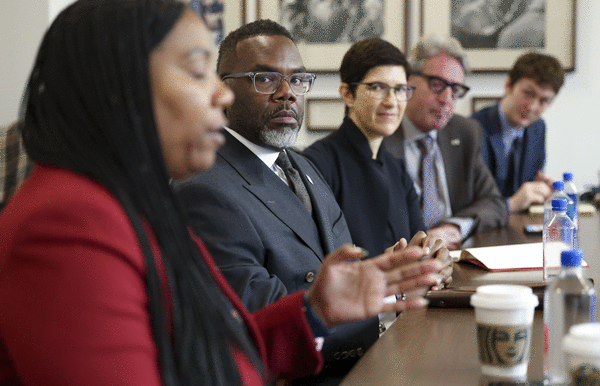
CHICAGO — Mayor Brandon Johnson’s administration on Thursday publicly shot down the 2026 budget plan backed by a narrow City Council majority.
A detailed memo from Johnson’s top finance officials, first obtained by the Tribune, generally sought to discredit the proposal floated earlier this week in a letter signed by 26 aldermen. Some ideas aren’t legal while others are simply bad ideas, Johnson’s team argued.
Releasing the 14-page letter is an unusual move for Johnson to take with less than a month until the end-of-year budget deadline as he struggles to convince aldermen to back his spending plan for 2026.
Johnson has for months called on aldermen opposed to his budget — particularly his $100 million corporate head tax proposal — to come up with their own solutions.
Now that they have, his response letter argues it is no real plan at all.
Johnson’s team defended its monthly $21-per-employee head tax for companies with over 100 employees by pointing to many of the same arguments the mayor has been using to defend the plan. The $100 million it will bring in, which Johnson says will directly fund crime-fighting work like violence prevention programs, is “not a threat to prosperity, but a prerequisite,” his administration said in the letter.
The authors — Budget Director Annette Guzman, Chief Financial Officer Jill Jaworski and Comptroller Michael Belsky — cited the 47% decrease in homicides and 43% drop in shootings this summer.
“A safer city strengthens economic activity, attracts new investment, and broadens the tax base, all of which help reduce the long-term burden on taxpayers,” the letter said.
It further said that the aldermen’s argument that the corporate head tax would harm economic growth and job growth “is not substantiated by any data.”
Johnson’s team said they will schedule meetings with aldermen and flagged places where they have already made changes to the budget, such as restoring Chicago Public Libraries’ circulation budget.
The letter had little to say about the aldermen’s proposal to make around $130 million more in payments to the city’s underfunded pensions, beyond saying doing so would require cuts or more revenue.
Johnson’s team also blasted the aldermen’s plan to hike monthly garbage collection fees from $9.50 to $18. His administration shared a ward-by-ward analysis of how much the fee hike would cost Chicagoans.
As property tax bills rise, “imposing another major cost escalation would create an immediate and disproportionate burden on households least able to absorb it,” the letter said.
In response to the group’s plan to shrink Johnson’s proposed $1 billion TIF surplus by $100 million, the mayor’s administration wrote that several of the entities set to receive large sums of the money — such as Chicago Public Schools and Cook County — have already made plans around the money.
“Adjusting the surplus at this stage would create material disruptions for these entities and could impair their ability to meet statutory and financial obligations,” the letter said.
Johnson’s team also argued that it is appropriate to pay for over $100 million owed in firefighter backpay with a three-year borrowing plan because the money was first spent over three years. Aldermen have called for the city to not borrow and instead pay for the backpay next year, a move they said is needed to avoid a credit downgrade.
To the group’s proposal that the city pull another $90 million in savings from changes recommended by the consulting firm Ernst & Young, Johnson’s administration said it had already implemented the recommendations from the firm that are viable next year. The budget must be “grounded in operational reality,” the letter said.
“This evaluation process will continue, but it is neither practical nor advisable to assume that every recommendation can or should be implemented in full or in the first year,” it said. “Incorporating unverified or highly uncertain savings would create fiscal risk, rather than reduce it.”
And the letter called a plan to sell off or more quickly collect $150 million in municipal debt “neither standard practice nor financially viable” because of the difficulty associated with recouping money owed to cities under Illinois law. “Legal, financial and operational realities” would make the payout aldermen projected – a massive piece of their plan – impossible, the letter argued.
The mayor’s team cited a court ruling to argue the aldermen’s proposal to raise $24 million by raising taxes on retail alcohol, but not alcohol at bars and restaurants would be struck down on court.
Illinois courts have determined there is no difference between on-premise and off-premise alcohol consumption for tax purposes. The decision would prevent the city from differentiating between the two, likely putting bars and restaurants in the crosshairs if City Hall raises alcohol taxes.
Johnson’s team also criticized a proposal to restore funding to two youth mentoring programs. The letter argued singling out the two programs would impede on an open, data-driven process to fund such programs and noted the aldermen’s request “is difficult to reconcile” with the group’s plans to cut a planned increase in spending on youth summer jobs.
The aldermen’s plan to cut proposed youth employment spending would lead to 5,100 fewer summer jobs, the mayor’s team said. Money for those jobs had previously been paid for with federal American Rescue Plan Act funds, it said.
And in response to a plan to change and ultimately raise rideshare taxes, Johnson’s team did not clearly reject the aldermen’s call to effectively restore a tax structure the mayor himself had first proposed, but suggested aldermen were overestimating how much the tax would bring in by $10 million.
Johnson’s team also cast doubt on the $26 million sum the aldermen said a “augmented reality licensing” system would bring in. Aldermen have not meaningfully described the plan, nor shared plan, nor information on how the striking revenue projection was reached, the letter said.
“Without a clear evidentiary basis, the City cannot responsibly rely on these figures for fiscal planning,” the letter said.
Johnson deferred to the City Council on whether $500,000 set to split among their 50 ward offices should instead go back into the budget, but warned it won’t have time to install more parking meters before next year, another recommendation by the aldermen.
The finance team also rejected the aldermen’s argument that the city’s revenue estimates should be $31.6 million higher. The aldermen pinned their more-favorable projection for the city on a report shared Friday.
“Relying on those moments as predictors of ongoing annual performance would risk overstating revenue capacity,” the letter said.
____
©2025 Chicago Tribune. Visit at chicagotribune.com. Distributed by Tribune Content Agency, LLC.





Comments