KY Senate GOP leadership teases policy, budget priorities ahead of party caucus
Published in News & Features
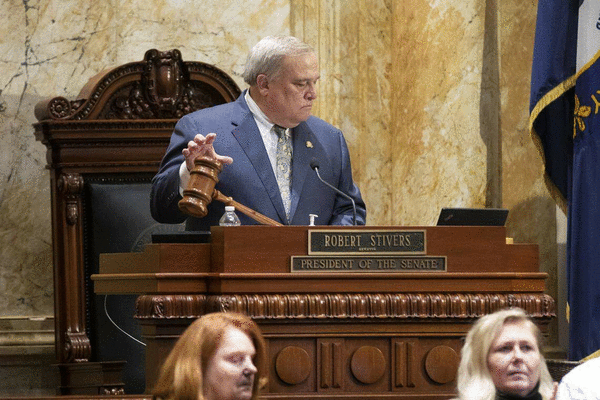
BARDSTOWN, Ky. — During next year’s legislative session, the Kentucky Republican supermajority will craft a budget aimed at incentivizing housing and supporting public education. Policy will closely follow recommendations from experts who testified in Frankfort during the summer months on health, artificial intelligence, aviation and more, according to senate majority leadership.
“The budget session gives us the chance to look at those places that we want to emphasize, and that’s growing business and industry, retaining the job creators here in the commonwealth,” Sen. David Givens, R-Greensburg, said Dec. 3 in Bardstown ahead of the party’s three-day caucus retreat.
Givens, who is Senate President Pro Tempore, stood Wednesday alongside other senate majority leadership to preview what upcoming meetings and political strategizing with other elected officials will look like just a month before the Kentucky General Assembly meets again.
Continuing to lower the state’s income tax
Kentucky didn’t hit the mark to trigger another half-point decrease in the state’s income tax. The state fell just $7.5 million in revenue short of the mark it set for itself to move forward with an income tax cut from 3.5% to 3% in 2027. The money is just part of last year’s total General Fund revenues of $15.7 billion.
Eliminating income taxes in Kentucky has been a priority for the GOP-led legislature as a way to entice businesses to locate in the Bluegrass State, increase the state’s economic competitiveness and give Kentuckians more individual financial freedom.
While the triggers weren’t hit this year for cuts to continue in 2027, they were met one year ago, allowing the General Assembly to pass a tax cut from 4% to 3.5% effective Jan. 1, 2026. The state’s personal income tax rate was 5% before a 2022 bill put Kentucky on its path to zero.
In November, House Majority Whip Jason Nemes, R-Middletown, said he did not accept the state didn’t meet the triggers to make the next cut.
“I think we did hit the triggers in Kentucky, and even if we didn’t — but we did — we should, we need to reduce the taxes anyway,” he said.
Senate President Robert Stivers, R-Manchester, said Wednesday there’s a process in place set by policy and the legislature will follow it.
“We set a policy and process and when you set the policy and process, you should follow it,” Stivers said. “Now, we know that you have to modify on occasion. ... It may not be as big of an incremental decline, but we set some different triggers that still give us the ability to hit those incremental spots, to make incremental declines.
“If we get it, we get it. If we don’t, we don’t. We follow the policy.”
Workforce and economic development progress
Last session, passed policy allowed students to count their on the job training toward required hours for getting a professional license, let military medical personnel transition their credentials to treat civilians and another bill aligned workplace safety rules with federal standards, said Sen. Mike Wilson, R-Bowling Green.
Wilson, who is majority whip, said it’s likely there will be more policy tying workforce efforts with infrastructure ones. New roads will take Kentuckians to new jobs they got from receiving training at one of the commonwealth’s schools focused on trades or technical training, he said.
“Kentucky’s economic momentum is not an accident,” Wilson said. “It’s the result of disciplined policy decision made over the past several years by our super majority. We’ve focused on pro growth tax reform, responsible budgeting and predictability for our employers by lowering our income tax.
“Our strategy has been to build skills, not bureaucracy,” he said.
Public education
Before the weekend, the Republican caucus is likely to discuss ways to create more career technical education and to support for teachers in the classroom.
Last year during the legislative session, a bill passed requiring school boards make rules restricting student phone use in the classroom. Next session, policy may extend to regulating the use of artificial intelligence across public schools, said Sen. Max Wise, R-Campbellsville, who is a member of the chamber’s education committee.
“As we enter into the budget session, we know that education will remain as it has been: a top priority for this legislative body,” Wise said.
“That means looking at our SEEK funding formula (the Support Education Excellence in Kentucky formula looks to create a guaranteed base spend amount for every student based on various factors of their school district). It also means ... giving back local control for school boards to make any decision that they need to make as it relates to teacher salaries, and just giving them the authority to make the best decisions for their districts,” he said.
As Kentucky’s legislators prepare to make the state’s next budget, one thing will likely be missing: money allocated to bail out the commonwealth’s two largest, financially struggling school districts, Givens and Sen. Chris McDaniel, R-Ryland Heights, who chairs the Senate Appropriations and Revenue Committee, said in early November.
“I think one of the biggest issues we have to deal with is the finances and the people who are handling the finances of our two biggest public school systems — and this is not me speaking, this is what’s being reported by the people in front of me — they’ve got some real problems, and they have some real confidence problems from the general public in both Fayette County and Jefferson,” Stivers said Wednesday.
Artificial intelligence and energy costs
Stivers said there will likely be policy to make Kentucky a critical part of artificial intelligence competition. Like other Republican policymakers, Stivers said it’s important not to let China and other adversaries get a leg up on the United States when it comes to AI because of the way it’s likely to continue embedding itself in everything, including national security.
But it will be imperative, he said, that the legislature and Republican caucus talk more about the costs associated with the construction and upkeep of data centers that support AI.
“If you do full cost allocation and there are any needs for additional infrastructure — that’s your grid, that’s your line, that’s your transformers, that’s your substations — if that’s going to be developed for artificial intelligence, then they have to bear the cost and it not be put back on the residential consumer,” Stivers said.
“The second thing is, if there is any increase in demand that you have to develop more generation, that has to be allocated to the person who creates the demand. That’s not the residential consumer.”
Other policy priorities
Policy recommendations from task forces and committees that met in the interim to discuss housing, artificial intelligence, health and public safety, infrastructure and natural disaster prevention will guide much of the discussions had among the Republican caucus through the remainder of the week.
Givens predicted he and the rest of the caucus would discuss eminent domain and property owner’s rights and work toward policy that eliminates red tape in occupational licensing to maintain a strong workforce.
While new policy is typically the main focus, Givens said revisions to older policy is still a possibility, and specifically mentioned the bill that limited communication schools could have with their students.
Following the UPS plane crash in Louisville on Nov. 4 that killed 14, Stivers said if the National Transportation Safety Board’s report show part of the reason for the crash is related to runway length or the structural integrity of the airport, the state may allocate money for preventative repairs.
During previous sessions, the legislative body has discussed ways to create work pathways for Kentuckians to become air traffic controllers and take up jobs in other aviation related fields, something the leadership said will continue next year.
©2025 Lexington Herald-Leader. Visit at kentucky.com. Distributed by Tribune Content Agency, LLC.






Comments