Israel and Lebanon take part in rare talks in bid to ease tensions
Published in News & Features
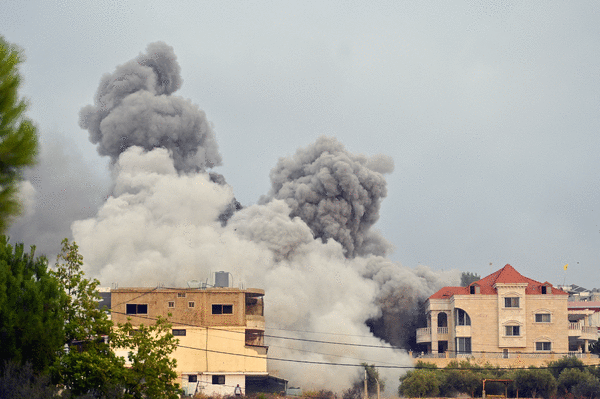
Lebanon and Israel sent negotiators to join a rare summit to address tensions surrounding last year’s ceasefire with Hezbollah, following fears that the militant group is attempting to rearm.
The Lebanese presidency named former ambassador to the U.S. Simon Karam as head of the country’s delegation, while Israel dispatched Uri Resnick, a member of Prime Minister Benjamin Netanyahu’s national security council, to attend the talks overseen by the U.S.-led committee supervising the truce.
U.S. envoy Morgan Ortagus also took part, according to a statement released by the U.S. Embassy in Beirut on Wednesday.
The negotiations follow weeks of escalating Israeli strikes on Hezbollah targets in Lebanon, culminating in last month’s assassination of the Iran-backed militia’s chief of staff in Beirut’s southern suburbs. That raised fears of another fully fledged Israeli military campaign after 2024’s fierce conflict, which officially ended a year ago with a U.S.- and France-mediated truce agreement.
During the meeting, which took place in a “good atmosphere,” “it was agreed that ideas would be formulated on possible economic cooperation between Israel and Lebanon,” the office of the Israeli prime minister said in a post on X, adding that the “disarmament of Hezbollah is obligatory.” Participants agreed to hold a follow-up discussion.
The aim of the meeting was to facilitate “political and military discussions with the aim of achieving security, stability, and a durable peace for all communities affected by the conflict,” the U.S. embassy earlier said. Furthermore, the talks could set a precedent for direct contact between Lebanon and Israel, which are technically at a state of war.
The Israel-Hezbollah truce established a so-called Cessation of Hostilities Implementation Mechanism, which has met regularly in the southern Lebanese town of Naqoura to follow up with both sides on the implementation of the deal.
Under the terms, Lebanon agreed to prevent attacks on Israel, dismantle Hezbollah’s infrastructure and work toward deploying state troops in the south of the country. The pact also stipulated that Israel would withdraw its forces “in a phased manner” from southern villages it still occupies. Israel has kept troops in five outposts.
Lebanon has deployed hundreds of army personnel to the border region, confiscated arms and seized dozens of tunnels dug by Hezbollah to facilitate the movement of its militants and store arsenal. Israel says it’s acting too slowly, and has struck Hezbollah assets and military figures hundreds of times over the duration of the truce.
Israel and the U.S. have both raised concerns that Hezbollah is rearming in violation of the deal.
“Hezbollah has been trying, each time anew, to build up strength and regroup — including in terms of weaponry,” Gila Gamliel, a member of Netanyahu’s security cabinet, told Army Radio on Wednesday. “Hezbollah will be disarmed, full stop. And this shall be done, either by actions taken by Lebanon itself — the Lebanese government tackling this — or by us tackling this.”
Lebanon has said it was willing to negotiate with Israel to resolve outstanding issues over land border disputes and ceasefire violations.
The war on Lebanon last year degraded Hezbollah’s military capabilities as well as its dominant political influence and allowed for the election of a U.S.-backed Lebanese president and the nomination of Prime Minister Nawaf Salam. Both have been vocal about the need for the state to regain its monopoly on arms in the country.
In a rare move earlier this year, the cabinet told the army to compile a plan to disarm Hezbollah and set the end of 2025 as a deadline for its implementation. Hezbollah, designated a terrorist organization by the U.S., has described the measure as a “grave sin” and vowed not to surrender its weapons beyond south of the Litani River.
_____
(With assistance from Youssef Diab, Dan Williams and Sherif Tarek.)
_____
©2025 Bloomberg L.P. Visit bloomberg.com. Distributed by Tribune Content Agency, LLC.





Comments