Boston Mayor Michelle Wu renews push for contentious tax shift bill to prevent 13% tax hike for homeowners: 'Best option'
Published in News & Features
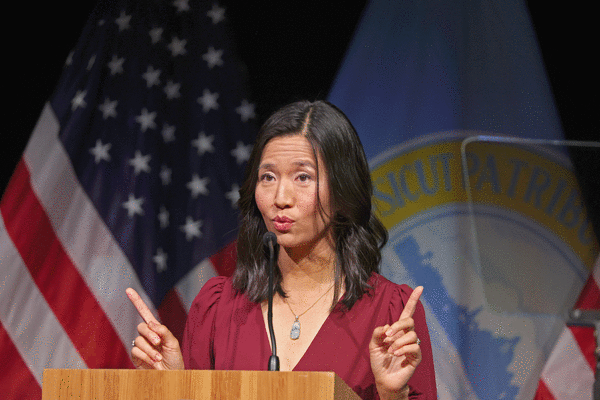
BOSTON — Boston Mayor Michelle Wu is urging a reluctant state Senate to act on the contentious tax shift legislation she’s been pushing for nearly two years, in light of city data that shows homeowners are facing an “unsustainable” 13% tax increase next year.
Insisting that there is no other option, Wu and her allies urged senators to “put all the other silly stuff aside” — as Boston Police Patrolmen’s Association President Larry Calderone put it — and pass stalled legislation that would provide residential tax relief by shifting more of the city’s tax burden onto commercial property owners for a three-year period, before property tax bills go out in the next few weeks.
Without the legislation, Wu said the average-single family homeowner will see a $780, or 13% increase, next year — based on a post-pandemic economic trend of “rising residential property values alongside dropping commercial values” that “will continue to put pressure and shift the tax burden onto residents in an unsustainable way.”
Residential taxes grew by 10.4% this year.
“Because it’s an average, many property owners will end up paying even more than that,” Wu said at an embargoed Tuesday press briefing. “It will be difficult to bear for far too many of our residents, and we need to do something about it.”
Because of state tax law constraints, the mayor insisted that her tax shift legislation — which drew backlash from the commercial sector and has failed to gain traction in the state Senate where it killed late last year — remains the only option that the city can pursue to provide residential tax relief.
“The best option in front of us is the option that we have passed, analyzed, reached a compromise with business groups on, and have continued to send up to the State House,” Wu said. “Otherwise, there’s not flexibility within state tax law for us to issue residential tax rebates directly or to change different thresholds for relief in other ways.”
Cutting the city’s $4.8 billion budget to lower taxes is not “realistic,” given the impact that would have on delivering city services and maintaining the city’s AAA bond rating, Wu said.
The mayor added that a mid-year budget cut right now — a route that the city historically hasn’t taken — would be particularly burdensome, given that it would lead to layoffs “or taking much more painful and disruptive measures.”
Wu said there is no appetite for any type of budget cut, when asked whether she would consider doing so to generate more support for her legislation in the Senate. A budget reduction would help commercial property owners, rather than residents, by way of the city’s budgetary revenue structure, the mayor said.
She also disputed criticism raised last year by state lawmakers that former Mayor Tom Menino pursued cost-cutting measures before seeking a similar temporary change in state tax law in 2004.
Wu said she has spoken with city financial employees from that time period, who have relayed to her that “the tax shift did not cause the need for a budget cut and was not directly tied to that.”
“What happened that year separately was, given the larger … dot-com bubble burst, there were larger economic trends that led the state to suddenly pull out their local aid from municipalities, and so that put a strain on every community,” Wu said. “That was separate from the commercial versus residential property value divergence.”
Rather, Wu said her administration has taken steps to limit spending growth to the “rate of inflation.” The city budget grew by 4.4% this fiscal year compared to 8% last year, and the mayor said she plans to continue with modest budget growth in future years to counter federal funding uncertainty and vacant office space that has sent commercial values plummeting.
Residential values are set to grow by 2% next year, while commercial values are projected to drop by 6%. Wu said the average Class A office taxpayer will see a 4.4%, or $210,000 decrease, in their property tax bills next year, “while our residents are experiencing the spike.”
Ashley Groffenberger, the city’s chief financial officer, said the mayor’s proposed tax shift legislation is meant to stabilize the impact falling commercial property values are having on the city’s tax structure. Property taxes account for roughly three-quarters of the city’s budgetary revenue.
The residential share of the city’s property tax burden grew from 41.7% in fiscal year 2024 to 44% in FY25 and is projected to increase 46.1% in FY26. During that time, the commercial share of its property tax levy has decreased, 58.3% in FY24, to 56% in FY25, and is projected to fall to 53.9% in FY26, Groffenberger said.
The legislation seeks to allow the city to shift the tax burden from the residential to commercial sector, beyond the state’s 175% maximum limit for a three-year period.
Shirley Jones, president of the MeetingHouse Hill Civic Association and a Dorchester homeowner, said she would love to grow old in Boston, “but it is tough to make ends meet as I grow older.”
“I’m happy to pay my taxes to ensure we have high-quality city services, but corporate land owners are not paying their fair share,” Jones said.
Wu said she would like to see an update to Prop 2 ½, a state law enacted in 1980 that places limits on how much property tax revenue cities can collect each year, as a long-term solution, and is convening a task force early next year to study ways the city can raise additional revenue to lower residential taxes.
In the meantime, Wu and her allies on the day’s press call made it clear that they blame the Senate, with the mayor singling out one of her adversaries, state Sen. Nick Collins, for using a procedural move to block her tax legislation repeatedly last year.
“We’re looking to our senators here in Boston to help keep Boston a world-class city,” Calderone, the police union president, said. “Put all the other silly stuff aside, please, and vote to pass this legislation like we’d done 20-odd years ago.”
The bill was ultimately killed by Senate President Karen Spilka, due to a lack of support, after Department of Revenue-certified numbers of city assessing data showed residential tax increases were lower than projected by the city last year.
It has passed the City Council and House of Representatives, where Wu ally Rep. Aaron Michlewitz chairs the budget committee, three times.
---------------
©2025 MediaNews Group, Inc. Visit at bostonherald.com. Distributed by Tribune Content Agency, LLC.






Comments