Elizabeth Holmes, Theranos fraudster, claims damning evidence against her was 'false claim'
Published in News & Features
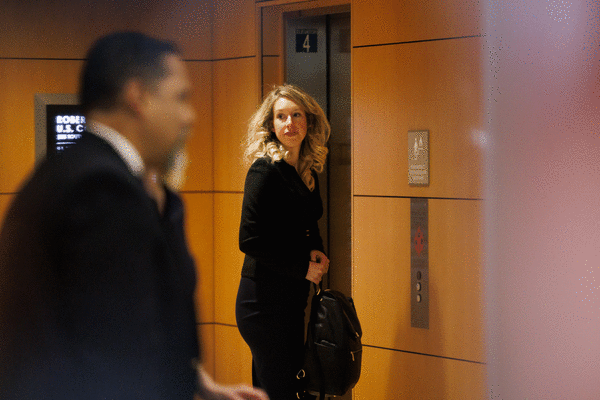
Elizabeth Holmes, serving a lengthy prison sentence for fraud, claimed Tuesday on social media that one of the most-damaging pieces of evidence against her — that she appropriated drug-companies’ logos and affixed them to internal Theranos reports to deceive investors — was a “false claim” and “(expletive) thrown against the wall” by federal prosecutors in her trial.
A post on Holmes’ X account said, “False Claim of Fraud: Theranos faked Pfizer endorsement to defraud investors by adding logo.” Holmes has no access to social media while incarcerated in federal prison, but describes the account as “mostly my words, posted by others.”
The “truth,” the post said, was “16 months of work in partnership with Pfizer who paid $900,000 for the validation.”
But jurors in her four-month trial heard that while Pfizer did pay Theranos $900,000 for an exploratory study, the pharmaceutical giant did not endorse or validate the report, but instead emphatically rejected its conclusions and Theranos’ technology. Still, the jury heard, representatives of wealthy investors believed the Pfizer logo showed the drug companies’ approval of Theranos’ technology.
Holmes admitted on the witness stand to adding pharmaceutical companies’ logos to reports lauding Theranos’ technology that were given to investors and budding business-partner Walgreens.
“I wish I had done it differently,” Holmes told the jury. She testified that she put the logos on the Theranos reports because “this work was done in partnership with those companies and I was trying to convey that.”
However, the jury saw a copy of an email Holmes sent to Walgreens with a comment that the reports were “from” the two companies.
Pfizer did not immediately respond to a request for comment.
Holmes was convicted in 2022 of four counts of felony fraud for bilking investors in her now-defunct Palo Alto blood-testing startup out of hundreds of millions of dollars via false claims about the technology. She was sentenced to more than 11 years in prison.
Shane Weber, then a scientist for Pfizer, had been tasked with a final review for the drug company to determine if it would work with Theranos, he testified at Holmes’ 2021 trial in U.S. District Court in San Jose.
During his testimony, Weber was shown a copy of the Theranos report that had the Pfizer and Theranos logos on it, and that Holmes emailed in 2010 to Walgreens executives when Theranos was trying to get its machines into the drugstore chain’s stores.
Holmes’ subject line in the email was “Pfizer Theranos System Validation Final Report,” and the report claimed Theranos’ technology had “superior performance” with “excellent” accuracy.
Weber testified that he disagreed with those claims. Regarding Pfizer’s “validation” of Theranos’ technology, Weber testified that he had come to the “opposite” conclusion, and that Pfizer never endorsed the technology.
“Theranos unconvincingly argues the case for having accomplished tasks of interest to Pfizer,” Weber wrote in a report to the drug firm. He recommended that Pfizer not invest more money or resources into working with Theranos.
The jury also heard that Holmes emailed Walgreens an internal Theranos report bearing the logo of a second major pharmaceutical firm, Schering-Plough, which later merged with Merck.
Schering-Plough scientist Constance Cullen told jurors that no one she knew at Schering-Plough agreed with the report’s assertion that Theranos produced “accurate and precise results.”
But representatives for high-profile investors in Theranos testified that the stolen Pfizer logo helped persuade them to put millions of dollars into the enterprise founded and led by Stanford University dropout Holmes.
A long-time lawyer for former U.S. Secretary of State Henry Kissinger testified that he believed the Pfizer logo meant the self-laudatory Theranos report was written by Pfizer, and showed the drug firm had approved Theranos’ technology.
Lawyer Daniel L. Mosley, who personally invested $6 million in Theranos, testified that the report had the Pfizer logo on every page, and was important to his decision to invest.
In a memo to Kissinger, who asked Mosley to look into Theranos and ended up investing $3 million in the company and taking a seat on its board, Mosley cited the Pfizer-emblazoned Theranos report as “the most extensive evidence supplied regarding the reliability of the Theranos technology and its applications.”
Mosley’s statements followed earlier testimony by an investment manager for the family of former U.S. Education Secretary Betsy DeVos, that Theranos sent her the Pfizer dual-logo report as the family was weighing what became a $100 million investment in Theranos. Investment manager Lisa Peterson testified that she believed Pfizer’s logo on the report — which also said “Pfizer, Inc.” directly below the title — meant Pfizer prepared it.
Holmes’ attack on evidence that led to her conviction comes amid an apparent campaign, via her X account, to obtain a pardon from President Donald Trump. In recent months, Holmes on X has repeatedly claimed she’s innocent, and posted a steady stream of content and comments aligned with Trump and his Make America Great Again movement.
The logos were a key element of the prosecution’s case, noted former Santa Clara County prosecutor Steven Clark, who followed Holmes’ case. Holmes’ claim that she was treated harshly and unfairly through a “false claim of fraud” fits with her apparent bid for a pardon from Trump, Clark said.
“That seems to go a long way with this administration in its approach to pardons,” Clark said.
_____
©2025 MediaNews Group, Inc. Visit at mercurynews.com. Distributed by Tribune Content Agency, LLC.






Comments