Judge's unusual criticism in dropped immigration case is latest strange twist for US attorney's office in Chicago
Published in News & Features
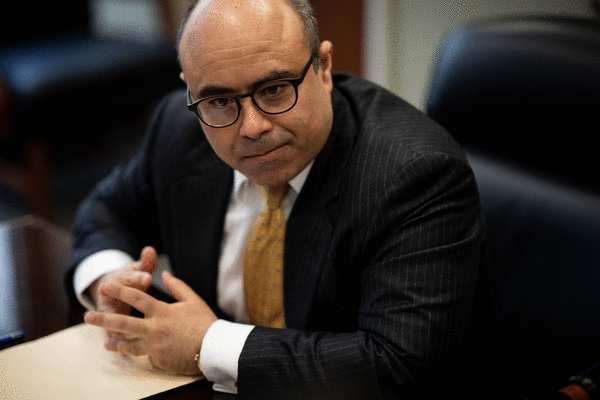
In the four months since U.S. Attorney Andrew Boutros was appointed to an open-ended term as Chicago’s top federal prosecutor, his office has seen a large turnover in leadership, been buffeted by the government shutdown and thrown headlong into the controversial Operation Midway Blitz immigration enforcement mission.
Unusual times to be sure. But then last week, things got even weirder.
After dismissing several criminal cases against protesters of the Trump administration’s aggressive immigration enforcement policies, the U.S. attorney’s office was called to the woodshed in an extraordinary opinion by a federal magistrate judge that lit up the water cooler talk in legal circles.
In granting the prosecution’s motion to dismiss assault charges against Dana Briggs, U.S. Magistrate Judge Gabriel Fuentes took the opportunity to opine more generally on the U.S. attorney’s office’s role in prosecuting a number of other immigration-related cases that have since fallen apart.
In his nine-page opinion, Fuentes wrote he could not “help but note just how unusual and possibly unprecedented it is” for Chicago’s venerable U.S. attorney’s office to bring charges “so hastily” that, once more facts came out, they were unable to obtain an indictment in the grand jury or were forced to dismiss the case as not provable.
“Being charged with a federal felony, even if it is later reduced to a misdemeanor, is no walk in the park,” Fuentes wrote. “… And any responsible federal prosecutor knows this. Any responsible federal prosecutor knows that federal charges, or any actions by the United States Attorney directed at the citizenry, must be undertaken with the utmost care.”
Fuentes, a former assistant U.S. attorney and journalist, closed by saying “doing the right thing has been a mantra of the Chicago U.S. Attorney’s Office for generations.”
“Let it remain so,” he said.
Fuentes’ opinion was cheered by some who saw the U.S. attorney’s office’s decision to bring serious felony charges against protesters — even in cases where the agents appeared to be the aggressors — as heavy-handed. Supporters also said Fuentes put into words what many have been worried about: that a traditionally apolitical and professional office was bringing cases without merit to satisfy some larger goal of the Trump administration.
Others, however, said Fuentes was way out over his skis, offering an op-ed style political commentary mostly on cases that he did not even preside over.
“Who does he think he is, grandstanding like that?” said Assistant U.S. Attorney William Hogan, a longtime veteran of the U.S. attorney’s office who has served under more bosses than anyone still there. “I have never in 45 years read an opinion remotely like that. It is shocking.”
Fuentes declined to comment further on the ruling Wednesday.
Hogan personally handled one of the cases that Fuentes criticized: Cole Sheridan, an Oak Park man accused of shoving Border Control Cmdr. Gregory Bovino in the back during a protest at the Broadview ICE facility on Oct. 3.
Sheridan became a mini-cause celebre in the west suburbs, where he was held up as an example of prosecutorial overreach in the Trump era.
But Hogan said that case actually showed the U.S. attorney’s office doing its job correctly. When agents make an arrest and refer the case for prosecution — with Bovino as the alleged victim and complaining witness in Sheridan’s case — prosecutors have to make a quick decision to file a charges or “cut them loose” pending further investigation, he said.
Hogan said prosecutors by and large chose the latter approach in the hundreds of cases referred to the office during Operation Midway Blitz. In Sheridan’s case, initial video footage from the scene did not capture the entire incident and a decision was made to file a criminal complaint based on sworn affidavits of the agents.
But as the case was prepared to go before the grand jury, Hogan said he asked for an extension to file an indictment so they could continue to investigate. During that time, they found someone had a camera “behind the lines who caught the entire incident on video and demonstrated to us the kid was innocent,” Hogan said.
Hogan filed a motion to drop the case Nov. 3 — exactly one month after the incident.
U.S. Magistrate Judge Heather McShain, unlike her colleague, granted the motion without fanfare, Hogan noted.
The U.S. attorney’s office declined to comment on whether cases like Sheridan’s damaged the credibility of Bovino going forward, saying in a written statement the office is “constantly evaluating new facts and information” in Midway Blitz investigation.
”This continuous review process applies to all matters—whether charged or under investigation,” the statement read. “It helps ensure that the interests of justice are served in each and every case, and that those cases that are charged are appropriately adjudicated through our federal court system.”
In an interview last week, Boutros said Operation Midway Blitz was unprecedented for the office and put a strain on staff that only got more intense after the government shut down in early October.
Boutros said the office processed more than 200 immigration-related cases in just 60 days, more than half what was typically done in a full year, even as many staff members, including the office’s civil attorneys, were working limited hours due to furlough or were going without pay.
A chart released as part of U.S. District Judge Sara Ellis’ recent preliminary injunction restricting the use of force by agents showed that out of nearly 100 protest-related arrests around the Chicago area between Sept. 2 and Oct. 29, only 15 were approved for charges by the U.S. attorney’s office.
Many of those arrested were issued citations, the chart shows, while about 20 others were listed as “declined,” meaning they did not face any legal action. Investigations were “continuing” for a handful of others.
Boutros decline to comment on Fuentes’s opinion.
Meanwhile, Fuentes’ negative remarks about are not the only reason the U.S. attorney’s office has been in recent headlines.
In August, several media outlets reported that Boutros had sent out an unorthodox email to former prosecutors who were now in private practice asking them to consider coming back to the office and to encourage friends who might be interested to do the same.
The Washington Post reported on the letter as an example of a wider problem of the Justice Department bleeding talent due to the Trump administration’s policies, which have led to unprecedented turmoil and embarrassing episodes such as the filing of charges — and their abrupt dismissal — against former FBI Director James Comey.
The U.S. attorney’s office in Chicago has indeed seen an exodus of veteran prosecutors and section leaders this year.
Shortly before Boutros was first appointed in April, longtime Assistant U.S. Attorney Amarjeet Bhachu, chief of the Public Corruption and Organized Crime section who’d headed investigations into Chicago mobsters and politicians such as Edward Burke and Michael Madigan, announced he was leaving.
Steven Dollear, the National Security and Cybercrime section chief, soon followed. Then, in August, Erika Csicsila abruptly quit after serving as the chief of the entire criminal division — a move that several sources said came after she had initially accepted reassignment to the public corruption squad.
In recent months, the office has also lost Barry Jonas, a top national security prosecutor, and other line prosecutors with years of experience.
And this month, Sarah Streicker, the veteran prosecutor who replaced Bhachu as head of public corruption just months ago, is also leaving the office.
While the number of departures in such a short period of time is unusual, it’s typical for there to be a shakeup whenever there is a change in administrations and a new U.S. attorney comes in, particularly with top deputies who report directly to the boss.
That reality can be significantly augmented in a solid-blue city such as Chicago, where ambitious attorneys looking to get ahead know that Democrats still hold most of the reins and having helped execute the justice policies of the Trump administration — such as the wildly unpopular Midway Blitz surge — is certainly no résumé booster.
In his comments to the Tribune, Boutros acknowledged staffing levels in his office are down, though the reasons for it are complex. When he started earlier this year, there were 142 total attorneys in the office, including criminal prosecutors and attorneys on the civil litigation side.
As of Wednesday, those numbers had dropped to 127, with only 90 criminal prosecutors working in the Chicago office and another six in Rockford, according to figures provided to the Tribune.
Some current and former staffers who spoke to the Tribune on condition of anonymity said the office has changed over the years in ways that have little or nothing to do with Trump. People tend to stay for shorter periods, leaving a higher percentage of young attorneys and a dearth of veterans with more than six years under their belts. There’s also been less drive to bring difficult cases or take risks in big investigations, some sources said.
Boutros said he was in the process of a hiring surge that was bringing fresh talent into the office after years of sagging productivity that landed the office at or near the bottom when it comes to key metrics kept by the district courts, including indictments filed and criminal trials handled per year.
“We are building up the ranks again,” Boutros said, adding that he’s been green-lighted to hire 25 new prosecutors in the coming weeks, and that applications have come in from experienced attorneys all over the country. “I am excited to have the ability to restock our office with veteran federal criminal and civil prosecutors.”
Boutros said indictments are on their way up, particularly when it comes to gun crimes and violence, adding the office has achieved “impressive results” with far fewer prosecutors and resources.
Overall, there were 366 federal criminal indictments filed January through October, an increase of 45% over the same period last year, Boutros said.
Hogan, who joined the U.S. attorney’s office in 1982 and has seen it cycle through eight presidential administrations, said the Chicago office has remained stable even as other districts have been mired in turmoil.
That includes Trump’s appointment of his former personal lawyer Alina Habba as U.S. attorney in New Jersey and the more recent fallout over Lindsey Halligan, another acolyte of the president’s whose selection to lead the U.S. attorney’s office in Eastern Virginia disintegrated when the judge presiding over the Comey case ruled she’d been illegally appointed.
Hogan said Boutros is no Habba or Halligan, but an experienced former federal prosecutor and white-collar attorney who’s spent countless hours interviewing each employee to find out where they think improvements can be made in the office.
Hogan has also helped out in the interviewing process and seen that there are many “extremely competent people waiting to take jobs” here, including experienced attorneys from other U.S. attorney’s offices around the country.
“They’re beating down the doors,” Hogan said.
_____
©2025 Chicago Tribune. Visit chicagotribune.com. Distributed by Tribune Content Agency, LLC.



Comments