'You have to make sacrifices': Central Floridians struggle with high costs
Published in Business News
ORLANDO, Florida — At a west Orlando Walmart, Natilee Hamilton carefully considers the cost of each item she places in her cart as she struggles to adhere to a budget outpaced by inflation.
It is a balancing act that extends beyond the grocery store. In the past few years, she’s had to defer dental work, eye exams and home repairs because she didn’t have the money.
“You have to make sacrifices. Huge sacrifices,” said Hamilton, 59, who worked at an Osceola County jail for 28 years but after an injury now gets by on disability payments. “You have to figure out, ‘Do I want to eat, pay my light bill or my water bill?’ Stuff that you really need you have to put on hold.”
Across Central Florida, where the median wage is among the lowest in the country for large metro areas, higher prices for groceries, housing and now gas have left many working-class residents straining to cover the basics. Food banks report a surge in demand, and those with jobs are among those seeking help.
Inflation spiked during the 2020 pandemic, driving up the cost of food, housing and other essential goods and services. Though inflation has since slowed, prices have not gone down. In 2024, the United Way reported that more than 44% of Central Florida households, while living above the poverty line, struggled to cover all their basic expenses, from childcare to transportation.
And now the war with Iran is driving price hikes at the gas pump — up more than a dollar a gallon in Florida. The higher oil prices impact the cost of other products, too.
“Every time I go to the supermarket, there’s always something going up,” said Charles Grey, an 82-year-old Orlando resident who lives off his Social Security. “You buy something today and tomorrow you go back and it’s a different price.”
Sean Snaith, director of the University of Central Florida’s Institute of Economic Forecasting, was hopeful earlier this year that the country’s economy was slowly moving in the right direction. But the war now has him doubtful prices will come down anytime soon.
“We were making progress in that wages and salaries were growing. They were growing faster than the cost of living,” Snaith said. “And then now here we are, under the fog of war and dealing with certainly a surge in some areas of the cost of living.”
Already, the Orlando area’s rental costs, which spiked 39% between 2019 and 2023, leave many lower-income residents paying far more for housing than their incomes comfortably allow, according to the Shimberg Center for Housing Studies at the University of Florida.
More than 112,000 people in Lake, Orange, Osceola and Seminole counties are “cost burdened” renters, the center’s 2025 annual report.
The average rental cost in Orange County for a two-bedroom apartment is now more than $1,700 a month, according to Zillow.
For Glenda Rigby, paying so much in rent, though she wants a home for her children in a safe neighborhood, seems out of reach, with each stop to get gas now further eroding that dream.
“It just seems like, when I think I have a budget plan and have everything figured out, everything costs more money,” Rigby said. “Like I just spent fifty dollars to fill up the gas tank the other day. Fifty dollars and they still wanted me to put more gas in. It wasn’t even completely full.”
After ending a marriage in which she was the victim of domestic violence, Rigby went to a drug rehabilitation program and now lives in transitional housing in the Orlando area in a space that accommodates only her. Her children, ages 13 and 16, are staying with their grandfather in Cocoa, and she doesn’t like the neighborhood or the local schools. She wants better for them, she said, “but I just can’t do it.”
She works full-time at One Heart for Women and Children, a food bank in College Park, and is trying to save enough for an apartment where her family can live together. But when she looks at rent prices, and knows she’ll need first and last month’s rent plus a security deposit to move in, she feels dejected.
“It just seems like more money’s going out, rather than in my savings,” she said. “Even just going to get yogurt and a couple of frozen meals, I feel like I’m spending like seventy dollars on nothing, and it keeps going up.”
Officials at One Heart said that since the pandemic the demographics of those seeking help has changed.
“In the last few years, what we’re seeing is people who are employed need more help than previously,” said Cindy Underwood, the nonprofit’s grant writer. “They’re not coming close to meeting their needs. And what happens is they have to choose between, ‘Am I going to pay for food or am I going to pay for my kid to go to the doctor?’”
Second Harvest Food Bank of Central Florida, which supplies food to One Heart and to about 400 other food pantries, said demand has increased across the region. Last year at this time, the agency was passing out enough food to supply about 300,000 meals a day. This year, that number has increased to 330,000 meals a day.
“We continue to hear from our partners that if they had more food available, they could feed more people, because they’re seeing more people,” said Greg Higgerson, the agency’s chief development officer.
Some residents don’t need free food but say higher prices have led them to alter their shopping lists when they go to the store.
Maxine Fergusen, a cook at a restaurant at Orlando International Airport, said she can no longer afford what she once considered staples.
“You got to be careful what you buy. You got to count it when you pick it up,” Fergusen said. “I can’t even buy water. I boil my water and drink it now.”
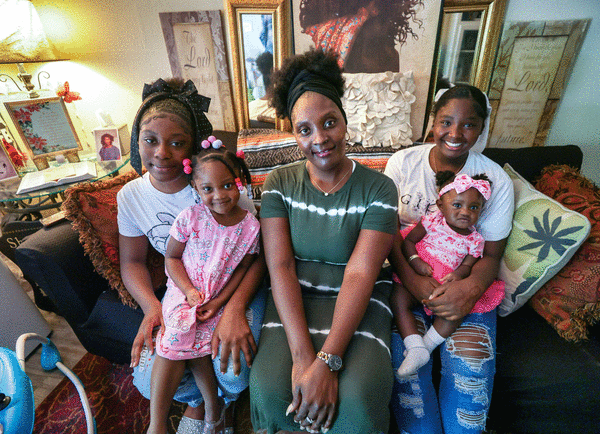
When the pandemic hit, Shanaya Mims, 36, was renting a 3-bedroom, 2-bathroom condo in Altamonte Springs, near Cranes Roost Park, for $1,250 a month.
“I didn’t have one worry in the world where my kids were because that’s how safe my neighborhood was, and that’s how close-knitted the community was,” said Mims, a single mother with four children.
She was laid off from her job cleaning houses and offices during the pandemic and relied on credit cards to get by for a time.
She returned to work eventually, but in 2022, when she went to renew her lease, her landlord raised her rent to $1,650 a month. She couldn’t keep up with that payment, and her family was evicted. They lived for a while with relatives and even slept in their car some nights.
Now Mims rents a two-bedroom, one-bath apartment near Camping World Stadium for $1,050 a month. At about 600 square feet, it is half the size of their place in Altamonte Springs, and doesn’t have central heat or air.
Her younger sister lives with her, sleeping in a room with Mims’ four children, which is barely large enough to fit the two sets of bunk beds and a bassinet.
Mims worries about crime in the neighborhood and for her children’s safety when they go outside to play.
But with limited income, bad credit and an eviction on her record, it is the best she can do.
She’s now working two cleaning jobs, an average of 60 hours a week, to try and get her family in a better position. But the rising costs have her feeling stuck.
Many nights, her children eat ramen noodles or peanut butter and jelly sandwiches for dinner because it’s all she can afford.
“Sometimes we can’t get the groceries we need. Sometimes I’m literally riding around on ‘E’ to get to work and get the kids to school,” Mims said. “There are nights that we don’t have lights on, I’m ashamed to say.”
©2026 Orlando Sentinel. Visit at orlandosentinel.com. Distributed by Tribune Content Agency, LLC.










Comments