Backlash builds against AI-powered digital price tags in stores
Published in Business News
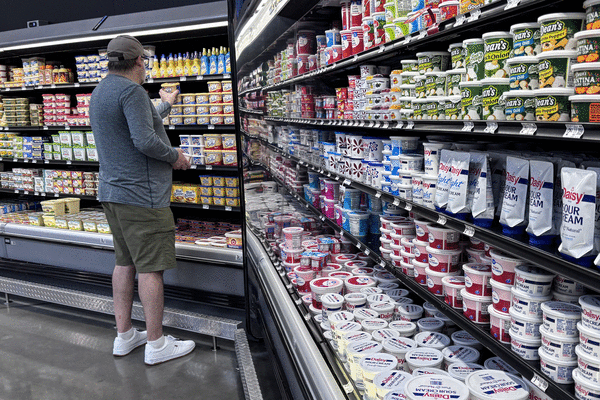
MINNEAPOLIS — As more retailers bring AI-powered technologies into stores — including charging different customers different prices for the same item — union leaders and lawmakers are starting to push back.
Retail chains have long varied prices from store to store. But with AI, companies are experimenting with more data-driven pricing, and technology is being developed that could adjust prices as shoppers move through aisles, based on factors like location or loyalty data.
Known as surveillance pricing, the practice has led lawmakers in Minnesota and across the country to propose bills aimed at curbing what they call “predatory pricing.”
The proposed bills also touch on electronic shelf labels, or ESLs — digital price tags that update in real time, rather than relying on employees to swap out paper tags.
Walmart has already begun installing ESLs, including in Minnesota. While the retailer and others say they don’t use surveillance pricing, other forms of dynamic pricing are becoming more common.
Retailers say digital price tags can benefit both stores and shoppers. By automating time-consuming tasks like replacing paper tags, companies can free up workers for customer service and keep shelves stocked more efficiently.
But leaders from the United Food and Commercial Workers (UFCW) Locals 663 and 1189, along with DFL lawmakers, are skeptical.
“Corporations want you to believe that ESLs will only help the customer,” Diana Tastad-Damer, secretary-treasurer of UFCW 1189, said at a news conference at the State Capitol on Wednesday. “With surveillance pricing and ESLs powered by AI, mass data collection and automation, consumers don’t stand a chance, and they won’t be alone. Workers will suffer, too.”
Rep. Samantha Sencer-Mura and Sen. Lindsey Port, the bills’ sponsors, said in statements to the Minnesota Star Tribune that constituents have raised concerns about affordability and the regulation of AI.
“All I’ve heard ... is that they want us to be laser-focused on affordability and are concerned about big tech surveillance of our purchases,” Sencer-Mura said.
The union leaders argue the shift could ultimately reduce staffing levels or change the nature of grocery jobs, while also opening the door to pricing models more commonly seen in industries like airlines and ride-hailing, where prices fluctuate based on demand.
Most Minnesota stores not using technology
“Prices aren’t going to improve. The shopping experience isn’t going to improve,” said Rena Wong, president of UFCW 663. “The only thing that is going to improve is the bottom line.”
Electronic shelf labels are legal in every U.S. state. New York requires companies to disclose when they use personal data to set prices, though it hasn’t banned surveillance pricing.
Similar proposals have been introduced in several states, including New York, Washington and Arizona, as part of a broader national campaign launched by the UFCW earlier this year.
Walmart said digital shelf labels will help customers.
“Price updates are people-led and support Walmart’s Everyday Low Price promise,” the Arkansas-based company said. “Prices are the same for all customers in any given store and are consistent regardless of demand, time of day or who is shopping.”
A Target spokesperson, Lunds & Byerlys and Cub said their stores do not use the technology or pricing practices targeted by the legislation. Hy-Vee did not immediately respond to a request for comment.
Sencer-Mura said the bills are proactive and responsive to changes lawmakers and unions are seeing in grocery stores across the state.
“Maybe true surveillance pricing is not here in a huge way in Minnesota. Maybe electronic shelf labeling is not here in Minnesota yet, so let’s do what we can while we can to stop these companies in their tracks,” she said at the news conference.
Jenny Winkels, a Super One Foods pricing coordinator in Two Harbors, said customers are already concerned about affordability, and the ability to change prices based on the shopper only worsens those fears.
She added that prohibiting the use of ESLs and surveillance pricing assures customers “the price of milk on a Monday will not be changing the next morning.”
Research shows concerns could be overstated
Fears of surge pricing in grocery aisles have grown as AI and electronic shelf labels have become more common. But recent academic research suggests those concerns may be overstated.
A study analyzing hundreds of millions of transactions across more than 100 Walmart and Kroger stores found “virtually no” evidence of real-time surge pricing before or after digital labels were introduced.
Researchers concluded that the complexity of grocery pricing — involving thousands of products, supplier agreements and long-planned promotions — makes rapid price changes difficult to implement.
Instead, they found digital labels are more often used to improve efficiency, reduce labor costs and mark down items nearing expiration.
Pat Garofalo, president of the Minnesota Grocers Association and former Republican state representative, wrote in emailed comments that banning ESLs is the “21st century equivalent of candlestick makers trying to ban light bulbs.”
He added that the technology reduces waste caused by paper tags and decreases error rates in pricing.
Pricing practices have come under scrutiny
Dynamic pricing, sometimes referred to as surge pricing, adjusts prices based on broad market factors like demand, inventory and competitor pricing. For example, stores in different suburbs or states may charge different prices, and online prices can vary as well.
Surveillance pricing, on the other hand, uses personal data — like browsing history, location, device type or behavior — to set customized prices for individual consumers.
For instance, when a shopper uses a retailer’s app to find a product, it can signal when they’re nearing a specific aisle. Based on past buying habits, electronic shelf labels could raise the price of Toll House cookies if the system determines the shopper is unlikely to compare options, said Akshay Rao, professor of marketing at the University of Minnesota’s Carlson School of Management.
“Surveillance pricing is: ‘I’m watching you, and I know your history. And I’m setting prices consistent with my understanding of your willingness to pay,’ ” Rao said.
Dynamic pricing — the broader practice of varying prices by location — has drawn scrutiny in Minnesota before. A 2019 KARE 11 investigation found Target’s app displayed higher prices to customers when they were inside or near a store, prompting the retailer to update how its labeled pricing.
More recently, a Consumer Reports investigation found Instacart used AI tools that enabled retailers to vary prices between customers. The company later said it would stop offering technology that let grocers charge different shoppers different prices for the same items at the same time.
Senate Majority Leader Erin Murphy said banning surveillance pricing is about fairness.
“If my neighbor and I go to the same store on the same day and stand in the same aisle, the bananas should cost the same,” Murphy said. “We’re learning with reports about surveillance pricing that it’s not hurting people with the money to spend on bananas, regardless of what they cost, but instead it is hurting the people who can’t afford the ever-changing price.”
While it’s difficult to gauge how surveillance pricing is being used in Minnesota, experts say it’s only a matter of time before retailers start adopting similar pricing strategies.
“Now, whether [changing prices] happens every second or every minute or every hour, or whether it tracks cell phone data, I don’t know for a fact, but I suspect that if the store is rational, it will be doing it, and if it’s not doing it now, it will at some point because there’s money to be made,” Rao said.
©2026 The Minnesota Star Tribune. Visit at startribune.com. Distributed by Tribune Content Agency, LLC.









Comments