Live Nation CEO pay tied to 'solving' DOJ-antitrust problem
Published in Business News
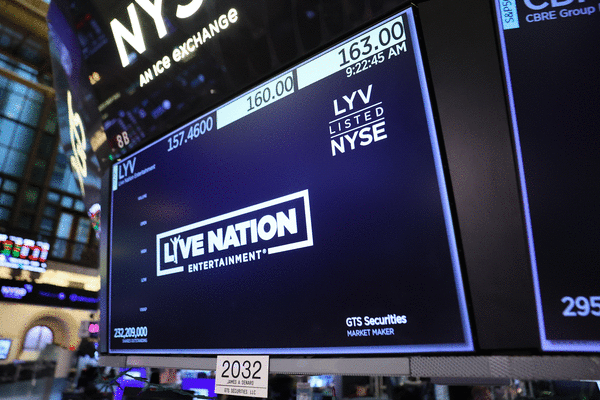
Live Nation Entertainment Inc. Chief Executive Officer Michael Rapino told a New York jury that his multi-million-dollar compensation is tied in part to his “solving the DOJ problem” — a reference to the threat posed by government antitrust enforcers who want to break up the company.
About 90% of Rapino’s pay comes from a cash bonus and stock grant, the CEO acknowledged Thursday during testimony at an antitrust trial in federal court. Live Nation’s board bases those payouts on whether certain profit targets are met, as well as a “regulatory affairs” goal set by the board, he said. The U.S. Department of Justice and dozens of states sued the company claiming it operates a monopoly in the live music business.
The DOJ reached a surprise settlement with Live Nation one week into a federal antitrust trial. But a group of state attorneys general, led by New York, are moving forward with their case, seeking to force the company to sell its ticketing arm, Ticketmaster.
Under questioning by an attorney for a group of states, Rapino denied the goal for his compensation was only related to the Justice Department’s case, saying Live Nation has regulatory issues around the world. The board was focused on “management of, not exactly the result” of, the antitrust lawsuit, Rapino said. It’s “not whether we win or lose” this case, he said.
Rapino, dressed in a form-fitting black suit, testified for nearly six hours Thursday, often asking for clarification during questioning by the states’ attorney. Rapino, the most senior Live Nation executive to take the stand at the trial that began March 2, during breaks snacked on white chocolate and sipped Diet Coke — the same drink of choice as the judge, who joked about it.
U.S. District Judge Arun Subramanian, who is overseeing the trial, ruled on Wednesday that the states couldn’t disclose the amount of Rapino’s compensation — which the states claim would be more than $27 million – because it could prejudice the jury. The states say he’s also one of Live Nation’s largest shareholders, but the judge ruled Thursday jurors can only be told the percentage of his ownership stake, not the dollar value.
Live Nation’s lawyers reiterated their claims Thursday that allowing the states to discuss anything about Rapino’s compensation is prejudicial to their defense.
Jeffrey Kessler, an attorney representing the states, argued that it was “unusual” for the CEO of a public company to be the “largest private owner.” That substantial stake means that “nobody can question him,” Kessler said. “A board member isn’t going to question him.”
Lauren Moskowitz, a lawyer for Live Nation, rejected the idea that Rapino was the largest shareholder saying he was only “the single human being who holds the largest number of shares.” According to data compiled by Bloomberg, the biggest holder is Liberty Live Holdings Inc., with the rest of the top 10 mostly institutional investors.
Exclusives
The states have also been critical of exclusive contracts that they say Live Nation uses to block out competition for ticketing, concert promotion and where the performances will take place. In a tense exchange with New York’s Kessler, Rapino maintained that concert venues and not Live Nation want exclusive agreements.
“The venue makes the decision, not me,” Rapino said. “I don’t tell the billionaire what to do with his venue. He tells me.”
Kessler responded, “The moat you built around your castle is that you have exclusives for your ticketing business and promotion business. That keeps competitors from getting near your castle.”
“Absolutely not,” Rapino said.
Earlier in the trial, jurors heard John Abbamondi, the former CEO of BSE Global — which owns the Barclays Center in Brooklyn, New York, and the Brooklyn Nets basketball team — testify about a phone call with Rapino after the venue decided to switch from Ticketmaster to SeatGeek Inc.
Rapino accused Abbamondi of engaging in an “entrapment strategy” by bringing up concert promotion during their discussion about ticketing. While Barclays and Live Nation did have a long-term concert promotion agreement, Rapino said that contract doesn’t provide a guarantee. Instead, it requires his company to make its “best efforts to deliver shows,” he said.
Barclays had promised to give Live Nation a chance to match any offers that had better financial terms, Rapino said, so he was “upset” and “caught flat footed” when he found out the venue was switching.
“He was trying to trap me,” Rapino said of Abbamondi. “I knew where he was headed. It was pretty obvious.”
Lawn Chairs
Among the claims by the states is that Live Nation has used its monopoly power over ticketing and venues to impose excess fees and to generate more revenue from extra services.
For example, in 2024, Live Nation eliminated the ability of fans to bring their own lawn chairs to shows at its outdoor amphitheaters, which the states said helped boost the company’s revenue by renting its own chairs.
Rapino said the policy was developed because of “a safety issue” and to respond to fan complaints about differing sizes of chairs. An October 2024 presentation about Live Nation’s venues, however, said the company was making more on upsells “from policy to no longer allow outside lawn chairs,” with one slide estimating the company increased revenue by $7 million from eliminating lawn chairs at 12 venues. Live Nation’s adjusted operating income at large amphitheaters increased 32% between 2022 and 2024, with a 237.4% increase at Live Nation’s smaller or boutique amphitheaters.
Rapino pushed back on several of the numbers, saying the company “didn’t make anywhere near this.”
Earlier this week, the head of ticketing for Live Nation’s venues testified about chats from 2022 in which he denigrated fans as “so stupid” for paying high fees on VIP add-ons at concerts and boasted about “robbing them blind.” Rapino said he only became aware of the chats last week, which he called “disgusting.”
The CEO said the employee hasn’t been disciplined yet, but Rapino said the issue was one he expected to “deal with” this week. “We tend to give our employees a break and we don’t fire easily,” Rapino said.
Oak View partnership
In 2022, Live Nation signed a 10-year deal with Oak View Group to provide ticketing services at OVG’s venues, Rapino confirmed. Oak View was founded in 2015 by high-profile music manager and former Ticketmaster CEO Irving Azoff and Tim Leiweke, former head of AEG. The Justice Department and states alleged in their original lawsuit that Oak View had a central role in Live Nation’s anticompetitive strategy.
In testimony Wednesday, Christian Lewis, an executive at rival ticketer Paciolan, said that after Oak View Group took over operation of some venues in 2022, it transitioned the ticketing contracts from Paciolan to Ticketmaster. Paciolan, a unit of Silver Lake’s Learfield that tickets mainly college athletic events, often wasn’t even given an opportunity to compete, Lewis said.
Rapino pushed back on the idea that Paciolan could have offered better terms.
Oak View Group would only switch ticketers “if the terms were better,” the Live Nation CEO said. “They wouldn’t be doing it for charity.”
In a December 2021 email, Rapino complained to executives at private equity firm Silver Lake — also an investor in Oak View Group — about some contemplated investments that would compete “with Live Nation-OVG.”
“We were working together,” Rapino said of Live Nation and Oak View Group in explanation for why he hyphenated the two company names in the message.
The case is U.S. v. Live Nation Entertainment, 24-cv-03973, U.S. District Court, Southern District of New York (Manhattan).
(With assistance from Mikella Schuettler.)
©2026 Bloomberg L.P. Visit bloomberg.com. Distributed by Tribune Content Agency, LLC.





Comments