USW prepared to strike at BP refinery, leadership announces
Published in Business News
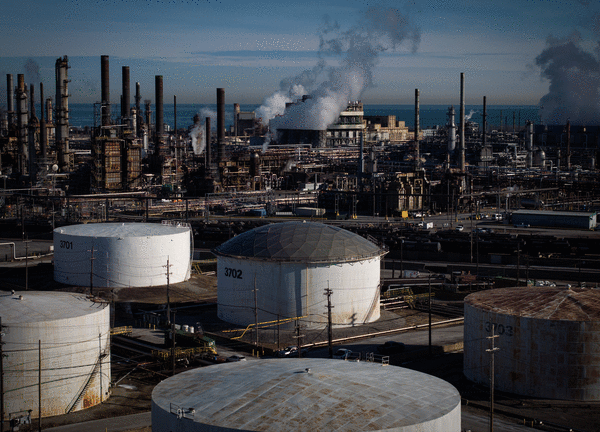
The United Steelworkers Union announced on Thursday that its workers should prepare for a strike or lockout at the BP Whiting refinery.
USW 7-1 members authorized an initial financial transfer from its reserves into a strike and defense fund, according to a Thursday USW news release.
On Jan. 5, BP and the union started negotiations for a new collective bargaining agreement because the former one expired at 11:59 p.m. on Jan. 31, according to the BP website. The union operated under a three-year agreement.
The parties were unable to reach an agreement by the deadline.
According to the USW, both parties agreed to rolling 24-hour extensions of the agreement for refinery workers. Since then, the union alleged BP “would not honor any contract extension for pipeline employees across the Midwest and there has been no meaningful progress in negotiations.”
“BP has rejected almost all of our proposals with very little discussion,” Eric Schultz, president of USW 7-1, said in the news release. “We have heard from many of our members who are ready to strike, in order to move the company toward a fair agreement, but this is not an option that we take lightly. We will continue to bargain in good faith and stand united in demanding a fair contract for all of our local union members.”
BP responded to the union’s intent to strike in a Thursday statement.
“We remain focused on reaching a fair and equitable agreement and avoiding a work stoppage,” the statement said. “Allegations that there has been little dialogue between BP and the union are inaccurate. BP continues to bargain in good faith with the USW to improve the long-term competitiveness of our business and create a sustainable future for our workforce, company and community. The BP Whiting Refinery is committed to safe, compliant, and efficient operations. We value our employees and their contributions.”
In preparation of a strike or lockout, the union encourages its members to remove personal belongings from the workplace, schedule any medical, dental or vision appointments, refill prescriptions with 90-day supplies, and postpone major purchases or financial obligations until an agreement is reached.
The USW claims that BP’s proposal would “gut the union,” alleging that they asked the union to waive many of their legal bargaining rights and allow for tracking and artificial intelligence surveillance of the refinery’s union employees.
Ten years ago, the USW went on strike for 99 days at 12 refineries nationwide, concerned with safety, training and manpower. According to the union, BP had about 1,100 USW workers, and today about 300 fewer union workers are at the refinery.
“We’ve seen firsthand the impact of the cuts BP has made since our last contract and how it has impacted operations,” Schultz said. “Our friends and neighbors in Northwest Indiana have personally experienced the impacts of those cuts, as well. We’re not willing to bargain away a safe workplace and good, stable union jobs so that BP can be more profitable.”
BP first provided online updates on Jan. 8, and it said the goal is to make sure the refinery remains safe and competitive for decades to come. The company did not specifically share its 11 proposals online but said they focus on three themes: safety, operational excellence and workforce optimization; market competitiveness and cost efficiency; and future risk mitigation.
On its website, BP denied that it’s seeking to remove 200 jobs from the refinery.
“The company has proposed reclassifying console operators to become salaried supervisory personnel, which is common in the industry and supports improved safety focus,” the website says. “The company has also proposed to outsource non-core activities such as builders and HVAC consistent with practices at other U.S. refineries.”
BP has held 42 documented bargaining sessions with the union since Jan. 5, according to an email from the company’s spokesperson. The parties have also met in informal settings to discuss the proposals.
BP has also trained replacement workers, consisting of current and former employees, to operate the refinery safely and in compliance with regulations if a work stoppage occurs, according to a Thursday email.
BP last provided online updates on its current proposals on Tuesday, according to its website. The company has regularly provided updates online since negotiations began.
According to the BP website, if employees are absent from work because of a strike or lockout, they will not be eligible for employee benefits. They can still receive benefits through alternative means, according to BP, including COBRA.
“While it may be a difficult message for our employees, it is consistent with the treatment of other union-represented employees who have been on strike, or locked out, at other refineries, chemical plants or other petrochemical complexes,” the website says. “This has also been true for non-represented BP employees when they have changed to a similar status. We encourage employees to carefully review this information and take necessary action should a strike or lockout occur.”
____
©2026 Chicago Tribune. Visit at chicagotribune.com. Distributed by Tribune Content Agency, LLC.









Comments