Chicago's Metropolitan Capital Bank becomes first US bank failure of 2026
Published in Business News
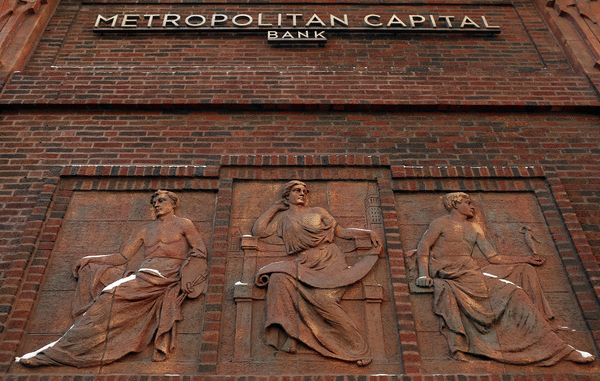
For the second year in a row, a Chicago bank became the first in the nation to fail.
Metropolitan Capital Bank & Trust, a so-called Universal Bank that focused on small- to medium-sized businesses, was closed Friday by the Illinois Department of Financial and Professional Regulation, citing “unsafe and unsound conditions and an impaired capital position.”
The Federal Deposit Insurance Corporation was appointed as receiver and entered into a purchase agreement with Detroit-based First Independence Bank, which reopened the failed bank under a new banner Monday, regulators said.
“We want to be clear that no depositor will lose any money as a result of this action,” Susana Soriano, acting director of IDFPR’s Division of Banking, said in a news release.
Metropolitan Capital Bank & Trust had $261 million in assets and total deposits of $212 million. First Independence Bank agreed to assume “substantially all deposits” and purchased $251 million of the failed bank’s assets, according to the FDIC, which will retain the remaining assets for later disposition.
The FDIC estimates the failure will cost its Deposit Insurance Fund about $19.7 million, but the actual cost will change as the retained assets are sold, the agency said.
Located at 9 E. Ontario St. in the River North neighborhood, Metropolitan Capital Bank & Trust opened in 2005. Founded as a Universal Bank, the mission was to provide a broad array of financial services, including commercial, private and investment banking, on a single platform. On its website, Metropolitan claimed to be the only boutique Universal Bank in North America focused on small- to medium-sized businesses and their founders.
First Independence Bank, a state-chartered commercial bank, was founded in 1970 with the mission to be a “beacon for capital accumulation” by delivering financial services to underserved and minority communities in the Detroit area. It is the only African American-owned bank headquartered in Michigan, according to the bank’s website.
“First Independence Bank is well-positioned to continue essential banking services for Metropolitan Capital Bank & Trust customers,” Soriano said in the release.
Reached by phone, a First Independence Bank spokesperson declined to comment Monday.
Chicago also had the dubious honor of having the first of only two bank failures nationwide last year. Pulaski Savings Bank was closed by the Illinois Department of Financial and Professional Regulation in January 2025, and its deposits and assets were assumed by Des Plaines-based Millennium Bank.
The Santa Anna National Bank in Texas failed in June 2025, according to the FDIC.
Before that, Chicago went nearly a decade without a bank failure. But in 2017, two Chicago banks failed, including one that imploded in a politically connected scandal.
Seaway Bank and Trust, a former African American-owned Chicago bank, was closed by regulators and acquired by State Bank of Texas in January 2017.
In December 2017, Washington Federal Bank for Savings, a century-old Bridgeport-based savings association, collapsed amid a $31 million embezzlement scheme and was closed by federal regulators.
Royal Savings Bank of Chicago bought Washington Federal’s insured deposits and took over its two locations in the Bridgeport and Little Italy neighborhoods.
Washington Federal had at least $66 million in bad loans on its books when regulators took control of the bank. The embezzlement scheme led to criminal charges against 16 defendants, including high-ranking bank officers and former Chicago Ald. Patrick Daley Thompson, who was forced to resign from City Council after being convicted of lying to regulators about loans he received from the now-shuttered bank.
John Gembara, 56, CEO and president of Washington Federal, whose grandfather launched the bank in 1913, took his own life in the home of bank customer Marek Matczek, where he had been staying, less than two weeks before the bank’s closure, according to a medical examiner’s report.
©2026 Chicago Tribune. Visit at chicagotribune.com. Distributed by Tribune Content Agency, LLC.









Comments