After a difficult 2025, here's what could be ahead for UPS
Published in Business News
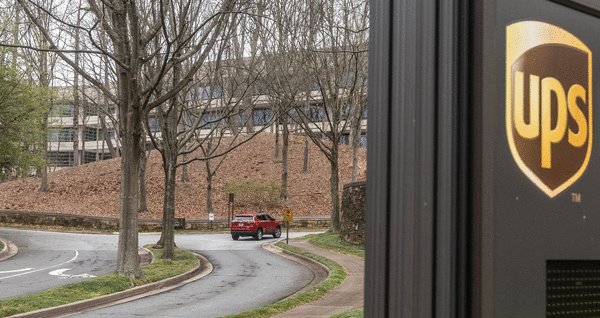
While a company’s stock price doesn’t always tell the whole story, Sandy Springs, Georgia-based UPS’ shares have certainly been telling one in 2025.
This year, the global shipping giant’s stock reached lows it hadn’t seen since the COVID-19 pandemic first hit the markets in 2020.
Nearly a year ago, UPS shares tumbled nearly 20% after the company revealed a major rollback in its relationship with its largest customer, Amazon. It also cut back part of its business with the U.S. Postal Service — both changes meaning less shipping volumes and less revenue.
It all amounts to the “largest network reconfiguration in UPS history,” the company declared.
The math sent alarm bells through the investor community. UPS — like other shippers — had already been grappling with an underlying post-pandemic freight recession. Then came the chaos of the Trump administration’s trade war, pressuring shippers like UPS and its customers.
UPS has slashed tens of thousands of jobs and closed buildings to save money.
On top of it all, this November saw a tragic plane crash at the company’s Louisville air shipping hub, which killed three UPS pilots and 11 people on the ground.
Satish Jindel, president of shipment technology firm ShipMatrix, said in the four decades he’s been following the company, 2025 has been “probably their most challenging year.”
But company leaders say they’re well on their way to enacting a long-term strategy that sets the company up for future success. UPS is pursuing a “better, not bigger” approach, CEO Carol Tomé has said for years.
Chief Commercial and Strategy Officer Matt Guffey told The Atlanta Journal-Constitution via email it has been “one of the most transformational years in our company’s history.”
And CFO Brian Dykes says the plan is showing early signs of working — even if the stock is still down year-to-date.
The plan
Dykes explained the Amazon move is part of a decision to rework UPS’ entire network over a year and a half to move away from less profitable shipments.
“There’s just not a lot of margin in delivering T-shirts to houses,” he said.
Where the company sees opportunities are segments like complex health care logistics, e-commerce returns, international shipping lanes, offering fulfillment and distribution services to small- and medium-sized businesses and growing its global supply chain presence.
UPS has been acquiring companies like specialized health care logistics providers Andlauer Healthcare Group, Frigo-Trans and BPL to that end.
But to make space for that new business, the company needed to move past its parcel delivery concentration, including its Amazon reliance, he said.
“We see huge opportunities to continue to grow our business in these large markets that, quite frankly, are probably not servicing e-commerce volume just in the U.S.”
“What we’re doing right now … is huge,” Dykes said of the changes.
But to make space for that new business, the company needed to move past its parcel delivery concentration, including its Amazon reliance, he said.
“We see huge opportunities to continue to grow our business in these large markets that, quite frankly, are probably not servicing e-commerce volume just in the U.S.”
“What we’re doing right now … is huge,” Dykes said of the changes.
The 118-year-old company has never consolidated its U.S. network in the way it is doing right now, he said.
“We’re really fundamentally changing not only the customer base that we’re targeting, but also the guts of how we target them.”
So what does a future UPS look like?
Today, it is the self-proclaimed world’s largest package delivery company.
And while Dykes said it will continue to be the “world’s largest logistics company,” it may someday cease to be the largest package delivery company in the U.S. as it chooses higher-margin volumes and expands its international network.
“I think we’re OK with that, as long as we’re serving the customer base that we can drive value for,” he said.
Guffey wrote that UPS is “looking beyond our small package business to accelerate growth.”
In 10 years, the company will have a more diversified customer base, geographic base and product set, Dykes predicted.
But to get there, he said, leadership has been making “tough choices.”
Doing ‘hard things’ in a hard time
The landscape in which UPS is undergoing this shift is a multiyear freight recession that followed a COVID-19 era spike in ordering and demand, said Rick Paterson, an independent transport industry analyst.
UPS’ earnings per share have been cut almost in half since 2022, he pointed out.
The company saw shrinking profits and volume declines in 2023 and 2024. It cut 12,000 management roles in 2024.
“It’s just been a crummy market for transportation companies,” said Lou Whiteman, a contributing analyst with The Motley Fool.
UPS has also been implementing a costly 2023 labor contract with the Teamsters union, which secured pay raises for nearly 350,000 workers and an unprecedented investment in air conditioning in delivery trucks. The union called it the “most lucrative agreement the Teamsters have ever negotiated at UPS.”
And then came 2025, the year UPS’ contract with its largest customer, Amazon, was up for renewal.
Company leaders explained they decided to bite the bullet. While it has been UPS’ largest customer, Amazon was not its most profitable, especially as the e-commerce giant continues to grow its own massive logistics arm.
UPS promised in January that to account for the lost revenue, it would eliminate $1 billion in costs across the board: cutting 20,000 jobs and closing 10% of its buildings, continuing to increase automation in its network and look for more efficiencies.
“We’ve got some pretty archaic processes in our company still today. For example, we still take checks. So we’ve identified over a billion dollars of cost savings just by running a better business going forward,” Tomé told CNBC last January. It vacated an office building in Sandy Springs this summer.
“They were trying to do hard things at a time when the market was just very, very difficult to deal with,” Whiteman said of the macro environment.
“Preferably, you want to restructure into a robust market so you still have the volumes coming in.”
Oh, and then came tariffs.
UPS withheld its annual guidance in April, “given the current macro-economic uncertainty” facing its customers.
The Trump administration’s trade war made for confusion and frustration among some UPS customers, dampened its stock price and tested its global duty collection systems.
It amounted to “kicking UPS while they were already down,” Paterson said.
‘Green shoots’
But in October, CFO Dykes celebrated a quarterly report that he said showed some of the “green shoots” that indicate its strategy is working.
UPS’ share price jumped about 10%.
That’s because even though shipping volumes were down more than 12%, he pointed out, its profit margin improved. Leadership was also optimistic about a solid upcoming holiday “peak” season.
Guffey said the quarter showed that more of its average daily volume is coming from its business-to-business strategic priorities and small- and medium-sized businesses.
The unionized company also announced it had cut more costs than expected, trimming 34,000 jobs instead of 20,000. It was able to close buildings faster than expected, too: 93 so far.
For some UPS Teamsters, however, the larger plans are concerning.
“The company slashed 34,000 operational jobs and Wall Street cheered. … Our union has fought to make Teamster jobs at UPS the best in the logistics industry — and now we have to fight to defend them,” UPS Teamsters United, an independent grassroots group of employees, wrote to its members in October.
Given its union contracts, Dykes noted, cuts have not come through layoffs but through attrition of its part-time workforce and voluntary driver buyouts.
UPS’ vaunted traditional career pathway from part-time employee up the ranks, he said, remains protected, albeit at a “smaller scale.”
Ken Hoexter, a transportation and shipping research analyst with Bank of America, said in an interview that for investors, UPS’ most recent quarterly results beat expectations, but there’s a long road ahead.
“You’re still battling a rapidly declining environment,” he said.
And while the company showed it is doing a “good job of trying to keep down costs,” he said, “when we talk about investors, they want to invest in growth companies that are growing. … Cutting costs to shrink the fit is always a tough battle.”
There’s still more “follow-through that investors want to see,” he said.
UPS stock, as of Monday afternoon, was down about 20% year-to-date.
However, if UPS hadn’t embarked on its network reconfiguration, Jindel argues, “the stock would have been considerably lower.”
UPS leadership takes its nearly 120 years of history seriously, Dykes said.
It started as a messenger service, which was basically forced out of business by the telephone and automobile and pivoted to parcel delivery. World Wars I and II also almost put them out of business, he said.
“We’ve had these phenomenons over time where, yeah, we’ve had to fundamentally transform the business.”
Today, the objective is to “create a business … that enables this company to sustain for the next 100 years,” he said.
“I think we’re on our way to do that.”
©2025 The Atlanta Journal-Constitution. Visit at ajc.com. Distributed by Tribune Content Agency, LLC.










Comments