Econometer: Some San Diego lawmakers want to ban self-driving taxis. Should they?
Published in Business News
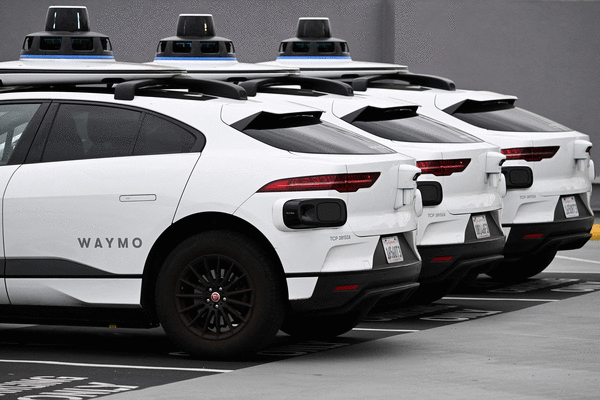
Opposition to self-driving taxi company Waymo in San Diego could halt its implementation before starting.
The Alphabet (Google)-owned Waymo is a major feature in San Francisco, where the white Jaguars are seemingly everywhere. It also operates in Los Angeles, Phoenix, Atlanta and Austin.
San Diego City Councilmember Sean Elo-Rivera, who chairs a taxi committee, is leading the charge against Waymo by arguing the autonomous driving company could take jobs away from taxi drivers and ride-hail drivers at services like Uber and Lyft. He is asking state officials for local control to stop Waymo and ban it at San Diego International Airport.
America’s Finest City has a history of opposing new forms of transportation, usually for public safety concerns. The City Council in 2022 heavily regulated electric scooter companies Lime and Bird, which eventually decided to leave the city.
Question: Should lawmakers ban Waymo in San Diego?
Economists
James Hamilton, University of California-San Diego
NO: I am not sure whether self-driving cabs are the best way to go. They could improve service for customers but eliminate some good jobs. One solution is to require Waymo to compensate $5,000 to everyone who has a current taxi permit in San Diego and in addition pay an annual fee to the city that is at least twice what we are currently receiving from taxi permits. Let Waymo decide if that’s worth it rather than slamming the door shut by regulation.
Norm Miller, University of San Diego
NO: From a safety point of view, cars like Waymo are already much safer than humans per mile driven. Our irrational tolerance for accidents is much greater for humans and near zero for autonomous cars. It would be a godsend for seniors who no longer drive, as well as drunk partygoers, to have access to alternatives. Suggesting a ban because of job loss or safety is akin to banning automated phone dialing to save switchboard operator jobs.
Caroline Freund, UC San Diego School of Global Policy and Strategy
NO: San Diego should lead on innovation, not shun it. Autonomous vehicles can cut traffic deaths, lower emissions and reduce transportation costs. We heard similar concerns when Uber and Lyft challenged taxis, but new jobs were created as old jobs disappeared. The more we experiment, the faster we learn, and staying ahead of global competitors demands exactly that. Better to guide change early than wait for a disruptive wave that hits us later.
Kelly Cunningham, San Diego Institute for Economic Research
NO: Self-driving vehicles will become normal for all transportation. Removing human error causing 90% of all crashes each year will drastically reduce fatalities, injuries, billions in property damage and lost productivity. Always adhering to safe, common rules of driving, the technology avoids harm caused by inattentive, incompetent, drug/alcohol impaired, self-absorbed human drivers. Embrace technology.
Alan Gin, University of San Diego
YES: Waymo will lead to a decrease in jobs in the passenger transportation industry, while not providing much advantage for customers. The service is expensive and currently has limits in terms of where it can operate. That could improve in the future, but it would hurt many drivers currently. And the overall local economy could be impacted, as taxi and Uber/Lyft drivers are typically local residents, whereas Waymo is an Alphabet (Google) operation.
David Ely, San Diego State University
NO: The residents of San Diego and visitors to the area should be able to choose to ride in Waymo robotaxis if that is their preferred mode of transportation. If a resident wants to support ride-hail drivers, they can choose not to patronize Waymo. But local or state elected officials should not be making this decision for residents. San Diegans should be able to take advantage of the services made possible by this innovation.
Ray Major, economist
NO: It’s ridiculous that San Diego pushes so hard for alternate forms of transportation yet every time a new idea comes up that might alleviate some of the problems, rather than embracing it they put an end to it. Once technology is invented, we must figure out how to embrace it and make the best use of it rather than trying to kill it. Self-driving cars have arrived so let’s figure out how to embrace them.
Executives
Jamie Moraga, Franklin Revere
NO: San Diego should welcome alternative transportation like Waymo. Overregulation or outright bans risk branding San Diego as business-unfriendly and resistant to future innovation. Cities such as Los Angeles, San Francisco and Phoenix have embraced innovation like Waymo. San Diego should, too. While Waymo has affected Uber and Lyft’s market share more than taxis, those companies adapted through collaboration. Self-driving services encourage competition, so let the market, not government, decide which options best serve consumers.
Phil Blair, Manpower
NO: How can San Diego present itself as a hub of innovation when a major innovation comes to our city and we don’t allow it? It is very close-minded to not embrace innovation. Yes, it will dislodge some jobs, as did Uber and Lyft when it provided thousands of San Diegan jobs. Did we ban locomotives to protect the buggy business?
Austin Neudecker, Weave Growth
NO: A preemptive ban is the wrong approach. We must decide with data, not lobbied interests. Automated vehicles should slash costs, curb drunken driving, and expand mobility for seniors and disabled riders. First, analyze the impacts in other cities, then run a pilot on fixed routes and hours. Require transparent incident reports, public performance reviews, and guard against establishing a monopoly. Tax companies, and fund retraining and job placement for affected drivers.
Gary London, London Moeder Advisors
NO: It’s a lost cause. In 1908, the Ford Model T began to replace horse-drawn carriages. Stable workers, carriage makers, drivers, blacksmiths and farriers lost their jobs. Now, 117 years later, autonomous vehicles are eventually likely to replace humans in the driver’s seat. The process will likely take well over a decade, giving current drivers time to find another place of employment, and unions and politicians to adjust to this obviously disruptive technology.
Bob Rauch, R.A. Rauch & Associates
NO: San Diego should embrace Waymo. Autonomous vehicles improve road safety by reducing human error, expand mobility for seniors and people with disabilities, and cut traffic congestion through efficient routing. They also support sustainability by lowering emissions and advancing clean transportation innovation. Banning Waymo would stall progress, while allowing it positions San Diego as a leader in smart, future-ready infrastructure that benefits residents, visitors and the local economy.
Chris Van Gorder, Scripps Health
NO: While I’m not sure driverless technology is good enough yet, I also don’t think legislators should prohibit new technology solely on the basis that it might impact other jobs. If we did that, we’d still have horses and buggies in San Diego and artificial intelligence would be prohibited. Taxi drivers did not want Uber or Lyft either. But I think the new technologies might be limited initially, primarily for safety reasons.
©2025 The San Diego Union-Tribune. Visit sandiegouniontribune.com. Distributed by Tribune Content Agency, LLC.









Comments