Bah humbug: Tariffs muffle holiday cheer, raise prices, squeeze margins
Published in Business News

ROYAL OAK, Michigan — Andy Linn hopes Santa will bring shoppers with holiday cheer to City Bird and Nest, a small Detroit gift shop that saw financial losses from tariffs and unpredictable customer traffic this year.
So far this year, only the Grinch has been visiting, delivering tariffs, unexpected bills and rapidly changing quotas — even on its locally sourced goods.
"We're seeing complexities across the spectrum, and it's a little hard to say whether it's tariffs, general inflation, or just economic anxiety," said Linn, co-founder of City Bird and Nest. "We're seeing unpredictability in the market in terms of fluctuation in traffic, customers up and down ... all year, since January."
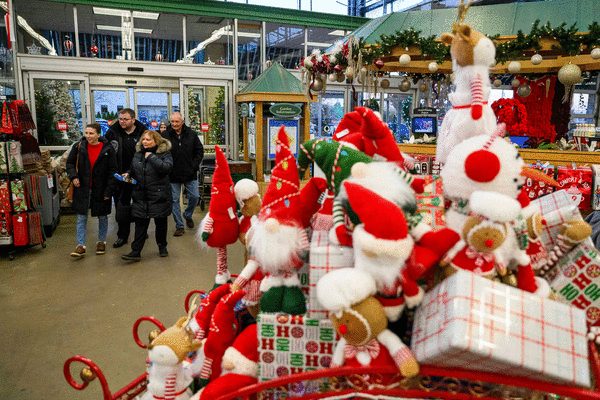
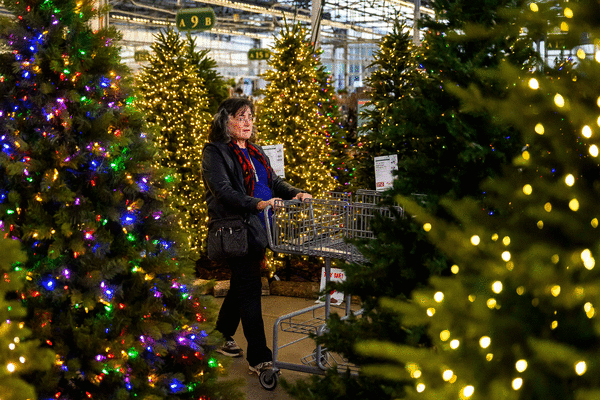
Other Michigan businesses like English Gardens, with its six stores in Metro Detroit, are dealing with tariffs on light sets and artificial trees like coal in a holiday stocking — negotiating for better options and pushing back on vendors.
The numbers tell a tale of humbug. According to the American Christmas Tree Association, almost all imported Christmas decor is subject to tariffs of 30% or higher. For some items like holiday lighting, the tariff can be as high as 63% on top of an existing 33% tariff.
Tariffs are typically paid by American companies that import the goods as they cross the border, and China accounts for roughly 87% of American Christmas decor. The Trump administration has also added tariffs on many components that make up the building blocks of manufacturing, including a 50% tax on steel, aluminum and copper.
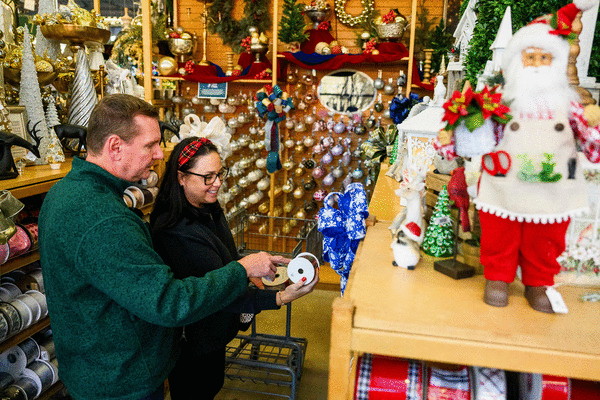
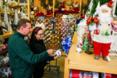
And shoppers are noticing, especially on international goods. Mother and daughter Kristen and Carolyn Andree of Bloomfield Village recently picked up snowflower garden ornaments and shopped for Christmas gifts at English Gardens in Royal Oak.
"Everyone knows that pricing and inflation is not ... what it was," said Kristen Andree, 36. "I think overall everything is a little bit higher. Sometimes you look at something, and you're like 'Wow, this tree base is $180' or 'This puzzle is cute, but it's $45.'"
Her mother's strategy to beat inflation: shop early, which is what organizations like the American Christmas Tree Association suggest to relieve pressure. The tree association says major retailers have cut back their purchases by 15% to 20% due to the increased costs, and that might lead to sell-outs and an undersupply of about 15% in the market for Christmas this year.
English Gardens, however, did the opposite. The garden store stocked up on 198 varieties of life-like trees while many independents and mass merchants of trees held back and increased prices, said Dean Darin, store director and buyer.
"When they announced the tariffs, we were getting contacted about canceling orders. We said, 'Absolutely not.' That's because everybody was canceling orders. Everybody was afraid," Darin said. "We didn't want to have less product. We have more inventory than last year."
The garden store has approached the additional line item by asking vendors to lower prices to reduce tariff costs, by passing some of the expense onto customers and by absorbing some of the cost, too.
"We're paying a tariff on everything. On an ornament that retails for $6.99 or $7.99 the tariff is change, it's not a lot," he said. But bigger ticket items like artificial trees, which can get up to $900, are where the store sees the most impact. Decorative light sets have had a duty of 33% since the 1970s, but tariffs on trees and ornaments are new for the store.
"We are paying the tariff to the U.S. government, though, it's not to China, it's being paid to Uncle Sam," Darin said. "Unfortunately, we have to pass some on, but it's not 30%. On average, on things that we're paying tariffs on, we may have had to raise our prices 10% when there's a 30% tariff ... you're not seeing a 30% increase in retail.
"Nobody can absorb all the tariff," he said. "It just doesn't work if you want to stay in business."
'Retailers have done everything in their power'
Linn at City Bird and Nest has high expectations for gains since about 40% of its revenue occurs during the holidays, including Black Friday and Small Business Saturday. While the year has been turbulent for small business owners, he hopes it ends with an influx of support from shoppers, which was not the case in the first nine months of the year.
City Bird features Michigan-made and -themed goods, while its neighbor store, Nest, touts unique home goods and plants. Although most of City Bird's goods are locally sourced, the small shop still faces secondary impacts from components like glass containers or jewelry chains that can be subject to importation taxes.
Nest shelves brands from the United Kingdom, China and France, among others. It has seen enough tariff headwinds to prompt the decision to discontinue two lines that supply Japanese toys and kitchen utensils.
"Because we're a small store, we often get things delivered common carrier, so we'll have a small order of Scottish paper goods delivered, for example, ... (and) we often get billed 30 days or several months later for the good we've already received and put on a shelf," Linn said.
East End Press, which handcrafts letter-pressed foil prints to make Christmas ornaments, garlands and other items, is another vendor giving Nest a delayed, unexpected bill. But since it's a customer favorite, the store carries it with less margin and absorbs some of the cost.
"In several cases, we'll do a $1,000 order of goods, and then two months later, half the goods will be sold, and we get a bill for $250, which turns your margins and the structure of your business upside down for those lines," he said. "Because we've already sold the goods, we've had to eat the costs, so that's been a challenge for the business."
Several strategies, like stockpiling inventory when pricing is advantageous, have helped City Bird and Nest, but that can soak up capital.
"Tariffs have been somewhat unpredictable," Linn added. "The day you order it, the tariff might be 15%, but by the time it ships, it's 25% ... so it's hard for everyone along the chain to predict how much to charge" customers. "We try to make our best assumption of the moving target for where the cost will be in the future."
Ben Johnston, COO of Kapitus, a small business lender and marketplace, said in an email to The Detroit News that retail holiday items will see inflation plus impact from the elimination of the de minimus tariff rule that previously allowed vendors an $800 limit to flood the U.S. market with low-cost consumer goods including clothing, electronics, beauty products, home goods and toys.
"We expect tariffs to most impact retail items imported from China or other Asian countries, which have traditionally manufactured many of the toys, clothes, and household items that we purchase," he wrote. "We expect these higher prices to dampen holiday sales marginally this year. However, employment in the U.S. remains relatively strong, meaning that most consumers still have reasonable purchasing power, which we expect to support holiday shopping this season."
Stephanie Scheuermann of Dearborn was happy to find a few decorations marked down at English Gardens in Royal Oak a few weeks ago, but still felt like some items are 20% higher compared to last year. She grabbed items like pine cones, a reindeer, artificial branch berries and a small Santa for two DIY porch pots she would make since premade pots were cost-prohibitive.
"They're like $60 to $80 ... if you went to all the different nurseries," said Scheuermann, 56. "I'm buying this in mind with reusing every year. I think this is going to be less than me buying it already made."
Johnston added: "It appears that U.S. retailers have done nearly everything in their power to keep from passing new tariffs on to their customers. However, in the coming months, we expect to reach the limits of these strategies and expect prices to rise to reflect the true cost the tariffs have imposed."
©2025 www.detroitnews.com. Visit at detroitnews.com. Distributed by Tribune Content Agency, LLC.










Comments